How to Source ESD-Safe and Cleanroom AGV Drive Wheels: Overcoming Particle Shedding
Source ESD-safe AGV drive wheels for cleanrooms: compare PU options, verify ISO/ESD test data, and request an RFQ-ready checklist.
The Short Answer for OEM Buyers: Sourcing AGV drive wheels for cleanrooms (semiconductor, pharma, lithium-ion battery production) requires balancing two directly opposing forces: the need to bleed off static electricity (ESD-safe) and the need to prevent particle generation (ISO cleanroom compliant). Adding traditional carbon black to polyurethane makes it ESD-safe but causes it to shed black dust under heavy loads, failing the cleanroom audit. Procurement teams must specify non-marking, ionic-dissipative polyurethane formulations and verify that resistance levels remain stable across varying humidity environments.
Request an ESD cleanroom AGV wheel RFQ review with your payload per wheel, floor type, target ISO class, humidity range, resistance target, wheel drawing, and duty cycle. If your buying team is still collecting inputs, start with the AGV drive wheel RFQ checklist and the forklift AGV wheel selector before asking suppliers for cleanroom material data.
The automation of highly controlled environments—such as semiconductor wafer fabrication plants (fabs), pharmaceutical laboratories, and lithium-ion battery gigafactories—has fundamentally altered the demands placed on Automated Guided Vehicles (AGVs) and Autonomous Mobile Robots (AMRs). In standard warehousing operations, a drive wheel only needs to provide traction, support the payload, and resist wear. In a cleanroom, however, the drive wheel becomes a critical interface in the facility’s environmental and electrostatic control program.
For engineering and procurement teams, sourcing an AGV drive wheel for these environments is notoriously difficult. A standard polyurethane (PU) wheel acts as a massive static generator, building up thousands of volts of charge that can instantly destroy sensitive electronic components or ignite volatile fumes. Conversely, the most common "off-the-shelf" anti-static wheels rely on carbon additives that structurally weaken the wheel, causing it to leave a trail of black conductive dust on the cleanroom floor.
This guide provides a deep, technical breakdown of the intersection between Electrostatic Discharge (ESD) compliance and Cleanroom particle standards. It explores why traditional solutions fail, how modern polymer chemistry solves the problem, and exactly how to construct your next RFQ to ensure your AGV drive wheels pass both ANSI/ESD S20.20 and ISO 14644-1 audits.
Scope and limits: This guide applies to indoor AGV/AMR drive wheels running on grounded ESD epoxy, vinyl, or coated concrete floors in ISO Class 4-8 controlled environments. It does not replace a facility-level ESD control plan, cleanroom certification, ATEX/explosion-proof assessment, or pharmaceutical validation protocol.
1. The Dual Threat: Triboelectric Charging vs. Particle Shedding
To understand why cleanroom AGV wheels fail, you must first understand the physics of how they interact with the floor. The challenge is essentially a contradiction in material science.
The Physics of Triboelectric Charging
When a standard polyurethane drive wheel rolls across an epoxy or vinyl floor, the constant contact and separation of the two materials generate static electricity. This is known as triboelectric charging. Because standard polyurethane is an excellent electrical insulator (typically measuring $> 10^12 \Omega$ surface resistance), the generated charge cannot escape to the ground.
As the AGV drives, it acts like a mobile capacitor. The chassis can accumulate a charge of over 5,000 to 10,000 volts. When the AGV approaches a grounded object—such as a semiconductor processing machine, a human operator, or a metal rack—the stored energy releases in a sudden arc. A discharge of just 20 volts is enough to permanently damage advanced microprocessors, while larger discharges pose severe explosion risks in chemical and battery handling zones.
The "Black Dust" Particle Shedding Problem
To solve the static problem, wheel manufacturers historically mixed carbon black (a highly conductive particulate) into the liquid polyurethane prepolymer. The carbon particles create a conductive network through the wheel, allowing the static electricity on the AGV chassis to bleed through the wheel and safely into the grounded ESD floor.
However, adding large amounts of carbon black drastically alters the mechanical properties of the polyurethane. The carbon particles disrupt the long polymer chains that give PU its legendary tear strength and elasticity.
When a heavy-duty AGV (carrying 1,000kg to 3,000kg) accelerates, brakes, or turns using a carbon-filled wheel, the weakened polyurethane begins to micro-fracture. The wheel wears down rapidly, shedding microscopic (and sometimes macroscopic) black particles directly onto the floor. In an ISO Class 4 or Class 5 cleanroom—where airborne particles are measured in the tens per cubic meter—this shedding is catastrophic, resulting in immediate audit failure and production halts.
2. Defining the Electrical Properties of AGV Wheels
When drafting specifications for an ESD-safe AGV, procurement teams must use precise terminology. "Anti-static" is heavily used in marketing, but it lacks strict engineering definitions. According to standards like ANSI/ESD S20.20 and ASTM D257, materials are classified by their surface and volume resistance, measured in Ohms ($\Omega$).
1. Insulative ($> 10^11 \Omega$)
- Standard Polyurethane, Nylon, Natural Rubber.
- Behavior: Generates and holds static charge. Charges cannot flow across the surface or through the volume.
- Application: General warehousing, logistics. Strictly forbidden in electronics manufacturing and cleanrooms.
2. Static Dissipative ($10^5 \Omega$ to $10^9 \Omega$)
- Specially Formulated Polyurethane (Ionic or lightly filled).
- Behavior: Allows electrical charges to flow to the ground slowly and in a controlled manner. This is the "sweet spot" for AGV wheels. It bleeds off the triboelectric charge fast enough to prevent accumulation, but slow enough to prevent a massive, sparking surge if the AGV contacts a high-voltage source.
- Application: Semiconductor fabs, PCB assembly, medical device manufacturing.
3. Conductive ($< 10^5 \Omega$)
- Carbon-heavy Rubber, Solid Steel, Conductive Cast Iron.
- Behavior: Offers virtually no resistance. Charges flow instantly to the ground.
- Application: Highly specific explosion-proof environments (ATEX zones) where immediate grounding is prioritized over all else. Usually avoided for general AGV drive wheels because if the vehicle accidentally touches a live circuit, the conductive wheels create a direct short to ground, posing a severe electrocution hazard to personnel.
3. The Grounding Path: How the AGV Connects to the Floor
Specifying a dissipative wheel is only half the battle. The static electricity must have an uninterrupted path from the chassis of the AGV, through the drive assembly, through the wheel, and into the floor.
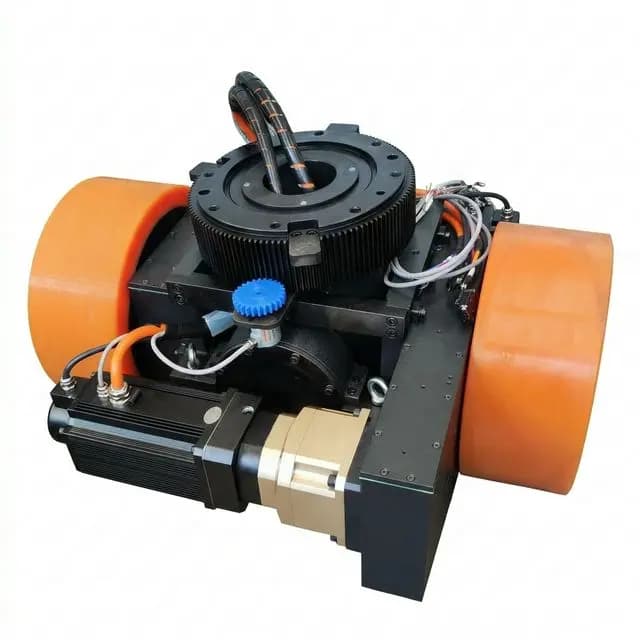
A critical engineering trap: Many engineers specify an expensive dissipative polyurethane wheel, but fail to realize that the motor bearings or gearbox lubricants are electrically insulating. If the wheel core is electrically isolated from the chassis by insulating grease or ceramic bearings, the static charge cannot reach the wheel. In these cases, engineers must add a mechanical grounding strap (a conductive copper or carbon brush) that drags along the floor, though these also wear out and shed particles. A properly designed drive wheel assembly ensures continuity from the chassis through conductive bearing lubricants directly to the wheel tread.
4. Modern Solutions: Ionic Dissipative Polyurethanes
To pass both ESD and cleanroom standards, premium wheel manufacturers have moved away from carbon black and now utilize ionic liquid additives or inherently dissipative polymers (IDPs).
Instead of suspending physical chunks of conductive material (carbon) in the polyurethane matrix, ionic additives are blended at the molecular level. These additives create a three-dimensional ion-conductive network within the polyurethane without disrupting its structural integrity.
The advantages of Ionic Dissipative PU:
- Zero Particle Shedding: Because there is no carbon filler to break apart, the wheel wears exactly like standard high-quality polyurethane. It is entirely non-marking and leaves no black dust, easily passing ISO Class 4 and 5 cleanroom requirements.
- Color Customization: Carbon-filled wheels are always black. Ionic dissipative wheels can be cast in any color (yellow, orange, white), making it easier for factory managers to visually identify wear or track different AGV fleets.
- Maintained Load Capacity: The tensile strength, tear resistance, and dynamic load capacity remain nearly identical to standard premium polyurethane.
The disadvantages:
- Cost: Ionic additives are significantly more expensive than carbon black, increasing the per-wheel cost.
- Humidity Sensitivity: Some older ionic formulations rely on drawing moisture from the ambient air to maintain their conductivity. In extremely dry environments (like battery dry rooms where humidity is kept below 1%), these specific formulations can lose their ESD properties. Modern IDPs mitigate this, but it requires careful specification during procurement.
5. Structural Comparison: AGV Wheel Materials for Cleanrooms
The following table breaks down the trade-offs between different wheel materials when evaluating them for a controlled environment.
| Material Type | Surface Resistance ($\Omega$) | Cleanroom Suitability (ISO 14644) | Particle Shedding Risk | Dynamic Load Capacity | Cost Profile |
|---|---|---|---|---|---|
| Standard Polyurethane (MDI/NDI) | $> 10^12$ (Insulative) | Excellent (Class 4-5) | Very Low | Very High | $ (Lowest) |
| Carbon-Filled Polyurethane | $10^3 - 10^5$ (Conductive) | Poor (Fails Class 7+) | Very High (Black Dust) | Medium (Reduced by 20-30%) | $$ (Low) |
| Ionic Dissipative PU | $10^6 - 10^9$ (Dissipative) | Excellent (Class 4-5) | Very Low (Non-marking) | High | $$$ (High) |
| Anti-Static Rubber | $10^5 - 10^7$ (Dissipative) | Moderate (Class 7-8) | High (Tire wear dust) | Low | $$ (Low) |
| Solid Stainless Steel | $< 10^1$ (Highly Conductive) | Excellent (Class 3-4) | Low (Floor damage risk) | Extreme | $$$$ (Highest) |
| ESD Vulkollan® | $10^5 - 10^7$ (Dissipative) | Excellent (Class 4-5) | Very Low | Very High (24/7 duty) | $$$$ (Highest) |
Note: Solid steel wheels are sometimes used as casters in heavy-duty cleanroom applications, but they provide zero traction and shock absorption, making them unsuitable as drive wheels for motorized AGVs.
6. Sourcing & Procurement Checklist for ESD Cleanroom Wheels
When sending out an RFQ for AGV drive wheels intended for a semiconductor, medical, or battery plant, simply asking for "an ESD wheel" is a guarantee of failure. Procurement teams must force the supplier to validate their chemistry. Use this checklist:
- Define the Resistance Target: Explicitly state the required surface and volume resistance range. (e.g., "Must measure between $10^6 \Omega$ and $10^9 \Omega$ per ASTM D257").
- Prohibit Carbon Black: Explicitly state that carbon-filled formulations are unacceptable due to particle shedding risks. Request ionic or inherently dissipative polymer (IDP) solutions.
- Request Humidity Performance Data: Ask the supplier to provide resistance test data at different humidity levels (e.g., 12% RH and 50% RH). If the wheel is for a lithium-ion dry room, it must remain dissipative in extreme dry conditions.
- Verify Dynamic Load Ratings: Ensure the supplier is quoting the load capacity of the actual dissipative formulation, not the capacity of their standard PU. (Some suppliers bait-and-switch the specs).
- Evaluate the Hub/Core Bonding: Ensure the primer and adhesive used to bond the PU to the metal core do not act as electrical insulators. The bond line must allow charge transfer.
- Request Cleanroom Certification (Optional but Recommended): Ask if the wheel material has been tested for outgassing and particle generation according to ISO 14644-14:2026 (assessment of suitability for use of equipment by airborne particle concentration).
For a quote-ready submission, attach the wheel diameter, tread width, hub/core drawing, target resistance range, expected static and dynamic load, floor material, slope, speed, acceleration profile, cleaning chemicals, and lowest expected relative humidity. This prevents suppliers from quoting a standard anti-static wheel when the application requires a volume-dissipative cleanroom formulation.
If the wheel also carries high payloads, review the same load and interface fields used for heavy-duty forklift AGV drive wheels; cleanroom compliance does not remove the need for torque, bonding, hub fit, and dynamic-load validation.
7. Verifying Supplier Claims (Testing Validation)
Once prototype wheels arrive, they must be tested before being installed on the AGV fleet.
The Megohmmeter Test: Using a calibrated megohmmeter (insulation resistance tester) and two 5-pound conductive electrodes, measure the resistance across the tread surface, and from the tread surface to the metal inner core. Record the test voltage, electrode geometry, ambient temperature, and relative humidity so the result can be compared with supplier data.
The Wear Test: Run the wheel on a test rig under its maximum rated dynamic load for 24 hours. Once the test concludes, wipe the test track with a white cleanroom cloth. If the cloth turns black, the wheel is shedding carbon and will fail your facility's audit.
Furthermore, resistance should be tested after the wear test. Some cheap anti-static wheels only have a topical anti-static coating sprayed on the outside. Once the AGV drives for a few miles, the coating wears off, and the wheel reverts to being an insulator. True dissipative wheels must be volume-dissipative (the additive is mixed throughout the entire thickness of the material).
8. Frequently Asked Questions (FAQ)
Can we just use a grounding chain instead of expensive ESD wheels?
Grounding chains or conductive copper brushes dragging on the floor are common retrofits, but they are generally banned in ISO Class 4 and 5 cleanrooms. The constant mechanical scraping of the metal chain against the epoxy floor generates a massive amount of particulate matter, failing the particle audit immediately. Furthermore, chains can lose contact with the floor if they bounce or snag.
Does the floor type matter if we buy the right wheels?
Absolutely. A dissipative AGV wheel is useless if the floor is an insulator. The wheel only acts as a bridge. If the facility floor is standard concrete or non-ESD epoxy, the charge has nowhere to go. The floor must be an installed, grounded ESD-control surface.
Do dissipative wheels wear out faster than standard polyurethane?
Historically, yes. However, modern ionic dissipative formulations (such as specialized ESD variants of NDI/Vulkollan) have bridged the gap. While they may experience a negligible drop in tear strength (perhaps 2-5%), they will comfortably last for the standard maintenance lifecycle of a 24/7 AGV operation.
Will the resistance change over the life of the wheel?
Yes, but it should remain within the acceptable range. As the wheel absorbs dirt, oils, or floor wax, surface resistance can increase. It is critical to maintain a clean floor. Additionally, if the supplier uses a migrating topical additive (which blooms to the surface over time), washing the wheel with harsh solvents can temporarily strip its anti-static properties.
9. Conclusion: Engineering for Compliance and Performance
Sourcing AGV drive wheels for cleanrooms is a zero-tolerance procurement exercise. You cannot afford to compromise on load capacity to pass a static audit, nor can you accept particle shedding to maintain electrical safety. By demanding ionic dissipative polyurethanes, verifying humidity stability, and ensuring continuous grounding paths through the entire drive assembly, manufacturers can deploy high-payload AGVs in the world's most sensitive environments without fear of contamination or electrostatic damage.
Struggling to find an AGV wheel that passes your cleanroom audit? Our engineering team designs and manufactures custom AGV drive wheels specifically formulated for ISO Class 4-7 cleanrooms and strict ANSI/ESD S20.20 environments. We provide zero-shedding, volume-dissipative polyurethane solutions engineered for 24/7 dynamic loads.
Contact our technical team today to review your specifications and request a material sample.
Sources
- ANSI/ESD S20.20-2021 Standard for the Development of an Electrostatic Discharge Control Program: The foundational standard defining the required resistance levels for mobile equipment and flooring in sensitive environments. ESDA.org
- ISO 14644-1:2015 Cleanrooms and associated controlled environments: Outlines the maximum allowable airborne particle concentrations, dictating why shedding materials like carbon-filled PU fail compliance. ISO.org
- ISO 14644-14:2026 Cleanrooms and associated controlled environments - Part 14: Defines a methodology for assessing equipment suitability for cleanroom use by airborne particle concentration, which is directly relevant to AGV wheel particle-shedding validation. ISO.org
- ASTM D257-14(2021)e1 Standard Test Methods for DC Resistance or Conductance of Insulating Materials: The definitive testing methodology for measuring surface and volume resistance in polymer wheels to verify supplier claims. ASTM.org