Direct Drive vs. Geared AGV Drive Wheels: Efficiency, Backlash, and TCO
Compare direct drive hub motors with geared AGV drive wheels. Learn how backlash affects SLAM navigation, thermal constraints, efficiency, and OEM sourcing TCO.
When engineering the powertrain for a new Automated Guided Vehicle (AGV) or Autonomous Mobile Robot (AMR), the choice of drive wheel architecture is one of the most consequential decisions a design team will make. For years, the default approach was to pair a high-speed electric motor with a reduction gearbox (planetary, cycloidal, or harmonic) to achieve the necessary wheel torque.
However, as AMRs become smaller, smarter, and are deployed in more noise-sensitive and precision-demanding environments, Direct Drive Hub Motors (in-wheel motors) have surged in popularity.
For OEM procurement teams, mechanical engineers, and robotics architects, choosing between a Direct Drive and a Geared AGV drive wheel is not just a matter of checking a torque specification. If the base wheel torque envelope is still open, start with the AGV drive wheel torque and motor sizing guide before comparing gearbox ratio or hub-motor diameter. The architecture choice fundamentally alters the robot’s Total Cost of Ownership (TCO), its thermal management requirements, its acoustic profile, and—most critically—the accuracy of its SLAM (Simultaneous Localization and Mapping) navigation algorithms.
This comprehensive engineering guide breaks down the mechanics, the efficiency trade-offs, the navigation implications, and the sourcing criteria for both architectures to help you specify the right solution for your next AMR platform.
The Mechanics of Geared AGV Drive Wheels
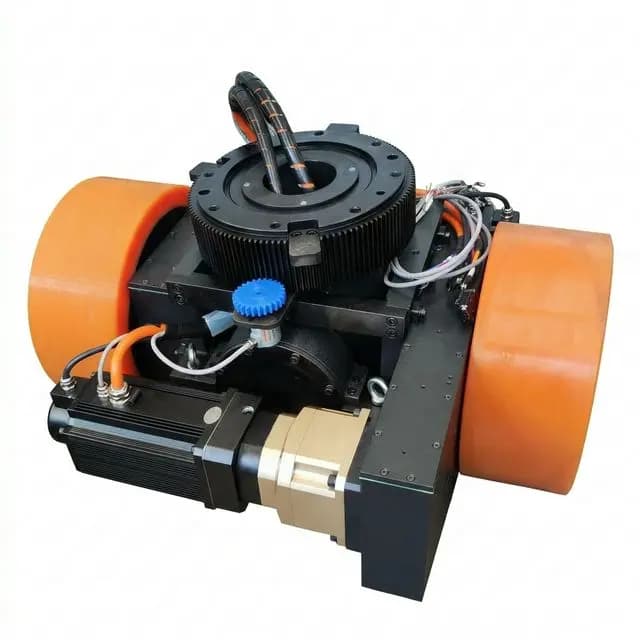
A geared drive wheel utilizes a mechanical speed reducer between the electric motor (typically a BLDC or AC Servo) and the wheel hub. The most common reduction mechanisms in heavy-duty AMRs are planetary gearboxes, though some high-precision units use harmonic drives, and low-cost units may use worm gears.
How They Work
Electric motors are most efficient when spinning at high speeds (e.g., 3,000 to 5,000 RPM). However, an AGV wheel needs to turn at low speeds (e.g., 50 to 200 RPM) to achieve a safe walking pace of 1.5 to 2.0 meters per second.
A gearbox solves this mismatch by reducing the speed and multiplying the torque by the gear ratio. For example, a 30:1 planetary gearbox takes a motor producing 1 Nm of torque at 3,000 RPM and outputs approximately 28 Nm of torque at 100 RPM (accounting for minor frictional losses).
Engineering Advantages
- Torque Density: Geared systems can move massive payloads (2,000 kg to over 10,000 kg for heavy-duty tuggers) using relatively small, lightweight motors.
- Thermal Stability: Because the motor spins at high RPMs, it draws less current to produce the required torque, reducing resistive heat ($I^2R$ losses) in the copper windings.
- Cost: High-speed, low-torque motors paired with commodity planetary gearboxes are often cheaper to manufacture than massive direct drive motors.
For payload classes closer to automated forklifts than light shelf AMRs, validate the wheel envelope against a forklift AGV drive wheel assembly instead of starting from a generic compact AMR wheel catalog.
Engineering Disadvantages
- Mechanical Complexity: Gears, bearings, seals, and lubrication introduce multiple failure points.
- Friction Losses: Every gear stage loses 5% to 10% of its power to friction, generating heat and reducing battery life.
- Backlash: The mechanical play between gear teeth introduces errors in wheel positioning.
The Mechanics of Direct Drive Hub Motors
Direct drive technology eliminates the gearbox entirely. The motor is integrated directly into the wheel hub—often utilizing an "outrunner" design where the outer casing of the motor rotates and acts as the wheel rim itself, covered in a polyurethane or rubber tire.
How They Work
Without a gearbox to multiply torque, a direct drive motor must generate 100% of the required wheel torque electromagnetically. To achieve high torque at low RPMs, these motors require larger diameters (to increase the lever arm of the magnetic force), stronger permanent magnets, and higher pole counts.
Engineering Advantages
- Zero Backlash: Because the motor is rigidly coupled to the wheel, there is no mechanical play. A fraction of a degree of motor rotation translates instantly to a fraction of a degree of wheel rotation.
- High Efficiency at Speed: With no gearbox friction, direct drive motors can achieve >90% mechanical efficiency at their nominal operating speeds.
- Extreme Compactness: Fitting the entire powertrain inside the wheel hub frees up massive amounts of chassis volume for larger batteries, lifting mechanisms, or payload capacity.
- Silent Operation: Without gear whine, direct drive wheels are virtually silent, perfect for hospitals, retail floors, and laboratories.
Engineering Disadvantages
- Low-Speed Thermal Issues: To generate high torque at a standstill or low speeds (like pushing a payload up a ramp), direct drive motors must draw enormous amounts of current, which can quickly lead to overheating if not carefully managed.
- Lower Peak Torque Limit: For a given volume, a direct drive motor cannot match the peak torque of a highly geared system. They are generally limited to lighter payloads (under 1,500 kg per vehicle).
SLAM Navigation and the Backlash Problem
To understand why autonomous vehicle engineers are increasingly migrating to direct drive wheels, one must understand the relationship between mechanical backlash and SLAM navigation software.
The Odometry Dead-Band
AMRs navigate by fusing data from external sensors (like 2D/3D LiDAR or cameras) with internal odometry data (wheel encoders). The wheel encoders tell the robot's computer exactly how far the wheels have turned, which the algorithm uses to calculate the robot's position relative to its starting point.
In a geared drive wheel, there is an inherent gap between the gear teeth, known as backlash, typically measured in arc-minutes (1/60th of a degree). When the AMR accelerates, decelerates, or reverses direction, the motor must rotate slightly to take up this slack before the wheel actually begins to turn.
During this brief moment, the motor's encoder reports movement to the computer, but the wheel (and the robot) has not actually moved in the physical world. This creates a "dead-band" of false data.
Localization Drift in Featureless Environments
In a cluttered environment with plenty of distinct walls, pillars, and racks, the LiDAR easily corrects this odometry error. The SLAM algorithm simply trusts the LiDAR more than the wheels.
However, consider an AMR navigating down a long, featureless warehouse aisle, or a wide-open logistics hall with uniform shelving. The LiDAR cannot easily determine forward progress because the walls look identical at every point. In these feature-poor environments, the SLAM algorithm is forced to rely heavily on wheel odometry to track movement.
Because of gear backlash, the odometry is inherently flawed. As the robot makes micro-adjustments to its trajectory, the errors accumulate exponentially. This causes localization drift, leading the robot to become "lost" or aggressively trigger its safety stops.
The Direct Drive Solution
Direct drive hub motors eliminate this problem entirely. Because there are no gears, there is zero backlash. The wheel encoder's data perfectly matches the physical movement of the wheel. This provides pristine, high-fidelity odometry data to the SLAM algorithm, dramatically improving navigation stability in challenging, featureless environments. For AMRs that require millimeter-level docking precision, direct drive is rapidly becoming mandatory.
Power Transmission & Backlash Comparison
Torque Density and Thermal Constraints
While direct drive wheels offer superior navigation, they face severe physics limitations regarding heat and torque.
When an AMR is commanded to push a heavy payload up a 5-degree ramp, the drive wheel must exert massive continuous torque.
In a Geared System, the motor spins rapidly, utilizing back-EMF to self-regulate current, while the gearbox mechanically multiplies the force. The motor stays relatively cool because it is operating within its optimal efficiency band.
In a Direct Drive System, the motor must produce that same massive torque at very low RPMs. To do so, the motor controller must pump massive amounts of electrical current into the stator windings. Because resistive heat ($I^2R$) scales with the square of the current, the direct drive motor will heat up exponentially. If the AMR is forced to hold its position on the ramp for too long, a direct drive motor will quickly reach its thermal limit and trigger a fault, shutting down the robot.
The Engineering Fix: Never use a direct drive motor to statically hold a payload on an incline. Always specify an electromagnetic holding brake. When the AMR stops on a ramp, the brake engages mechanically, allowing the motor current to drop to zero while the robot remains safely stationary. Furthermore, ensure your thermal calculations account for the worst-case continuous duty cycle, not just peak acceleration, and capture the ramp-hold brake test in your AGV drive wheel acceptance criteria before sampling.
Comprehensive Total Cost of Ownership (TCO) Comparison
For procurement teams, the decision extends beyond the spec sheet. Here is how the two architectures impact the broader TCO of the vehicle platform:
| Evaluation Dimension | Geared Drive Wheel System | Direct Drive Hub Motor System | TCO & Sourcing Implications |
|---|---|---|---|
| Initial Sourcing Cost | Lower to Medium | Higher | Geared systems use commodity parts. Direct drive requires massive permanent magnets and custom stators, increasing upfront BOM costs. |
| Maintenance Frequency | High | Very Low | Gearboxes require seal inspections, lubrication changes, and eventual rebuilds. Direct drive only requires tire and bearing replacements. |
| SLAM / Odometry Accuracy | Moderate (Suffers from gear backlash) | Pristine (Zero mechanical backlash) | Direct drive reduces R&D costs for software teams trying to filter out odometry errors in featureless warehouses. |
| Acoustic Noise Limits | Noticeable gear whine (65-75 dB) | Virtually Silent (<55 dB) | Direct drive is mandatory for hospital AMRs, retail robots, and quiet office environments. |
| Space Claim in Chassis | Large (Motor sticks out horizontally or vertically) | Minimal (Everything is in the wheel) | Direct drive allows for much larger battery packs, extending the AMR's operational shifts. |
| Freewheeling (Pushing a dead robot) | Difficult (Gearbox resistance is high) | Very Easy (Only magnetic cogging) | Direct drive reduces downtime on the factory floor when a robot faults and must be manually pushed away. |
| Shock Load Resistance | Vulnerable (Gear teeth can shear) | Robust (No teeth to break) | Direct drive survives rough, uneven factory floors better due to fewer fragile mechanical linkages. |
| Heavy Towing & Ramp Thermal Limits | Excellent (Motor stays in high-efficiency band) | Poor (Prone to extreme overheating) | Geared systems are strictly required for heavy tuggers (>2000kg) and applications with long, steep inclines. |
Application Boundaries: When to Choose Which
Because neither technology is universally superior, OEM architects must draw strict application boundaries based on the robot's operational design domain.
When to Specify Geared Drive Wheels
- Heavy-Duty Forklifts & Tuggers: Any vehicle moving gross weights exceeding 2,000 kg.
- Outdoor AMRs: Agricultural or yard robots that must overcome thick mud, steep inclines, or obstacles requiring massive low-end torque.
- Ramp-Heavy Environments: Facilities where the robot spends significant time traversing ramps or holding loads on inclines.
- Cost-Optimized Platforms: Budget-conscious AGVs following magnetic tape where SLAM accuracy and noise are not primary concerns.
When to Specify Direct Drive Hub Motors
- Precision Assembly AMRs: Where millimeter-level docking accuracy is required and gear backlash is unacceptable.
- Cleanrooms and Hospitals: Environments with strict acoustic noise limits and zero tolerance for gearbox oil leaks.
- Compact Low-Profile AMRs: Under-ride AMRs (like Kiva systems) where vertical and horizontal space is extremely constrained.
- Featureless Warehouses: Facilities with wide-open spaces where SLAM localization algorithms struggle and rely heavily on flawless wheel odometry.
OEM Procurement: The Sourcing Checklist
If you are a buyer or procurement engineer preparing an RFQ for drive wheels, pair this section with the AGV Drive Wheel RFQ Checklist for OEM Buyers and request the following specific data points to make an apples-to-apples comparison:
- Continuous vs. Peak Torque (with Thermal Time Limits): Do not accept a generic "Peak Torque" number. Ask: “How many seconds can this wheel sustain peak torque before triggering a thermal fault at 25°C ambient?”
- Backlash Specification (for Geared units): Request the maximum backlash in arc-minutes (arcmin). Anything above 15 arcmin will severely degrade SLAM performance.
- Freewheeling Resistance: Ask for the back-drive torque required to push the wheel when unpowered. This determines how easily a technician can push a dead AMR off the floor.
- Encoder Resolution: Verify the encoder is mounted directly to the wheel shaft (or motor shaft, accounting for gear ratio) to ensure high-resolution odometry tracking.
- Radial Load Capacity: Ensure the bearings inside the hub motor or gearbox can handle the dynamic shock loads of the vehicle bouncing over floor expansion joints.
- Brake Integration: Verify that the electromagnetic brake is sized to hold the fully loaded vehicle on your maximum specified incline.
Frequently Asked Questions (Buyer Q&A)
Why do geared AGV wheels cause navigation issues in featureless environments?
Geared wheels have mechanical backlash (play between gear teeth). When the AMR reverses or changes speed, the motor turns slightly before the wheel moves. This creates a "dead-band" in wheel odometry. In featureless environments where LiDAR struggles to find reference points, the robot relies heavily on this flawed odometry, leading to localization drift and navigation failures.
Can a direct drive hub motor hold a heavy payload on a ramp?
Yes, but not efficiently on its own. Holding a payload on a ramp with a direct drive motor requires continuous, high electrical current (stall current), which generates massive heat. For ramp holding, the drive wheel must be equipped with an electromagnetic parking brake to hold the load mechanically without thermal buildup.
Are direct drive wheels more energy-efficient than geared wheels?
It depends on the operating point. Direct drive wheels are highly efficient (often >90%) at nominal speeds because they lack gearbox friction. However, at very low speeds with high torque demands (like accelerating a heavy load), geared motors are often more efficient overall because the motor spins in its optimal high-rpm efficiency band while the gearbox multiplies the torque.
What is the typical lifespan difference between the two designs?
Direct drive wheels typically offer longer maintenance-free lifespans because the only wearing parts are the wheel bearings and the polyurethane tire. Geared systems have gears, pinions, seals, and lubrication that degrade over time, often requiring rebuilds or replacements sooner in continuous 24/7 operations.
How does acoustic noise compare between the two architectures?
Direct drive hub motors are virtually silent, making them ideal for hospitals, offices, and cleanrooms. Geared systems, particularly planetary and spur gears under heavy load, produce a distinct mechanical whine that can be problematic in noise-sensitive environments.
Is it possible to retrofit a geared AGV with direct drive wheels?
Retrofitting is mechanically possible but software-intensive. Direct drive wheels require vastly different motor controller tuning (due to lack of back-EMF at low speeds and different PI loop requirements) and SLAM parameter updates. From a procurement standpoint, it is usually only viable during a major platform redesign or "Gen 2" vehicle release.
Conclusion
The shift toward Direct Drive Hub Motors represents a maturation of the AMR industry, prioritizing precision, software reliability, and low maintenance over brute mechanical force. However, for heavy industry, logistics tuggers, and extreme payload applications, the Geared Drive Wheel remains physically indispensable.
By understanding the thermal limits, the impact of backlash on SLAM algorithms, and the lifecycle TCO, engineering and procurement teams can confidently specify the right powertrain architecture for their unique operational environment.
If you are defining the specifications for a new AMR platform and need assistance calculating exact torque requirements, thermal envelopes, or selecting the right architecture, our engineering team can provide application-specific modeling to ensure your next deployment is a success. Contact us to review your next AGV drive wheel RFQ.
Sources & References
For further engineering research and validation on drive wheel architectures, refer to these industry sources: