AGV for Pallets Fleet & Aisle Calculator
Size an AGV pallet truck route before RFQ, including AGV for pallets layout questions: choose pallet type, hourly moves, travel distance, speed, and shift hours to get a deterministic fleet estimate with boundary warnings.
Safety validation is a project gate, not a brochure checkbox.
Ramps and heavy payloads need supplier validation.
Floor flatness cannot be an afterthought.
Fleet sizing tool
Empty, invalid, and boundary states stay visible and recoverable. Results update locally; no data is submitted.
EPAL lists the Euro pallet as 800 x 1200 mm with 1500 kg safe working load. Evidence: S2.
Results
ReadyThe route fits a baseline screening envelope. Treat this as a pre-RFQ result and validate the site drawing.
Use these assumptions in a supplier RFQ and request swept-path plus safety-field confirmation.
Decision Summary
The tool answers the immediate sizing question. The report layer below explains why the output is trustworthy, where it can fail, and what to ask suppliers before committing budget. Evidence reviewed: 2026-07-11.
Alias intent stays on the canonical AGV pallet truck page.
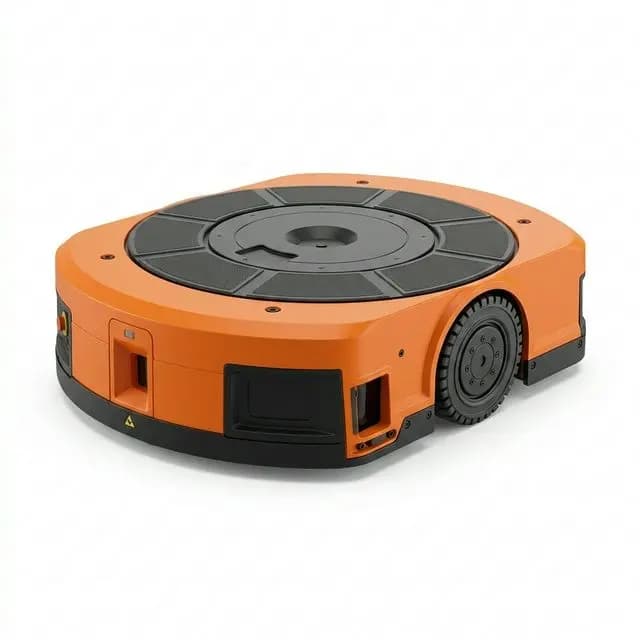
The queries "AGV automated pallet truck", "AGV for pallets", "AGV pallets", and "AGV pallet truck" are answered here as the same intent cluster for floor-to-floor pallet transport. No separate route is needed.
Safety validation is a project gate, not a brochure checkbox.
The public ISO 3691-4:2023 page scopes safety requirements and verification for driverless industrial trucks, while also flagging that a DIS replacement is expected. Treat speed, braking, and operating-zone assumptions as site-validation items.
Ramps and heavy payloads need supplier validation.
Use 1,500 kg payloads or sustained 3 degree / 5% ramps as conservative RFQ trigger values, not universal rejection limits. Supplier specs vary by chassis, braking, wheels, floor friction, and load stability.
Floor flatness cannot be an afterthought.
Treat DIN 18202 as named floor-flatness language for early RFQs, then ask the supplier for project-specific tolerances. Uneven transitions, steps, slopes, or degraded joints can still trigger scanner faults or load instability.
Pallet footprint changes the aisle result immediately.
The calculator starts with the EPAL Euro pallet footprint, then lets users test wider US or oversize pallets before RFQ.
Payback should be modeled, not copied from a benchmark.
No universal public payback baseline is reliable for every warehouse. Compare vehicle, FMS, charging, service, and integration costs against shift labor and exception handling before treating ROI as procurement-ready.
Fleet-control integration must be version-aware.
VDA describes Version 3.0.0 (March 2026) as the current interface for communication between mobile robots and central master control systems, which matters for multi-vendor fleets.
Method, Assumptions, and Evidence
The calculator uses a transparent screening model. It is intentionally conservative enough for early planning, while still forcing unknowns into the evidence table instead of hiding them behind a single score.
Calculation logic
- Aisle width = 900 mm estimated truck body + selected pallet length + 200 mm clearance.
- Cycle time = loaded outbound and return travel + 40 seconds for pickup, drop-off, and turn delays.
- Fleet size applies an 85% utilization factor before rounding up to a whole AGV count.
- Boundary warnings do not block the output; they identify what must be verified before procurement.
Aisle Width Visualization
The screening AST estimate is a planning envelope. Final clearance must include scanner fields, pallet overhang, turning path, and site traffic rules.
| Source | Verified fact or model claim | Decision use | Limit |
|---|---|---|---|
| S1 - ISO 3691-4:2023 | As of 2026-07-11, the public ISO entry scopes safety requirements and verification for driverless industrial trucks and notes that a DIS replacement is expected within coming months. | Supports keeping speed, braking, protective-field, and operating-zone checks outside a simple calculator result. | The full standard is not reproduced here; confirm the active edition and require a qualified safety review before commissioning. |
| S2 - EPAL Euro Pallet | EPAL specifies the Euro pallet envelope as 800 x 1200 mm with a 1500 kg safe working load limit. | Anchors the default pallet layout baseline before adjusting for wider US or heavy GMA footprints. | Does not account for payload overhang, damaged boards, or deflection, which increase the required swept path. |
| S3 - VDA 5050 Version 3.0.0 | VDA lists Version 3.0.0, March 2026, as the current VDA 5050 recommendation for communication between mobile robots and central master control systems. | Validates the warning that fleets over 5 units require an interoperable FMS, not just basic traffic rules. | "VDA 5050 compliant" marketing requires explicit testing of which sub-features a supplier actually implemented. |
| S4 - Pallet AGV supplier spec example | A published Integra AGV pallet transport specification lists 1,500 kg maximum load, 1.5 m/s maximum speed, 3° / 5% maximum surmountable slope, and 5 mm maximum step. | Turns heavy payloads, ramps, and floor transitions into explicit supplier-validation triggers instead of hidden calculator assumptions. | This is a model-specific supplier example, not a universal AGV limit. Validate the exact chassis, drive wheel, braking, floor friction, and payload center of gravity. |
| S5 - DIN 18202 / Floor Flatness | Face Consultants summarizes Section 5 of DIN 18202 as flatness tolerances for floor surfaces, ceilings, screeds, and walls. | Supports asking for a floor-flatness survey and tolerance language before attributing navigation or scanner faults to the AGV alone. | DIN 18202 is a construction-tolerance reference. AGV suppliers may require stricter project-specific limits for transitions, ramps, VNA areas, or scanner behavior. |
| TCO model boundary | Public payback ranges are not universal enough for final procurement decisions. | Keeps ROI as a site-specific model driven by shifts, labor assumptions, travel repeatability, and integration scope. | Requires buyer cost inputs; this page does not estimate vehicle price, wage rates, maintenance, or financing. |
| Model assumptions on this page | Aisle width = 900 mm truck body + selected pallet length + 200 mm clearance. 85% utilization factor applied. | Provides a deterministic throughput and aisle screening envelope before entering supplier RFQs. | Not a substitute for dynamic traffic simulation, floor-flatness audits, or Wi-Fi coverage mapping. |
Scenarios, Comparison, and Risk Controls
Use these tables to decide whether the tool result should move to supplier RFQ, a pilot, or a different material-handling architecture.
| Scenario | Inputs | Likely outcome | Action |
|---|---|---|---|
| Cross-dock staging | 30 pallets/hr, 50 m one way, EUR pallet | Usually starts as a 1-2 unit pilot if route conflicts are low. | Validate pickup/drop dwell time and pedestrian separation. |
| Line-feed loop (3 shifts) | 60-100 pallets/hr, 80-150 m one way, mixed pallets | Best candidate for a TCO model because utilization is high; fleet manager and battery/charger plan become procurement gates. | Request traffic simulation and route priority rules in the RFQ. |
| Short ad-hoc movement | Less than 15 m one way or highly irregular requests | Automation value may be weaker than manual or tugger alternatives. | Confirm repeatability before specifying an AGV pallet truck. |
Risk Matrix
Highest-risk items are the ones that turn a plausible AGV pallet truck concept into an expensive site exception.
| Decision dimension | Manual pallet jack | AGV automated pallet truck | Autonomous forklift |
|---|---|---|---|
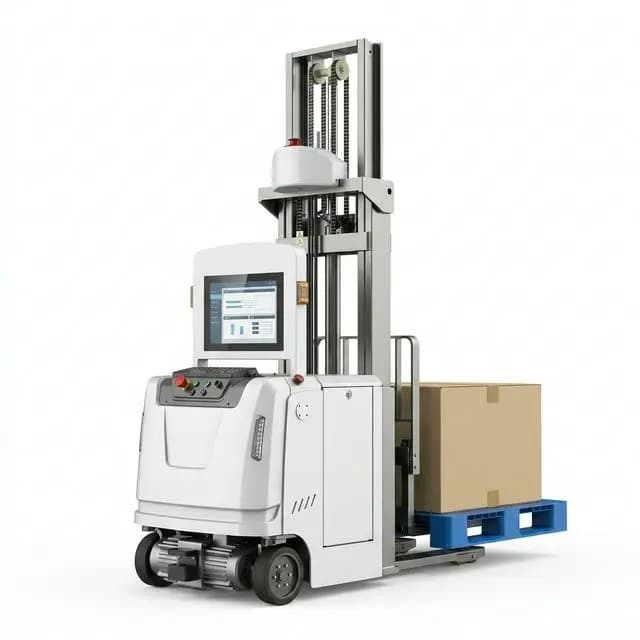
| Best fit | Irregular short moves | Repetitive floor-level pallet transport | Vertical lift and high-bay storage |
| Infrastructure change | None | Map, traffic rules, charging area | Map, mast clearance, rack interface, wider safety envelope |
| Evidence confidence | Known labor process | High after route timing and safety-field validation | Medium until rack interface and load stability are tested |
| Payback signal | N/A - baseline labor cost | Site-specific; strongest in multi-shift, repeatable routes | Site-specific; often longer due to higher integration scope |
| Risk | Trigger | Mitigation |
|---|---|---|
| Misuse risk | Using the tool output as a final aisle certification. | Treat the result as pre-RFQ screening; require supplier swept-path and safety-field drawings. |
| Cost risk | Ignoring fleet-management, chargers, mapping, and traffic-control work. | Ask suppliers to separate vehicle, FMS, safety validation, and service line items. |
| Scenario mismatch | Low repeatability, damaged pallets, inclines above the supplier-rated grade, payloads above published capacity, or manual congestion. | Run a route audit before automation; keep manual/tugger options for heavy-ramp exceptions. |
| Evidence gap | Unknown floor flatness (e.g., non-compliant with DIN 18202), pallet overhang, load stability, or Wi-Fi coverage. | Mark unknowns as site-confirm items and collect floor-flatness logs during a pilot week. |
Decision FAQ
These questions focus on procurement and site-fit decisions, not glossary definitions. For uncertain values, the minimum next step is to mark them as site-confirm items.
Send Route Data for ReviewPublished 2026-06-25 · Updated 2026-07-11
Related AGV automated guided vehicle engineering resources
Continue researching high-load wheel modules, forklift integrations, system safety checklists, and motor selection equations.