AGV Forklifts Australia Fit Checker & Meaning Guide
Reviewed by AGV Drive Wheel engineering content on 2026-07-18; source limits and calculator assumptions are listed in Standards & Evidence.
Meaning: an AGV forklift (or AGV forklift robot) is a driverless industrial forklift that moves, lifts, and stacks pallets on programmed routes.
This page treats AGV forklift, AGV forklift robot, automated forklift, forklift AGV, and driverless industrial truck as one category, then uses the calculator to test wheel load, ramp torque, safety readiness, and quote next steps.
Default values are loaded for a 1.5-ton counterbalance AGV. Run the check now or edit the mission inputs below.
Default values are loaded. Adjust any field, then run the checker to calculate safety readiness classification.
Estimated Physical Outputs
Run the fit checker to reveal total moving mass, drive-axle load bias, per-wheel estimate, required torque, readiness class, and RFQ action guidance.
Key Market Insights
AGV Automated Forklifts Decision Framework
ISO 3691-4:2023 / AS 5144.4:2021
Safety verification is standards-led, not brochure-led.
Automated forklifts carry high center-of-gravity loads, so public product claims are not enough. ISO 3691-4:2023 is the published international reference for driverless industrial-truck safety scope. Final protective-field dimensions, stop-function performance levels, passenger protection measures, and acceptance criteria must come from the purchased standard text, ISO 13849-1 validation, IEC 61496 scanner certificates, and the site risk assessment.
Evidence: ISO 3691-4:2023 public listing, AS 5144.4 listing, and Safe Work Australia plant-risk guidance reviewed 2026-07-18.
Up to 65% screening bias
Wheel loading is a conservative screening assumption.
For counterbalance mode, the checker models up to 65% of gross mass on the drive axle during braking or ramp review. Confirm the final axle distribution from the chassis drawing, scale test, and tire-load certificate before purchase release.
Evidence: On-page physics model and forklift chassis profile; not a replacement for measured axle loads.
1 URL
Canonical page clusters all related queries.
agv automated forklifts, agv forklift robot, agv forklift australia, agv forklifts australia, and agv forklift intents are unified here. We avoid duplicating technical specs and concentrate evidence in one place for global and local (e.g., Australian WHS) deployment.
Evidence: Canonical route /solutions/warehouse-logistics/agv-forklift and structured FAQ alias mapping.
12-15% review band
Gradeability boundaries trigger engineering review.
The tool treats 12-15% incline as a screening boundary, not a universal pass/fail law. Above that range, motor thermal curves, tire compound, braking duty, floor friction, and emergency-stop stability need supplier engineering review.
Evidence: Calculator limits, torque model, and field-validation checklist on this page.
VDA 5050 3.0
Interoperability reduces proprietary fleet lock-in, but requires validation.
VDA 5050 v3.0.0 (tagged on GitHub 2026-03-18 and noted as released by VDA on 2026-03-19) supports freely-navigating AMRs via a new zone concept alongside fixed-path AGVs. However, it does not manage functional safety out of the box, and traffic deadlock prevention in highly dynamic mixed-vendor layouts still requires robust fleet management validation.
Evidence: VDA 5050 v3.0.0 GitHub release and discussion notes reviewed 2026-07-18.
Terminology boundary
AGV forklift robot is a buyer phrase, not a guaranteed AMR stack.
Some vendors use AGV forklift robot for fixed-route driverless trucks, while others mean AMR-style SLAM forklifts with software-defined routing. Treat navigation architecture, obstacle handling, fleet-manager interface, and safety validation evidence as RFQ fields instead of assuming the phrase guarantees dynamic autonomy.
Evidence: Robotic-vs-AGV comparison table, VDA 5050 scope, and source table reviewed 2026-07-18; exact market CAGR is intentionally excluded from generic global claims because public aggregators conflict.
~5% forecast
Forklift automation remains a long-term planning driver.
Interact Analysis reported 7.1% forklift shipment growth in 2025, a roughly 5% annual growth forecast from 2024 to 2030, and annual orders expected to exceed 3.6 million units by 2034.
Evidence: Interact Analysis article published Jan 2026 and reviewed 2026-07-18.
Third-party AU forecast
Australian AGV demand is directional context, not ROI proof.
Spherical Insights estimates the Australian Automated Guided Vehicle market at USD 138.25 million in 2023 and projects USD 407.11 million by 2033 (11.40% CAGR). Treat this as third-party macro demand context only; it does not prove site ROI, forklift-specific availability, or WHS readiness for an individual warehouse.
Evidence: Spherical Insights Australian AGV market report listing released Oct 2024 and reviewed 2026-07-18.
12-24 Months
Multi-shift ROI is a benchmark, not a guarantee.
Vendor and industry calculators often model 12-24 month payback for well-fit multi-shift operations, with longer payback in lower-utilization sites. Treat that as a screening benchmark only: actual ROI must include CapEx ($80k-$150k per truck), integration software licenses, VDA 5050 adapter fees, IT network upgrades, and quoted maintenance before calculating release limits.
Evidence: K-Hartwall ROI guidance, AGVNetwork calculator notes, and Movanis calculator inputs reviewed 2026-07-18.
1.3-1.5 planning band
Replacement ratio is a simulation input, not a purchase rule.
Do not assume a 1:1 manual-to-AGV replacement. Some AGV planning guides use 1.3 to 1.5 automated vehicles per manual vehicle to preserve peak throughput, reflecting safety speeds, manoeuvre time, traffic control, and charging downtime. Confirm the ratio with route simulation and measured task times before final RFQ quantities.
Evidence: Antdriven AGV guide and AGVNetwork calculator assumptions reviewed 2026-07-18.
Supplier-set F-min
VNA automation needs measured defined-traffic flatness.
For high-lift VNA automated forklifts, standard FF/FL random-traffic metrics are insufficient. The RFQ should set a supplier-approved ACI F-min or TR34 defined-traffic target, then verify the selected aisles with a certified continuous-profile floor survey. Automated systems are sensitive to "washboarding" and joint curling, which can cause mast sway or LiDAR false-positives.
Evidence: Face Consultants F-min explanation, Hyster VNA floor-flatness guidance, and floor-survey acceptance checklist reviewed 2026-07-18.
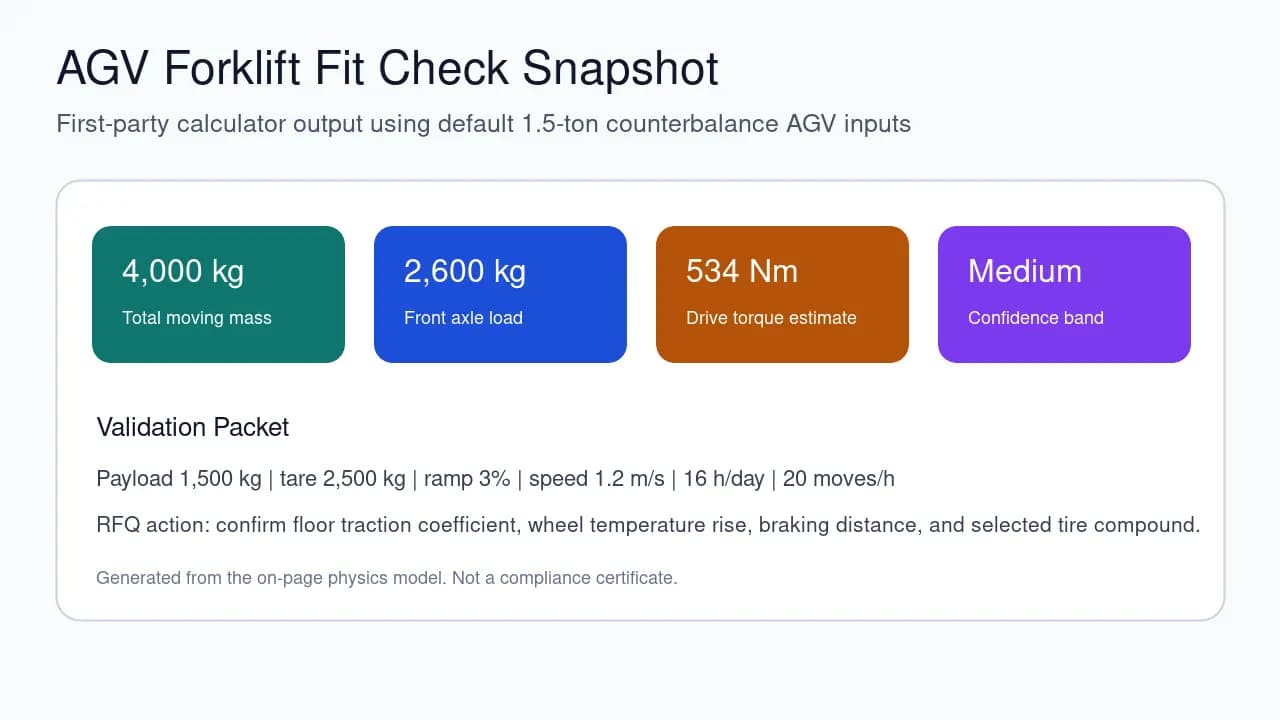
First-party fit-check validation snapshot
This anonymized packet shows the default calculator output and the exact parameters a buyer should attach to an engineering quote request: payload, tare weight, ramp, speed, duty cycle, torque estimate, and validation limits.
1. AGV Automated Forklift Types Specifications
| Chassis Type | Capacity | Max Speed | Min Aisle |
|---|---|---|---|
| Pallet Stacker AGV | 1.0 - 2.0 Tons | Up to 1.5 m/s | 2.2m min |
| Counterbalance AGV | 1.5 - 5.0 Tons | Up to 2.0 m/s | 3.2m min |
| Reach Truck AGV | 1.2 - 2.5 Tons | Up to 1.8 m/s | 2.8m min |
| VNA Stacker AGV | 1.0 - 1.5 Tons | Up to 1.5 m/s | 1.6m min |
Corridor Turn Clearance Radius
2. Recommended Drive Tire Materials
| Tire Elastomer | Screening Load Note | Friction Coeff. | Typical Surface |
|---|---|---|---|
| Standard Polyurethane (93 Shore A) | <=1200 kg screening load; confirm datasheet | 0.3 - 0.4 | Flat indoor warehouse flooring |
| Premium Polyurethane (93 Shore A) | 1200-2000 kg screening load; verify heat rise | 0.35 - 0.45 | Higher-duty flat indoor warehouse loops |
| Heavy-duty NDI / Vulkollan-class PU (supplier-specific) | >2000 kg or ramp duty; supplier approval required | 0.4 - 0.55 | High throughput, high ramps, braking friction |
| Cold-rated NDI / polyurethane blend (supplier-specific) | Cold/moisture duty; request low-temp load data | 0.35 - 0.45 | Cold storage, high moisture floors |
| Antistatic Polyurethane | ESD duty; verify resistance and load certificate | 0.3 - 0.4 | Electronics assembly, cleanroom applications |
High Lift Mast Load Capacity Derating
Polyurethane Friction Coefficient vs Temperature
*Note: This curve is illustrative. Cold storage can harden polyurethane and reduce available traction, but the actual μ value must be measured on the selected tire compound and floor.
3. Robotic Forklift (AMR) vs. Traditional AGV
Understanding the boundary between fixed-path AGVs and AMR-based robotic forklifts is critical for integration planning. While both are driverless, their obstacle handling and infrastructure needs differ.
| Feature | Traditional AGV | Robotic Forklift (AMR) |
|---|---|---|
| Navigation System | Fixed paths (magnetic tape, wires, QR grids) | Dynamic map-based (SLAM, LiDAR, vision) |
| Infrastructure Requirements | High (requires physical floor modifications) | None (software-defined paths, natural features) |
| Obstacle Handling | Stops and waits until path is clear | Re-routes dynamically around obstacles |
| Layout Flexibility | Rigid; costly and slow to change routes | High; adapts to changes via software updates |
| Best Use Case | Stable, high-volume, fixed-route repetitive tasks | Dynamic environments, evolving warehouse layouts |
4. International Safety Standards Compliance
Source check date: 2026-07-18. Public standard pages are used for scope verification; final release still requires the purchased standard text and site-specific hazard analysis.
| Regulation | Integration Scope | Safety focus |
|---|---|---|
| ISO 3691-4:2023 | Driverless industrial trucks safety requirements | Safety zones, steering clearance, dynamic braking |
| AS 5144.4:2021 (Australia) | Safety of industrial trucks — Driverless industrial trucks and their systems | Australian adoption/modification of ISO 3691-4:2020; align deployment with WHS plant-risk duties |
| ANSI/ITSDF B56.5-2024 | Automatic guided vehicles US safety consensus | Travel path margins, warning systems, clearance zones |
| ANSI/A3 R15.08-2-2023 | Industrial mobile robot system integration | Workstation interfaces, hazard areas, fleet coordination |
| VDA 5050 v3.0.0 (2026) | Vendor-neutral mobile robot and fleet-control communication | Interoperability, order/state/factsheet topics, planned paths, zone concepts |
*Warning: Consensus standard listings describe scope and compliance paths. Detailed numeric thresholds require consulting the standard document text.
5. Evidence Gaps & Field Validation Needs
| Subject | Known Standard | Pending Confirmation |
|---|---|---|
| Real-world dynamic braking on ramp | ISO 3691-4:2023 braking performance math and active detection fields | Actual tire friction coefficient on oily concrete floor during an emergency stop |
| Battery cycle life under high torque | Motor nominal current and battery capacity (LFP vs NMC) | Voltage drop and cell degradation during continuous uphill peak torque climbs |
| Chassis clearance over dock ramp transitions | Chassis dimensional drawings and height | Dynamic pitch deflection during high speed crossings |
| Mixed-fleet VDA 5050 interoperability (AGV + AMR) | VDA 5050 3.0.0 defines vendor-neutral order, state, zone concepts, and free-navigation support for AMRs | Actual latency, traffic deadlock resolution, and fallback APIs in highly congested multi-vendor intersections |
| VNA Floor Flatness Requirements | ACI F-min standard defines acceptable tolerances for defined-path vehicles | Actual F-min rating of the legacy warehouse floor |
Evidence Traceability
Source Links, Time Context, and Decision Limits
| Source / Model | Year or Review Date | What It Supports | Decision Limit |
|---|---|---|---|
| ISO 3691-4:2023 | 2023; reviewed 2026-07-18 | Official listing confirming ISO 3691-4:2023 publication status, safety-requirements scope, verification scope, and applicability to driverless industrial trucks and their systems. | The public listing does not expose all detailed clearance, restart, protective-field, or stop-function rules. Confirm those thresholds in the purchased standard text; ISO also lists a successor DIS under development. |
| AS 5144.4:2021 (Australian adoption/modification) | 2021; official listing reviewed 2026-07-18 | Australian standard listing for driverless industrial trucks and their systems, based on ISO 3691-4:2020 with modifications. | Paid standard text; confirm the edition required by the Australian state, site, insurer, and purchaser before final release. |
| Safe Work Australia plant risk guidance | Dec 2023 code; reviewed 2026-07-18 | WHS plant-risk framing for powered mobile plant, including collision, overturning, unauthorised movement, and control measures. | Model guidance is not a forklift-AGV design certificate; legal duties depend on the jurisdiction and site-specific risk assessment. |
| ANSI/ITSDF B56.5-2024 | 2024 | US safety standard scope for driverless and automatic guided industrial vehicles. | Public listing confirms scope; project release still needs site-specific safety validation. |
| ANSI/A3 R15.08-2-2023 | 2023 | Integration responsibilities for industrial mobile robot systems and applications. | Applies to IMR system integration; forklift-specific load and mast risks must be checked separately. |
| On-page physics model | Calculator reviewed 2026-07-18 | Pre-screening estimate for total mass, ramp force, acceleration force, and drive wheel torque. | Not a compliance certificate; traction coefficient, floor condition, and duty cycle need field measurement. |
| Interact Analysis: Forklift Market Shipment Growth | Published Jan 2026; reviewed 2026-07-18 | Reports 7.1% shipment growth in 2025, roughly 5% annual growth from 2024 to 2030, and annual orders forecast above 3.6 million units by 2034. | Market forecasts are directional planning inputs, not proof that a specific automated forklift project will achieve ROI. |
| VDA 5050 Version 3.0.0 | GitHub release dated 2026-03-18; VDA discussion notes release on 2026-03-19; reviewed 2026-07-18 | Defines a vendor-neutral communication interface between mobile robots and central fleet control. | It is an interoperability interface, not a safety standard or a guaranteed cost-reduction mechanism. |
| Face Consultants ACI F-min number system | Floor-flatness guidance reviewed 2026-07-18 | Explains F-min as a defined-traffic VNA aisle floor-flatness and levelness index assigned from the expected lift truck and rack height. | Treat as secondary context only. Set the target from the truck supplier, floor surveyor, ACI/TR34 documentation, route geometry, and mast height. |
| Hyster VNA floor-flatness guide | PDF guidance reviewed 2026-07-18 | Explains that defined-movement VNA floors are measured under the ACI F-min standard and that F-min is assigned from expected rack and truck height. | Vendor educational guidance only. Automated-forklift release still needs the selected supplier, surveyor, and acceptance-test criteria. |
| AGV Multi-Shift ROI Benchmarks | K-Hartwall article and industry ROI calculator data reviewed 2026-07-18 | Vendor ROI framing that many suitable AGV projects can show positive ROI in roughly 12-24 months, depending on utilization, labor cost, current process, and implementation scope. | Treat as a vendor benchmark, not a site guarantee. Exact payback still needs project CapEx, uptime, charging infrastructure, integration costs, labor rates, and IT upgrades. |
| AGVNetwork ROI calculator notes | Calculator article reviewed 2026-07-18 | Illustrative payback bands by shift pattern and explicit warning that values are indicative and vary case by case. | Secondary calculator guidance only; it does not replace a supplier-validated throughput simulation or finance model. |
| Antdriven AGV replacement-ratio guide | AGV guide reviewed 2026-07-18 | Planning rule of thumb that 1.3-1.5 AGVs may be needed to replace one manually driven vehicle. | Vendor guidance only. Use measured route cycle times, charge strategy, traffic-control rules, and safety speed limits for purchase quantities. |
| Spherical Insights Australian AGV Market Report | Released Oct 2024; reviewed 2026-07-18 | Third-party Australian AGV market estimate of USD 138.25M in 2023 and 11.4% CAGR forecast to 2033. | Single market-research listing used only as directional demand context. It does not validate forklift-specific availability, site ROI, safety compliance, or procurement readiness. |
| Robotic forklift terminology boundary | Reviewed 2026-07-18 | Defines how this page treats "agv forklift robot" as an alias while distinguishing fixed-path AGVs from AMR-style navigation. | Not a market-size source. The buyer still needs vendor documentation for the actual navigation stack, fleet-manager interface, protective-field design, and site acceptance test. |
5. Automated Forklift Safety Verification Flow
6. Financial Procurement: Capex vs RaaS
| Procurement Metric | Capex Model | RaaS Model |
|---|---|---|
| Initial Investment (CapEx) | $80,000 - $150,000 per truck budgetary estimate (excludes site software/VDA 5050 adapters) | $2,500 - $4,500 monthly budgetary estimate (typically includes basic software and maintenance) |
| Payback Period (ROI) | Use 12-24 months as a best-fit multi-shift screening benchmark; lower-utilization sites can extend materially. Actual ROI requires custom validation. | Immediate OpEx cashflow benefit, but higher long-term Total Cost of Ownership (TCO) |
| Fleet Replacement Ratio | Model 1.3 to 1.5 AGVs per manual forklift as a planning band, then validate with route simulation, safety speed limits, and charging windows. | RaaS contracts can bundle peak-season units, but the replacement ratio still needs route-level validation. |
| Maintenance Costs | Paid by owner (estimate 5-8% annually of truck cost; verify preventive maintenance schedule quote) | Included in monthly subscription, shifts downtime risk to supplier |
| Software and Map Updates | Paid upgrade per service contract (mapping dynamic environments can be costly) | Included in continuous cloud updates (requires reliable facility Wi-Fi/5G) |
| Risk Allocation | Depreciation, asset obsolescence, and battery replacement risk on buyer | Minimum term contract; easy scaling and tech-refresh options |
Opportunity Charging Profile (24-Hour Operation)
Battery Capacity Retention: LFP vs NMC
*Note: This visual shows a directional chemistry tradeoff, not a guaranteed cycle-life claim. Confirm cycle count, depth of discharge, and temperature envelope with the selected battery supplier.
7. Dynamic Torque Sizing vs Slope Incline
| Grade | Frictional Drag | Accel. Force | Total Force | Torque (0.15m Wheel) |
|---|---|---|---|---|
| 0% (Flat Floor) | ~800 N | ~1600 N | ~2400 N | 360 Nm |
| 3% (Standard Ramp) | ~2000 N | ~1600 N | ~3600 N | 540 Nm |
| 6% (Medium Incline) | ~3200 N | ~1600 N | ~4800 N | 720 Nm |
| 10% (Steep Incline) | ~4800 N | ~1600 N | ~6400 N | 960 Nm |
Load Shift & Sloped Travel Risk Matrix
8. Guidance System Accuracy vs Environment
| Technology | Accuracy | Safety Maturity | Best Fit Environment |
|---|---|---|---|
| Laser Reflector | ± 5 mm | High | Static warehouses with clear lines-of-sight |
| Natural SLAM | ± 10 mm | Medium | Dynamic workspaces; requires periodic map updates |
| Hybrid Guidance | ± 5 mm | High | Narrow aisle racking with transition corridors |
9. Major Failure Modes & Sizing Mitigations
| Failure Mode | Primary Mechanical Cause | Sizing / Control Mitigation |
|---|---|---|
| Tire Delamination | Excessive continuous wheel load + high speed hysteresis | Request heat-rise and load-cycle data for the selected PU/NDI/Vulkollan-class compound; reduce speed or duty cycle if prototype logs exceed supplier limits |
| Drive Motor Overheating | Continuous operation on steep ramps with no cooling periods | Introduce opportunity charging or cooling pauses in cycle schedule |
| LiDAR False Stops | Dust build-up or direct sunlight glare on laser scanner | Add scanner hoods, implement periodic maintenance cleaning schedules |
| Proprietary FMS Lock-In | Procuring AGVs that only communicate with the vendor’s closed-ecosystem server | Ask vendors to document VDA 5050 3.0.0 compatibility, supported topics, version gaps, and fallback APIs in the RFQ |
| Mast Sway in VNA | Operating on legacy floors that do not meet ACI F-min defined-path flatness standards | Conduct a certified floor survey. Set the supplier-specific F-min/TR34 target before acceptance, then grind only measured non-compliant paths |
Representative Planning Scenarios
Automated Forklift Verification Scenarios
These are representative engineering scenarios for decision planning, not public performance claims. Use them to structure RFQ assumptions and validation tests.
Scenario 1: Heavy counterbalance AGV in beverage bottling line
Representative planning scenario for a high-cycle beverage pallet line loading pallets directly onto shuttle conveyors.
Config Parameters
Load: 2200 kg, Speed: 1.5 m/s, Ramp: 2%, Navigation: Laser
Integration Outcome
The checker flags front tire hysteresis and continuous torque load as the first supplier-verification topic. RFQ should request wheel temperature rise data and tire replacement assumptions for 24/7 loops.
Scenario 2: High-lift reach truck AGV in cold storage deep rack facility
Representative cold-chain layout with reach truck AGVs storing dairy pallets at high rack levels in -20°C rooms.
Config Parameters
Load: 1200 kg, Speed: 1.2 m/s, Ramp: 0%, Navigation: Hybrid
Integration Outcome
The decision path should require cold-room rated elastomer samples, condensation checks, and loaded braking-distance validation before committing to the tire compound.
Scenario 3: Narrow aisle VNA automated forklift in electronics parts warehouse
Representative electronics-parts warehouse considering automated tri-lateral VNA forklifts for high-density corridors.
Config Parameters
Load: 800 kg, Speed: 1.0 m/s, Aisle: 1.65m, Navigation: Hybrid
Integration Outcome
The result depends on actual aisle straightness, rack protection, and guidance accuracy. Treat storage-density gain as a layout simulation output, not a generic promise.
Technical FAQ
AGV Automated Forklifts Frequently Asked Questions
Review standard inquiries regarding terminology mapping, sizing calculations, tire materials, and site hazard mapping rules.
Intent & Terminology (关于关键词合并与释义)
Mechanical & Sizing (机械选型与计算器)
Safety & Integration (安全规范与系统集成)
Battery & Environmental Sizing (电池与环境工况适配)
Software & Interoperability (软件调度与混合编队)
Submit Your Forklift AGV Parameters for Custom Quote
Our engineering team reviews axle distributions, grade stability margins, and dynamic braking requirements to match standard and high-load polyurethane/NDI wheel modules.
Related AGV automated forklifts engineering resources
Continue researching high-load wheel modules, Mecanum adaptations, system integration checklists, and motor sizing math.
- AGV forklift manufacturers list and selection guide
- Agv electric tugger route fit checker
- 1.5 Ton Electric Forklift AGV Wheel Selector
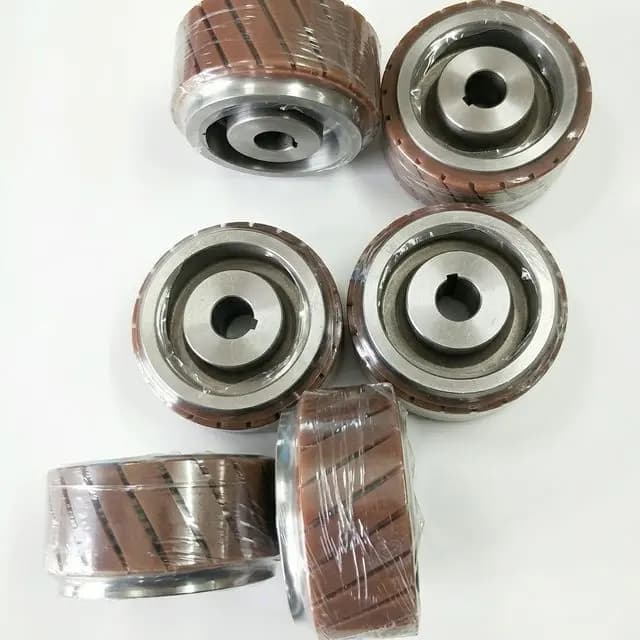
- AGV for warehouse route decision report
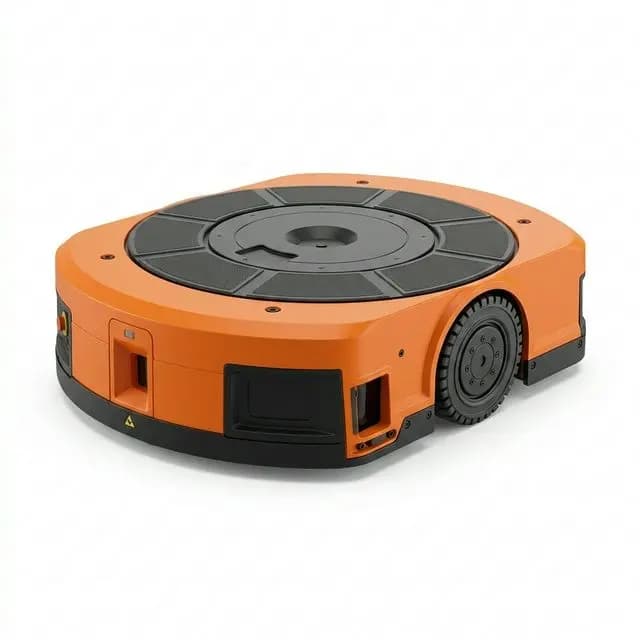
- AGV automated pallet truck and AGV for pallets calculator
- Material Handling Robot Safety Checker
- 310mm Mecanum Wheel Forklift Retrofit Guide

- AGV Drive Wheel RFQ Checklist for OEM Buyers
- How to Calculate AGV Drive Wheel Torque and Motor Sizing
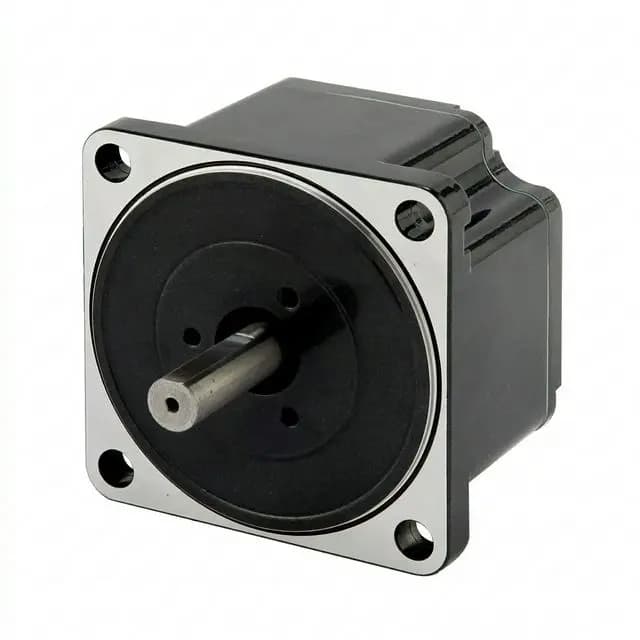
- AGV Forklift Steering Wheel Selection Calculator & Report