The 6-Month Countdown to EU Machinery Regulation 2023/1230: What AMR Buyers and Engineers Need to Know
EU Machinery Regulation 2023/1230 applies from January 20, 2027. See what AGV drive wheel buyers must change in RFQs, firmware evidence, and CE files.
Decision-Level Conclusion As of July 2026, the 6-month countdown has begun for the mandatory enforcement of EU Machinery Regulation 2023/1230, taking effect on January 20, 2027. This regulation elevates cybersecurity and AI behavior to essential health and safety requirements (EHSRs). For AMR/AGV buyers and OEM engineers, if current RFQs for drive wheels, traction modules, and smart safety controllers do not explicitly demand anti-tampering measures (e.g., IEC 62443 compliance) and secure firmware update protocols, vehicles delivered in early 2027 risk failing CE certification.
Scope: AGV drive wheels, traction modules, mecanum and omni wheel assemblies, warehouse automation reliability, and buyer-facing sourcing changes across United States + European Union + global warehouse automation markets.
Date note: EUR-Lex's original Official Journal text used January 14, 2027, but the consolidated text with the C1 corrigendum shows January 20, 2027 for application, repeal of Directive 2006/42/EC, and the cutoff for products placed on the market under the old Directive. This article follows the consolidated EUR-Lex text checked on July 1, 2026.
Fast Navigation and Next Actions
- For a procurement-ready input template: AGV Drive Wheel RFQ Checklist for OEM Buyers
- For safety wheel drives: Safety Wheel Drives (SWD) AMR Engineering
- For motor and torque checks: How to Calculate AGV Drive Wheel Torque and Motor Sizing
- For lateral-movement wheel options: Mecanum Wheel vs Omni Wheel
- For RFQ and compliance review support: Contact Engineering and Sourcing Team
What Changed: The Shift to 2023/1230
The transition from the legacy Machinery Directive (2006/42/EC) to the new Regulation (EU) 2023/1230 introduces sweeping changes for robotics. Published in the Official Journal on June 29, 2023, the regulation is currently in a transition phase that effectively closes at the end of January 19, 2027, with mandatory application starting January 20, 2027 under the consolidated EUR-Lex text.
For buyers and specifiers of AGV drive wheels and traction modules, the most critical shift is the formal inclusion of Cybersecurity and Artificial Intelligence (AI) / Machine Learning into the Essential Health and Safety Requirements (EHSRs).
Core Differences: Legacy Directive vs. New Regulation
| Dimension | Directive 2006/42/EC (Legacy) | Regulation (EU) 2023/1230 (New) | OEM / Buyer Action Required |
|---|---|---|---|
| Legal Structure | Directive (required national transposition) | Regulation (applies directly across all EU member states) | Update compliance paperwork to reference the new Regulation directly. |
| Cybersecurity | Not explicitly addressed as a core safety risk. | Mandatory EHSRs (Annex III, 1.1.9 & 1.2.1). Protection against corruption and unauthorized access. | Require suppliers to validate firmware integrity and secure communication (e.g., IEC 62443). |
| Artificial Intelligence | No specific provisions for self-learning or autonomous behavior. | Addresses risks from AI and machine learning influencing safety functions. | Document boundaries of AI behavior in navigation and drive modules. |
| Firmware Updates | Addressed vaguely or managed via secondary standards. | Explicit requirements for secure OTA (Over-The-Air) updates and software version control. | Ensure traction controllers support cryptographically signed firmware updates. |
| Transition Period | N/A | Hard cut-off on Jan 19, 2027. No dual-validity period thereafter. | Align current RFQs with 2027 delivery dates to new standards. |
Impact on Drive Wheels & Traction Modules
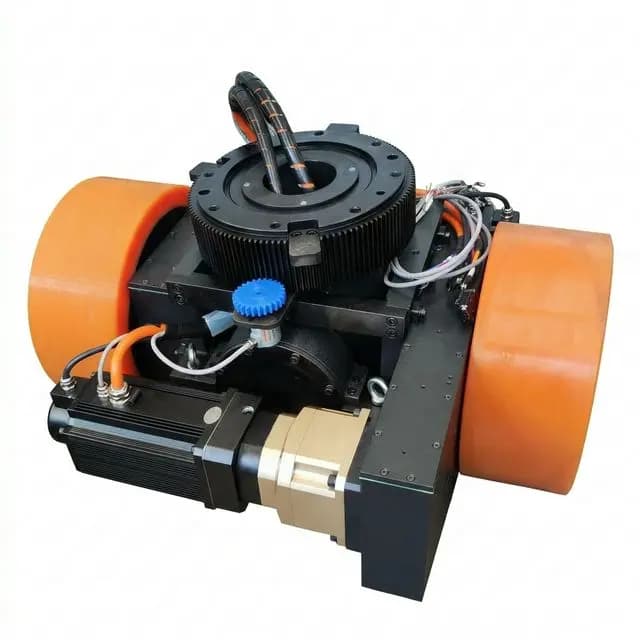
The new regulation is not just a software issue; it directly impacts the electromechanical core of an AMR. Modern AGV drive wheels and traction modules often integrate advanced safety controllers (handling Safe Torque Off - STO, and Safely-Limited Speed - SLS), encoders, and networking interfaces.
Under 2023/1230, these integrated modules are evaluated for their vulnerability to cyber corruption:
- Networked Components: If a drive module connects to a CAN bus or Industrial Ethernet network, it must not allow an unauthorized command to bypass STO or alter safety parameters.
- Firmware Integrity: Any smart wheel that supports Over-The-Air (OTA) updates must verify the integrity of the update package to prevent malicious firmware from causing runaway vehicle scenarios.
- AI and Learning: If a traction controller uses adaptive algorithms for slippage control or motor tuning, the safety boundaries of those algorithms must be rigorously defined and immune to manipulation.
The "Substantial Modification" Trap for Legacy Fleets
While the new regulation does not apply retroactively to AMRs commissioned before January 20, 2027, any Substantial Modification to an existing vehicle will void its legacy CE mark and force immediate compliance under the new 2023/1230 rules. For AMR drive wheels and traction modules, digital changes can be just as significant as physical ones.
| Modification Type | Example Scenario in AGV Drive Modules | Triggers 2023/1230? (Substantial Modification) | Buyer/OEM Action |
|---|---|---|---|
| Firmware Update (Safety) | Updating the integrated safety controller (e.g., STO/SLS logic) to a new major version that alters braking distance. | Yes. Changes the safety profile and risk boundaries. | Requires new risk assessment and conformity under 2023/1230. |
| Drive Parameter Tuning | Changing torque limits or acceleration curves beyond the original manufacturer's specified envelope. | Yes. Increases existing risks of collision or slippage. | The entity making the change becomes the "legal manufacturer". |
| AI Navigation Swap | Replacing a deterministic path-following module with an AI-based adaptive routing system that influences drive speed. | Yes. Introduces AI influencing safety functions. | Must comply with new AI safety EHSRs. |
| Like-for-Like Replacement | Swapping a damaged polyurethane drive wheel with an identical OEM spare part. | No. Original safety envelope is maintained. | Standard maintenance logging. |
| Security Patch | Applying an OTA security patch that does not alter the machine's safety logic or kinematics. | No. Preserves existing safety state while addressing software vulnerabilities. | Document the patch under standard cybersecurity lifecycle management. |
Risks and Limits: Navigating the Deadline
Buyers and OEMs face significant risks if they underestimate the timeline or scope of the new regulation:
- The "Wait and See" Risk: 2027 seems distant, but enterprise AMR deployments often have a 6 to 12-month lead time from RFQ to final commissioning. Hardware ordered today will likely be delivered and placed into service exactly when the new regulation is strictly enforced.
- Supplier Readiness Gaps: Many Tier 2 component suppliers (providing standard motors or basic controllers) are unaware of the cybersecurity EHSRs. Integrating their components into a safety-critical AGV architecture may push the compliance burden entirely onto the OEM.
- Documentation Burden: Demonstrating compliance requires extensive technical documentation, including cybersecurity risk assessments. Lacking these documents will halt CE marking, blocking entry into the EU market.
Who Should Act Now (Action Checklist)
OEM buyers, system integrators, and engineering managers must immediately audit their supply chains. Do not wait for 2027 to request compliance evidence.
- Procurement Managers: Update RFQ templates today to explicitly require suppliers of smart drive wheels and controllers to provide timelines for Regulation (EU) 2023/1230 compliance, specifically addressing Annex III cybersecurity requirements.
- OEM Engineers: Verify that all networked traction controllers incorporate secure communication protocols and cryptographically signed firmware update mechanisms. Request IEC 62443 certification mapping where available.
- System Integrators: For AMR fleets planned for deployment in late 2026 or early 2027, secure written confirmation from the vehicle manufacturer that the delivered systems will carry valid CE marks under the new Regulation, not the expiring Directive.
- Compliance Teams: Begin integrating cybersecurity threat modeling into the standard mechanical and electrical risk assessments for all new vehicle platforms.
FAQ
Q: Does Regulation (EU) 2023/1230 apply retroactively to AMRs already in service?
A: Generally, no. Machines placed on the market before January 20, 2027, under Directive 2006/42/EC remain valid. However, if you perform a "Substantial Modification"—such as altering drive safety parameters, upgrading to AI-based navigation, or pushing firmware that changes braking kinematics—the vehicle must be recertified under the new 2023/1230 regulation. The entity making this change is legally considered the new manufacturer.
Q: How does this relate to the IEC 62443 standard?
A: While the Regulation does not mandate a specific standard, implementing harmonized standards like the IEC 62443 series (Industrial communication networks - Network and system security) is currently the best practice for demonstrating compliance with the new cybersecurity EHSRs.
Q: Can we use a third-party cybersecurity module to protect legacy drive wheels?
A: Potentially, but the overall system architecture must guarantee that the safety functions (like emergency braking or STO) cannot be compromised, even if the primary network is breached. A secure gateway helps, but endpoint resilience is highly scrutinized.
Next Steps for Compliance
The window to secure compliant hardware for 2027 deployments is closing. Start reviewing your traction module specifications now:
- Align your next purchase order using the AGV Drive Wheel RFQ Checklist for OEM Buyers.
- Understand the integration of safety controllers in our Safety Wheel Drives (SWD) Guide.
- For expert guidance on specifying compliant drive wheel assemblies, Contact our Engineering and Sourcing Team.
Sources
- EUR-Lex consolidated text (checked 2026-07-01): Regulation (EU) 2023/1230 of the European Parliament and of the Council on machinery, including C1 corrigendum date changes for application and Directive repeal.
https://eur-lex.europa.eu/legal-content/EN/TXT/?uri=CELEX:02023R1230-20230629 (Checked: 2026-07-01) - Pilz Automation Safety Guide (2024-2026): Industrial Control System Cybersecurity & EU Machinery Regulation.
https://www.pilz.com/en-int/support/knowhow/law-standards-norms/machinery-regulation (Checked: 2026-07-01) - TÜV NORD Certification Guidelines (2025-2026): New Machinery Regulation (EU) 2023/1230 Requirements and Transition.
https://www.tuev-nord.de/en/company/certification/product-certification/machinery-directive-regulation/ (Checked: 2026-07-01) - TÜV SÜD (2023): The new EU Machinery Regulation and its impact on substantial modifications and digital safety.
https://www.tuvsud.com/en/themes/machine-safety/machinery-regulation (Checked: 2026-07-01)