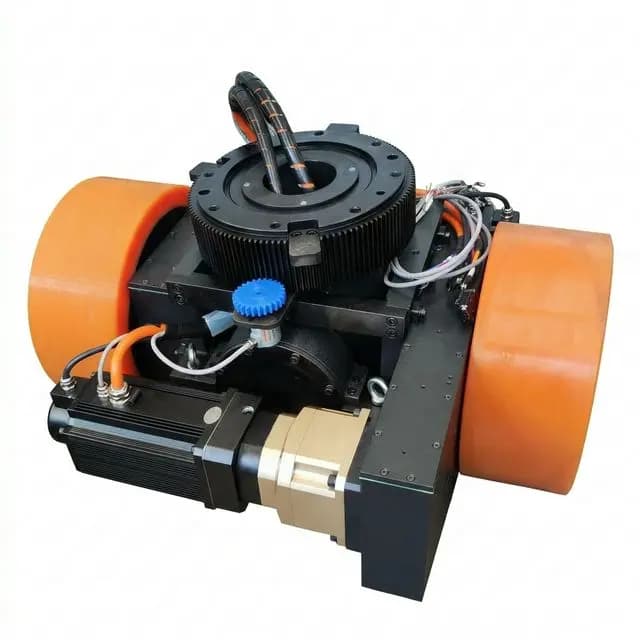
EU Regulation 2026/1455: 0% Customs Duties on U.S.-Origin AGV Drive Wheels and Polyurethane (July 2026 Update)
Effective July 1, 2026, EU Regulation 2026/1455 drops customs duties to 0% for eligible U.S.-origin industrial goods, significantly lowering TCO for European AGV/AMR buyers sourcing heavy-duty polyurethane wheels and traction modules.
Decision-Level Conclusion Starting July 1, 2026, Regulation (EU) 2026/1455 enforces a 0% customs duty rate on eligible U.S.-origin industrial products entering the European Union. For European AGV/AMR buyers and system integrators, this effectively lowers the Total Cost of Ownership (TCO) for importing premium U.S.-manufactured heavy-duty polyurethane wheels, drive motors, and integrated traction modules by removing typical 2.7% to 4% ad valorem duties. Procurement teams must immediately review origin declarations with U.S. suppliers to capture these savings while maintaining strict Rules of Origin compliance.
Scope: AGV drive wheels, traction modules, mecanum and omni wheel assemblies, warehouse automation reliability, and buyer-facing sourcing changes across United States + European Union + global warehouse automation markets.
This analysis provides a procurement and engineering perspective on the recent tariff changes. It is not legal customs advice; always consult a licensed customs broker for specific HS code classification and origin validation.
What Changed (July 2026 Regulation)
Regulation (EU) 2026/1455 was published in the Official Journal of the European Union on June 30, 2026, and officially entered into force on July 1, 2026. This bilateral trade framework between the EU and the United States addresses industrial goods by either completely removing customs duties (Annex I) or adjusting ad valorem rates.
For the warehouse automation sector, the most critical impact falls under specific Harmonized System (HS) chapters:
- Chapter 39 (Plastics/Polyurethane): High-load polyurethane wheels cast in the U.S. can now enter the EU duty-free, eliminating the traditional ~4% tariff.
- Chapter 85 (Electrical Machinery): Integrated AGV traction modules and industrial motors meeting the origin requirements can also benefit from 0% duties.
This shift transforms the cost structure for high-end U.S. automation components, making them significantly more competitive against domestic EU suppliers or Asian imports.
Impact on EU Buyers & System Integrators
For European Original Equipment Manufacturers (OEMs) and automation integrators, sourcing advanced drive wheels from the U.S. previously carried a noticeable landed cost penalty. The new regulation allows buyers to acquire specialized components—such as cleanroom-certified polyurethane wheels, ESD-safe traction modules, and ultra-high-load capacities—without the customs duty overhead.
This improves the Total Cost of Ownership (TCO) calculation. Buyers can now justify specifying premium U.S. engineering, which often yields longer lifespans and reduced maintenance downtime, because the upfront tax barrier has been removed.
Impact on US OEMs & Exporters
U.S. manufacturers of AGV components suddenly find themselves with improved pricing power in the European market. By shedding the duty cost, American exporters can offer more competitive Delivered Duty Paid (DDP) or Cost, Insurance, and Freight (CIF) pricing.
This is an optimal moment for U.S. suppliers to push high-margin, highly customized drive wheels into European automotive factories and logistics centers that demand extreme reliability.
Limitations & Risks (Rules of Origin Boundaries)
The primary barrier to exploiting this regulation is strict adherence to Non-Preferential Rules of Origin (RoO) under Article 60 of the Union Customs Code. The 0% tariff is not a blanket exemption for anything shipped from a U.S. port.
Under the accompanying Commission Implementing Regulation (EU) 2026/1422, products must undergo "substantial transformation" within the United States. If an American supplier simply imports a finished drive motor from Asia, attaches a wheel hub, and ships it to the EU, it likely will not qualify for the preferential rate. The core casting of the polyurethane and the primary assembly of the traction module must occur stateside to satisfy origin audits. Furthermore, failure to provide valid proof of origin upon customs request will result in immediate reversion to standard Most-Favored-Nation (MFN) tariffs, plus potential administrative penalties.
Compliance and Documentation Matrix
| Criteria / Component | Pre-July 2026 (Typical Duty) | Post-July 2026 (Reg. 2026/1455) | Compliance Evidence Required | Risk if Mismatched |
|---|---|---|---|---|
| Heavy-Duty PU Wheels | ~4.0% (Ch. 39 Plastics) | 0% (Annex I) | US Certificate of Origin | Reverts to standard MFN tariff |
| Drive Motors (Standard) | ~2.7% (Ch. 85 Electrical) | 0% | Manufacturer BOM audit | Reverts to standard MFN tariff |
| Integrated Traction Modules | ~2.7% - 4.0% Blended | 0% | Substantial transformation proof | Reverts to standard MFN tariff |
| Non-US Raw Materials | Evaluated per origin | Standard Tariff | N/A | Tariff savings disqualified |
| Logistics/Freight Cost | Standard | Standard | Commercial Invoice | Excluded from customs value |
| Customs Documentation | Standard SAD | SAD + Origin Declaration | Valid origin statement | Delays at EU port |
| Harmonized System (HS) Codes | 8501 (Motors), 3926 (Plastics) | Must match Annex I / Annex II | HS Code verification | Audits and fines |
| Validity Period | Indefinite | Ends Dec 31, 2029 | Continuous monitoring | Unplanned future cost increases |
Buyer Action Thresholds & ROI Matrix
Implementing the 0% tariff is not free; it requires administrative overhead to generate and verify origin documentation under Regulation (EU) 2026/1422. Buyers must calculate whether the 2.7% - 4.0% tariff savings outweigh the document processing costs (typically €200 - €350 per shipment for formal origin certificates and audit preparation).
| Order Value (Per Shipment) | Est. Origin Doc Cost | Est. 4% Tariff Savings | Net ROI | Recommended Action |
|---|---|---|---|---|
| Below €5,000 | ~€250 | ~€200 | Negative | Pay standard MFN duty; skip complex origin paperwork. |
| €5,000 - €12,500 | ~€250 - €350 | €200 - €500 | Marginal / Breakeven | Batch orders into larger quarterly shipments to maximize savings. |
| Above €12,500 | ~€350 | €500+ | Positive | Mandate supplier provides Regulation (EU) 2026/1422 proof of origin. |
Action Checklist (Who Should Act Now)
For European AGV Buyers and Integrators:
- Audit Current Orders: Review any U.S.-sourced drive wheels entering customs after July 1, 2026. Ensure the forwarder applies the 0% rate under Regulation 2026/1455.
- Request Origin Documentation: Mandate that U.S. suppliers provide a formal declaration of origin with every commercial invoice to prevent clearance delays.
- Re-evaluate TCO Models: Update Q3 and Q4 procurement budgets. The 3-4% savings may offset higher U.S. manufacturing costs, making premium wheels financially viable for mid-tier AGV lines.
For U.S. Manufacturers and Exporters:
- Verify HS Codes: Ensure product classification aligns perfectly with the Annex I list of the regulation.
- Conduct a BOM Audit: Trace the origin of raw polyurethane and electric motors to prove substantial transformation occurs on U.S. soil.
- Update Sales Proposals: Proactively inform EU clients of the duty drop to close pending Q3 deals.
FAQs
Please refer to the top of the page for frequently asked questions regarding the applicability and timeframe of the tariff adjustments.
Sources
- Official Journal of the European Union: Regulation (EU) 2026/1455
- Official Journal of the European Union: Implementing Regulation (EU) 2026/1422
- EU Tariffs on US Imports | Regulation (EU) 2026/1455
- Detailed compliance guidelines are available through European Commission Trade Updates regarding the EU-U.S. tariff agreement on industrial goods and Article 60 of the Union Customs Code.