
AGV Chassis Designs Calculator & Engineering Guide
Define your payload, kinematics, and environment to generate a baseline AGV chassis specification. Understand the critical design choices for structural integrity, traction, and drive wheel integration.
Key Conclusions in AGV Chassis Designs
These conclusions are screening rules for the canonical AGV chassis page and the alias intent AGV chassis designs. They are suitable for concept sizing and supplier discussion, but final release still requires project-specific stability, braking, control-system, and structural verification.
Method, Evidence, and Limits
| Evidence Source | How It Supports the Page | Status |
|---|---|---|
| ISO 3691-4:2023 ISO standard catalogue | Driverless industrial truck safety reference used to frame braking, obstacle detection, and validation responsibilities. | Public ISO catalogue checked July 2026. Edition 2 was published in 2023-06 and ISO lists ISO/DIS 3691-4 as a replacement draft, so confirm the current edition before release. |
| ISO 12100:2010 ISO standard catalogue | General machinery risk-assessment framework used to structure tipping, traction, and misuse hazard reviews. | Public ISO catalogue checked July 2026. ISO says the 2010 edition was confirmed in 2022 and remains current, with ISO/DIS 12100.2 under development. |
| ANSI/ITSDF B56.5-2024 ANSI Webstore | US safety standard context for guided industrial vehicle design, operation, and maintenance. | ANSI Webstore official reference retained for July 2026 review. Automated checks can be blocked by anti-bot controls, so confirm the current edition and US project applicability manually before release. |
| VDI 2510 Blatt 2 VDI official guideline pages | German AGVS safety planning context for conception, design, installation, and commissioning reviews. | Public VDI page checked July 2026. Publication date shown as 2022-12; confirm purchased text and customer jurisdiction before using as a requirement. |
| VDI 2510 Blatt 4 VDI official guideline page | German AGVS power-supply and charging-technology context for battery bay, charging interface, component, and system-design reviews. | Public VDI page checked July 2026. Use it for energy-supply interface planning; it is not evidence for a universal chassis geometry formula. |
| VDI 2710 VDI official guideline pages | Interdisciplinary AGVS planning context across system identification, detailed design, procurement, operation, and change planning. | Public VDI page checked July 2026. Publication date shown as 2025-06. Use it as AGVS planning context; wheel-rate, damping, and suspension calculations still require project engineering analysis. |
| Evidence Limit | Decision Impact | Required Recovery Action |
|---|---|---|
| Public source only | Catalogue and overview pages identify relevant standards, but they do not replace the purchased standard text, national adoption, or customer safety file. | Before design release, freeze the exact standard edition and assign the owner for braking, stability, scanner, and energy-supply validation. |
| Screening formula only | The calculator estimates a starting envelope from payload, speed, floor, and kinematics. It does not model CG height, frame deflection, wheel-load transfer, slope, thermal duty, or emergency-stop distance. | Use the output for RFQ scoping, then replace assumptions with CAD mass properties, wheel reaction calculations, floor tests, and loaded braking tests. |
| Version-sensitive standards | ISO public pages reviewed in July 2026 show draft replacement work for ISO 3691-4 and ISO 12100, so a copied citation can become stale during a long AGV project. | Record the source review date in the RFQ package and re-check ISO, ANSI, VDI, and local customer requirements before final procurement. |
Visual AGV Chassis Design References
Use these visuals as packaging references, not finished drawings. Each image shows a different AGV chassis designs conversation: clean indoor carts, heavy payload envelopes, and mobile platform packaging where batteries, drive modules, scanners, and service access compete for frame space.
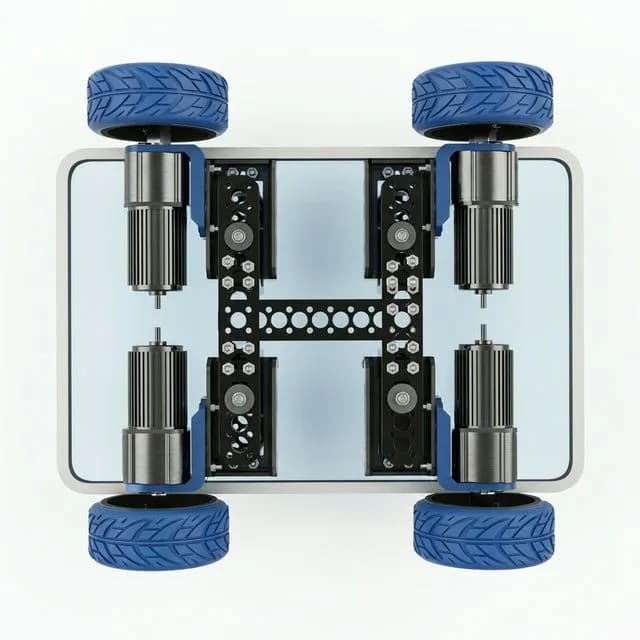
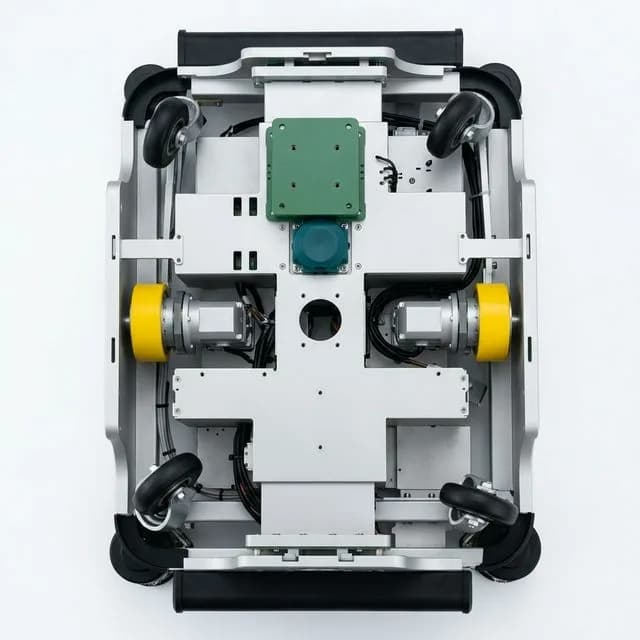

AGV Chassis Design Workflow
Use the calculator as the first gate, then convert the result into a controlled design workflow. The table below separates decisions that can be made from public project inputs from decisions that need supplier drawings, testing, or paid standard review.
| Phase | Decision to Make | Required Output |
|---|---|---|
| 1. Mission envelope | Freeze payload mass, loaded CG height, route speed, ramp grade, stop distance, floor joints, and duty cycle before choosing a wheel layout. | Input sheet with payload, CG envelope, floor map, maximum speed, route constraints, and charging window. |
| 2. Layout selection | Choose differential, tricycle, quad steer-drive, or omni/mecanum based on aisle width, turning requirement, docking accuracy, and traction reserve. | Kinematic layout, drive wheel count, caster count, estimated turning envelope, and control complexity note. |
| 3. Load and traction check | Estimate static wheel reactions first, then test worst-case acceleration, braking, ramp, and floor-joint cases where one wheel may unload. | Wheel-load table, traction margin, suspension or floating-axis decision, and tire material shortlist. |
| 4. Mechanical package | Size wheelbase, track width, ground clearance, frame height, battery bay, lift points, service access, and cable routing together. | Concept drawing package with chassis envelope, drive module interface, battery location, and maintenance clearances. |
| 5. Verification plan | Connect the concept to safety, braking, stability, EMC, ingress protection, thermal, and acceptance-test requirements before procurement. | Supplier RFQ package, validation checklist, risk register, and unresolved assumptions list. |
Drive Kinematics Comparison
The layout of drive and caster wheels (AGV chassis designs) determines the vehicle's maneuverability, traction, and control complexity.
| Kinematic Model | Maneuverability | Traction & Payload | Control Complexity | Best For |
|---|---|---|---|---|
| Differential Drive | Zero-radius turn, cannot strafe | Good (if payload centered over drive axis) | Low | Standard warehousing, tuggers |
| Tricycle | Car-like steering, larger turning radius | High (drive wheel loaded directly) | Medium | Heavy payload transport, forklifts |
| Quad (Steer/Drive) | Holonomic-like, crab steering | Excellent (load distributed on 4 motors) | High | Ultra-heavy loads, aerospace |
| Omni/Mecanum | True holonomic (strafe, rotate freely) | Lower (rollers suffer on rough terrain) | Medium-High | Tight spaces, precision docking |
Supplier Handoff Checklist
A chassis calculator is only useful if it produces a better RFQ. Include these items when turning an AGV chassis designs concept into a supplier review package.
| Specification Item | What to Include | Why It Matters |
|---|---|---|
| Payload and CG | Maximum payload, empty vehicle mass estimate, loaded CG height and offset range, pallet or fixture dimensions. | Prevents a chassis that carries the weight but fails traction, tip-over, or braking checks. |
| Floor and route | Floor type, joint gap, ramp grade, wet/dry state, debris exposure, aisle width, docking tolerance, and turn points. | Separates clean indoor AGV chassis designs from rough-floor or outdoor designs that need larger wheels and suspension. |
| Motion profile | Target speed, acceleration, deceleration, stop accuracy, cycle count, continuous run time, and charging strategy. | Connects motor power, gearbox ratio, thermal load, braking distance, and battery packaging. |
| Drive-wheel interface | Wheel diameter target, tire material, encoder or brake needs, mounting pattern, cable exit, and service replacement access. | Avoids late frame changes when the selected drive wheel or steer-drive module does not fit the chassis bay. |
| Safety and evidence file | Applicable standard version, project jurisdiction, validation owner, test method, and assumptions still awaiting confirmation. | Keeps concept sizing separate from certified design release and makes audit gaps visible early. |
Risk Boundaries and Mitigations
| Risk | When It Appears | Mitigation | Fallback Path |
|---|---|---|---|
| Tip-over or unstable braking | Tall payloads, narrow track width, speed above 1.0 m/s, emergency stops, or cornering on slopes. | Validate braking distance and loaded CG dynamically per ISO 3691-4. Lower CG, widen track width, or cap maximum speed. | Move to a 4-wheel steer/drive or wider tricycle base. |
| Lost traction on drive wheels | Rigid differential layouts where floor joints or ramps cause one drive wheel to lift and spin freely. | Implement shock-absorbing floating structures, rocker arms, or active suspension to maintain continuous ground contact and normal-force margin, then verify the model with project-specific wheel-load and floor-joint tests. | Move to a tricycle layout where the drive wheel is directly loaded. |
| Dynamic clearance trapping hazards | Suspension travel lowers the chassis under heavy payload or braking, creating a risk of crushing or foot-trapping. | Assess the dynamic clearance range under worst-case loading. Ensure safety laser scanners cover the lowest plane (ISO 3691-4). | Increase static ground clearance or stiffen suspension (at the cost of traction capability). |
| Caster flutter (shimmy) | Speeds > 1.0 m/s on smooth floors where the caster's natural frequency matches floor vibration. | Reduce swivel lead offset, upgrade to kingpinless precision bearings, or use high-rebound polyurethane wheels. | Use active dampening or switch to fixed wheels (requires different kinematics). |
| Environment mismatch | Outdoor or rough floors selected with small wheels (<150mm), low clearance, or mecanum rollers (which wear rapidly). | Increase wheel diameter, add sealing/IP rating, and perform physical tests on the actual floor surface. | Switch from omni/mecanum to differential or heavy-duty steer-drive modules. |