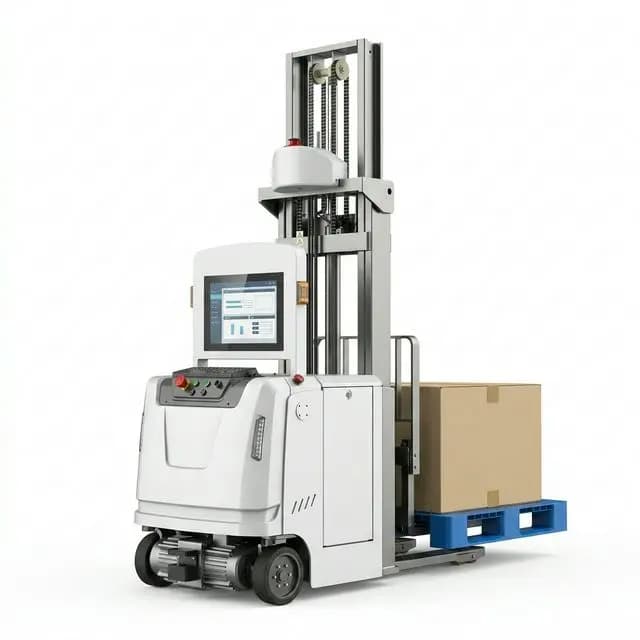
AGV Warehouse Automation & AGV in Intelligent Warehouse ROI
Evaluate the business case for an AGV in intelligent warehouse operations. Input your manual labor costs to generate a baseline fleet size and ROI payback period.
Canonical intent
agv warehouse automation
Alias covered
agv in intelligent warehouse
Route policy
single canonical URL
This page keeps "agv in intelligent warehouse" and "warehouse agv automation" on the same AGV warehouse automation URL because both searches need the same answer: fleet sizing, ROI payback, integration scope, and validation risk.
Optimize workflows before automating.
High utilization is required for payback.
Standardization has limitations.
ROI Tool
Local calculation only.
The number of forklift or tugger drivers working on material transport simultaneously.
Includes wages, benefits, taxes, and overhead per operator.
The numbers show a strong theoretical business case for AGV warehouse automation. Proceed with a formal RFQ.
Recommended next step
Request a detailed simulation mapping from a supplier.
Screening estimate only. Final AGV warehouse automation ROI needs route simulation, safety review, WMS scope, and supplier pricing.
Key Findings: AGV in Intelligent Warehouse Architecture
Transitioning to AGV warehouse automation requires both physical integration and intelligent software orchestration. Based on industry data (e.g., MHI, IFR), here are the core takeaways for evaluating a deployment.
Optimize workflows before automating.
Deploying an AGV in intelligent warehouse operations requires resolving manual workflow inefficiencies first. Mapped routes, exception ownership, and repeatable pickup/drop-off rules should precede equipment selection.
High utilization is required for payback.
The most defensible ROI for AGV warehouse automation usually comes from multi-shift labor replacement. Single-shift automation often needs a safety, damage, precision, or labor-availability case in addition to labor savings.
Standardization has limitations.
While VDA 5050 ensures basic communication interoperability, it does not dictate internal safety protocols or advanced route logic. Achieving "plug-and-play" behavior in multi-vendor fleets still requires significant commissioning and debugging.
Software dictates physical throughput.
An AGV requires continuous mission generation from the WMS or ERP. Without low-latency network infrastructure (e.g., 5G/Wi-Fi 6) and tight API integration, vehicles will sit idle waiting for manual triggers.
Evidence, Assumptions & Limits
The tool layer gives a quick AGV warehouse automation screen. The report layer explains what the screen can and cannot prove. Source checks and model assumptions are dated 2026-07-25.
| Source | Evidence Used | Decision Use | Limit |
|---|---|---|---|
| S1. MHI warehouse automation readiness Checked 2026-07-25 | Warehouse automation should follow a mapped, measurable process problem instead of automating an unstable manual workflow. | Use before RFQ to decide whether the transport route needs redesign before AGV selection. | Readiness guidance, not a supplier quote, safety assessment, or route simulation. |
| S2. IFR World Robotics 2025 Checked 2026-07-25 | Transportation and logistics remains a major professional service-robot use case, with 102,900 units sold in 2024 and 14% growth reported by IFR. | Use as adoption context for intelligent warehouse material flow, not as a site-specific ROI proof. | The category includes more than this exact AGV warehouse automation scenario. |
| S3. VDA 5050 Checked 2026-07-25 | VDA lists version 3.0.0, dated March 2026, as the current recommendation for mobile-robot to master-control communication. | Use to frame master-control integration and mixed-fleet communication requirements. | It does not replace site safety engineering, route logic, or vendor commissioning. |
| S4. ISO 3691-4:2023 Checked 2026-07-25 | The driverless industrial truck standard is relevant to safety requirements and verification planning. | Use to separate ROI screening from mandatory safety and risk-assessment work. | Access to full standard text and local regulatory review may be required. |
| S5. This calculator model Checked 2026-07-25 | The model uses labor cost, shifts, a generic AGV unit-cost placeholder, and annual maintenance placeholder. | Use for early screening and vendor conversation prep. | It excludes facility modifications, WMS work, chargers, floor marking, safety validation, and service contract differences. |
| Calculator Assumption | Value | Why It Matters |
|---|---|---|
| Operating calendar | 250 working days/year, 8 hours/shift | Keeps the calculator simple and comparable across shift patterns. |
| Fleet sizing heuristic | ceil(manual operators per shift x 1.2) | Treats the output as an initial fleet count for simulation, not a final layout design. |
| AGV capex placeholder | $60,000 per vehicle | A conservative screening number for basic material-transport ROI discussion. |
| Annual maintenance placeholder | $3,000 per vehicle/year | Subtracts recurring fleet cost before calculating payback. |
| Excluded from payback | Charging, floor work, WMS/API work, safety validation, spares | These items vary by site and must be quoted or simulated before purchase approval. |
Fit Scenarios & Alternatives
Use these scenarios to decide whether the calculator result should move to simulation, process redesign, or a different automation option.
| Scenario | Fit | Next Decision |
|---|---|---|
| Two- or three-shift pallet transfer loop | Strong candidate | Run route simulation after confirming WMS mission release and charging windows. |
| Single-shift warehouse with low transport volume | Caution | Use the calculator to test payback, then look for safety, damage, or labor-scarcity benefits. |
| Narrow aisles with frequent manual forklift crossings | Needs redesign | Separate traffic, define crossings, and pilot blocked-route recovery before scaling. |
| Option | Best For | Tradeoff |
|---|---|---|
| AGV | Predictable pallet, cart, or tugger routes | Strong repeatability but sensitive to traffic rules and route discipline. |
| AMR | Changing routes, tote movement, or flexible picking support | More dynamic navigation, but payload and fleet-control scope must be checked. |
| Conveyor | Fixed high-volume lanes | High throughput, but layout changes are harder and capex can be less flexible. |
| Manual forklift | Low-volume, irregular, or exception-heavy movement | Flexible, but labor cost, safety exposure, and process variation remain. |
Implementation Risks & Mitigations
| Risk Category | Trigger Condition | Mitigation Strategy |
|---|---|---|
| Traffic Congestion | Mixing manual forklifts and AGVs in the same narrow aisles. | Implement one-way lanes or segregate automated zones entirely. AGV safety scanners will always yield, causing throughput drops if traffic is unmanaged. |
| VDA 5050 Latency | Inconsistent message validation across different PLC hardware in a mixed fleet. | Standardize on robust, low-latency network infrastructure (e.g., private 5G) and perform rigorous compliance testing before scaling the fleet. |
| Exception Handling | Damaged pallets or unreadable barcodes stalling the AGV. | Maintain a designated human exception-handler to quickly clear jams. Do not expect AGVs to improvise solutions for malformed loads. |
Frequently Asked Questions
Move from ROI screen to warehouse route validation.
Send shift count, route map, transport volume, payload details, and WMS scope so the first supplier conversation starts with evidence instead of generic fleet sizing.
Published 2026-07-25 · Updated 2026-07-25
Related AGV automated guided vehicle engineering resources
Continue researching high-load wheel modules, forklift integrations, and system safety checklists.