310mm Mecanum Wheel Forklift Checker and Decision Report
This single canonical page answers 310mm mecanum wheel forklift intent with an executable fit-check tool first, then evidence, boundaries, and risk controls.
10 public sources checked on 2026-05-03
Added regulatory gates + load-center derating evidence
3 pending items kept explicit (no forced conclusion)
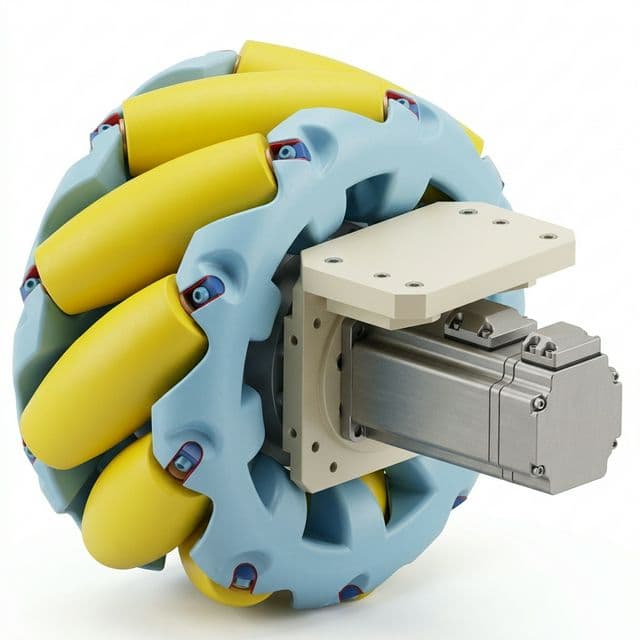
Empty state: run the checker to generate your 310mm adaptation result.
Baseline preview below uses conservative default forklift assumptions.
Drive-axle mass
2,604 kg
Dynamic load per wheel
1,291 kg
Load utilization
143.4%
Diameter delta
5.2 mm
Clearance risk index
0 / 100
Slip risk
High (Radius checked; chassis geometry partly verified)
Current profile exceeds safe adaptation envelope for standard 310 mm mecanum retrofit assumptions.
310 mm equals 310.0 mm (12.20 in). Baseline comparison uses 304.8 mm (12 in exact).
Report Summary: Decision Snapshot
Updated 2026-05-03Load utilization > 100% or severe clearance deficiency
Calibration work alone cannot offset fundamental mechanical overload
Uses 304.8 mm baseline and exact inch-mm conversion anchor
Relative indicator for route stress and slip propensity
- Indoor forklift platforms with known floor quality and measurable duty cycle.
- Teams needing a rapid go/pilot/redesign decision before detailed RFQ.
- Integration workflows that can provide controller geometry calibration evidence.
- Scenarios expecting compliance sign-off from this page without formal safety process.
- Outdoor or highly variable routes where floor and traction statistics are unknown.
- Profiles with severe overload or tight clearance that require immediate architecture redesign.
Stage1b Audit: Gap Closure
Research enhancement complete (pending items explicit)| Gap | Decision impact | Stage1b update | Status |
|---|---|---|---|
| No explicit legal gate for forklift modification sign-off was visible in the previous stage1 content. | Teams could move from checker output to implementation without documented manufacturer/QRPE approval logic. | Added 1910.178(a)(4), 1910.178(q)(6), and OSHA interpretation fallback pathway as explicit decision gates. | Closed |
| Ramp and grade handling lacked a standards-linked threshold. | Users could treat a 10%+ grade as just another numeric input, not an operational control trigger. | Added 1910.178(n)(7)(i) (>10% grade load-upgrade rule) and daily/shift inspection references for operations gating. | Closed |
| Load-center shift effect was not quantified in the report layer. | Procurement could overestimate allowable payload when attachments move the load center forward. | Added OSHA Appendix A load-moment example (72,000 in-lb baseline -> 2400 lb at 30 in load center) and linked it to pilot/redesign decisions. | Closed |
| 6-wheel configuration was accepted by the tool without an explicit controller-scope warning. | Readers could assume public 4-wheel controller guidance transfers directly to 6-wheel implementations. | Added a dedicated boundary warning for 6-wheel inputs and marked custom kinematic validation as mandatory. | Closed |
| No reliable public benchmark defines a universal slip/drift pass threshold for forklift-grade mecanum duty. | Readers may expect a single public KPI threshold that does not currently exist in open standards/docs. | Kept this item explicitly open and provided minimum telemetry evidence requirements instead of hard-coded false certainty. | Pending confirmation |
Methodology and Evidence
1) Drive-axle mass = gross mass x drive-axle share.
2) Dynamic load per wheel = static load x floor factor x ramp factor x safety factor.
3) Utilization = dynamic load / rated per-wheel load.
4) Adapt class combines utilization, clearance risk, and calibration-aware slip risk.
| Assumption | Default | Boundary note |
|---|---|---|
| Baseline diameter | 304.8 mm (12 in) | Exact unit anchor; fit still depends on tolerance stack |
| Ramp factor | 1 + ramp% x 0.02 | Conservative approximation for pre-screen only |
| Grade governance threshold | >10% loaded grade | 1910.178 requires load-upgrade handling; route to pilot-level controls |
| Floor dynamic factors | 1.08 / 1.18 / 1.32 | Representative envelope, not route-certified measurement |
| Controller scope baseline | 4-wheel mecanum reference stack | 6-wheel layouts require custom kinematics validation |
| Safety factor options | 1.3 / 1.5 / 1.8 | Higher value tightens pass band under uncertainty |
| Source | Decision use |
|---|---|
| NIST Handbook 44 Appendix C (2026) 2026 edition PDF, checked 2026-05-03 | NIST lists 1 inch = 2.54 cm exactly and 1 foot = 0.3048 m exactly, anchoring 310 mm = 12.20 in class conversion. Conversion is exact, but interchangeability still depends on hub geometry and tolerance stack. |
| eCFR 29 CFR 1910.178 (current text) eCFR current through 2026-04-30, checked 2026-05-03 | 1910.178(a)(4) requires prior written manufacturer approval for modifications affecting capacity/safe operation; 1910.178(q)(6) restricts added counterweighting without manufacturer approval. Regulation sets governance gates and minimum practices, not wheel-by-wheel life prediction. |
| OSHA interpretation letter on 1910.178(a)(4) Issued 1997-04-11, corrected 2009-04-07, checked 2026-05-03 | If manufacturer is unavailable or gives no response, OSHA states a Qualified Registered Professional Engineer can provide written approval with safety analysis. This is a fallback pathway, not a shortcut to bypass engineering diligence or nameplate updates. |
| eCFR 1910.178 traveling and maintenance clauses eCFR current through 2026-04-30, checked 2026-05-03 | 1910.178(n)(7) requires slow grade travel, 1910.178(n)(7)(i) specifies load-upgrade driving on grades over 10%, and 1910.178(q)(7) requires at least daily inspections (or per shift for round-the-clock use). Operational controls reduce incident probability but cannot salvage an overload design. |
| OSHA 1910.178 App A stability guidance OSHA page checked 2026-05-03 | Appendix A states many trucks <=30,000 lb are rated at a 24 in load center and gives a worked example: 3000 lb at 24 in => 72,000 in-lb, dropping to 2400 lb allowable at a 30 in load center. Appendix A is non-mandatory guidance, but it provides a transparent load-moment reasoning baseline for pre-screening. |
| ROS2 mecanum_drive_controller user documentation Rolling docs (May 2026) checked 2026-05-03 | Controller scope is four mecanum wheels; parameters include wheels_radius > 0 and lx+ly geometry. reference_timeout resets stale velocity commands. Controller math quality cannot compensate for unsafe mechanical envelopes. |
| ROS package API docs for mecanum_drive_controller Rolling 6.6.0 docs checked 2026-05-03 | The rolling package explicitly describes the implementation as a 4-wheel mecanum controller and publishes rapid 2026 release cadence (6.5.0 on 2026-04-02, 6.6.0 on 2026-04-22). Behavior may shift across minor releases, so project teams should pin tested controller versions. |
| WPILib MecanumDrive API (2026.2.2) WPILib API 2026.2.2 checked 2026-05-03 | Describes the canonical four-corner mecanum layout and states roller axles should form an X pattern. This is a kinematic/orientation reference, not an industrial durability or compliance standard. |
| NEXUS NM305A product page (official) Vendor page checked 2026-05-03 | NM305A is published as a 305 mm class wheel with 3000 kg/set headline capacity. Set-level headline rating does not include duty cycle, route shock, or thermal assumptions. |
| NEXUS NM305B product page (official) Vendor pages checked 2026-05-03 | NM305B is also 305 mm class, but published at 2000 kg/set headline capacity. Diameter class match does not imply identical capacity or lifecycle behavior. |
| Decision question | New data point | Boundary | Action | Sources |
|---|---|---|---|---|
| Can 310 mm be treated as a 12 inch class input in tool formulas? | NIST Handbook 44 Appendix C publishes exact inch-foot metric anchors (1 in = 2.54 cm exact; 1 ft = 0.3048 m exact), placing 310 mm in a 12.20 in class. | Exact conversion does not eliminate mechanical stack-up from hub bore, offset, and roller envelope. | Use 310 mm as diameter input but keep adapter tolerance validation mandatory before release. | NIST Handbook 44 Appendix C (2026), checked 2026-05-03 |
| What approval path is required before forklift wheel adaptation is implemented? | 1910.178(a)(4) requires prior written manufacturer approval for capacity-impacting modifications; OSHA interpretation allows QRPE written approval when manufacturer path is unavailable. | This gate governs legal/safety process but does not replace mechanical and control validation testing. | Treat manufacturer/QRPE approval + nameplate update as mandatory artifacts before PO release. | eCFR 1910.178(a)(4), OSHA interpretation letter 1997-04-11 (checked 2026-05-03) |
| How should slope and operating checks affect go/pilot/redesign decisions? | 1910.178(n)(7) requires slow grade travel; for grades >10%, loaded trucks must be driven with load upgrade; 1910.178(q)(7) requires at least daily inspections. | Operational rules lower misuse risk but cannot make an overload design acceptable. | Keep ramp/floor as required tool inputs and escalate >10% grade cases to pilot-required or redesign governance. | eCFR 1910.178(n)(7), 1910.178(q)(7) (checked 2026-05-03) |
| How much can load-center shift change allowable capacity? | OSHA Appendix A provides a worked load-moment example: 3000 lb at 24 in load center -> 72,000 in-lb, which drops allowable load to 2400 lb at a 30 in center. | Appendix A is non-mandatory guidance, but the load-moment logic is still useful for conservative screening. | When attachment geometry pushes load center outward, down-rate capacity and route borderline cases to pilot/review. | OSHA 1910.178 App A, checked 2026-05-03 |
| Can 6-wheel profiles reuse public 4-wheel mecanum controller assumptions? | ROS package/API explicitly scopes mecanum_drive_controller to 4-wheel drive; user docs define 4 wheel command joints and geometry parameterization for that model. | 6-wheel mechanical layouts can still be valid, but public controller references here are not sufficient by themselves. | Keep 6-wheel option for pre-screening, but require custom kinematic model validation and controller version pinning. | ROS2 mecanum_drive_controller docs + rolling package API/changelog (checked 2026-05-03) |
| Are headline vendor load capacities enough to finalize adaptation decisions? | Official NEXUS 305 mm models publish different set-level ratings (NM305A 3000 kg/set vs NM305B 2000 kg/set) despite same diameter class. | Set-level marketing ratings do not include route shock, duty cycle, and thermal drift assumptions. | Use model-specific supplier test evidence and pilot telemetry, not diameter-level generic claims. | NEXUS NM305A/NM305B product pages (checked 2026-05-03) |
| Gate | Requirement | Engineering consequence | Source |
|---|---|---|---|
| Modification approval gate | Capacity/safe-operation affecting changes require prior written manufacturer approval. | No approval artifact -> do not treat adaptation result as implementation-ready. | 29 CFR 1910.178(a)(4) |
| Fallback approval gate | If manufacturer path is unavailable, OSHA interpretation accepts qualified registered professional engineer written approval with safety analysis. | Include QRPE sign-off package before procurement lock if OEM path cannot be executed. | OSHA interpretation letter (1997-04-11, corrected 2009-04-07) |
| Grade operation gate | Grades must be ascended/descended slowly; for >10% grades, loaded trucks are driven with load upgrade. | Treat >10% ramp cases as high-governance scenarios even when utilization appears passable. | 29 CFR 1910.178(n)(7) and (n)(7)(i) |
| Unsafe condition gate | Unsafe trucks must be removed from service and not placed back until corrected; inspections at least daily (or each shift for round-the-clock use). | Pilot plan must include inspection cadence and explicit stop criteria. | 29 CFR 1910.178(q)(1) and (q)(7) |
| Load-center derating gate | Load center shifts reduce allowable load moment (Appendix A worked example: 72,000 in-lb baseline reduces allowed load to 2400 lb at 30 in center). | Any attachment moving load center forward must trigger capacity down-rating review. | OSHA 1910.178 App A (A-5.2/A-5.3) |
| Question | Why pending | Minimum evidence to close | Status |
|---|---|---|---|
| What universal slip-event threshold should define pass/fail for forklift-grade mecanum routes? | No reliable open standard/public benchmark found that provides a one-size-fits-all numeric threshold. | At least one full-shift dataset with slip count, wheel current, thermal trend, and route shock annotation. | Pending confirmation |
| What public lifecycle benchmark proves 305-310 mm class mecanum durability under heavy forklift duty? | Public vendor pages provide set-level load ratings but not comparable lifecycle test protocols. | Supplier fatigue protocol + mission-profile equivalent cycle count + pass/fail criteria in writing. | Pending confirmation |
| Can a generic open-source controller profile be reused safely for 6-wheel forklift mecanum geometry? | Public ROS references in this stack are explicitly scoped to 4-wheel mecanum implementations. | Custom kinematic model validation report plus route replay error and stability traces. | Pending confirmation |
Comparison and Risk Controls
| Option | Typical lead time | Risk level | Best fit | Evidence boundary |
|---|---|---|---|---|
| Direct fit integration | 2-4 weeks | Low-Medium | Known route + commissioned geometry | Internal planning heuristic only; no reliable public benchmark dataset found |
| Adapter retrofit | 4-7 weeks | Medium | Near-boundary load or clearance envelope | Lead-time value is internal estimate; external public benchmark unavailable |
| Pilot before release | 6-10 weeks | Medium-High | High utilization, rough floor, or partial calibration | Pilot telemetry is mandatory; lead-time range remains an internal estimate |
| Custom redesign | 10-16 weeks | High | Overload or severe clearance conflict | Requires supplier engineering package; no public cross-vendor benchmark for redesign duration |
| Class | Load boundary | Calibration boundary | Action |
|---|---|---|---|
| Direct fit candidate | Load utilization <= 65% with controlled floor envelope | Commissioned geometry strongly recommended before production release | Proceed to RFQ with full mission dataset and supplier drawings. |
| Adapter fit candidate | Load utilization 66%-85% or geometric margin near caution | Controller commissioning cannot remain partial | Run adapter design review and verify bearing life model. |
| Pilot required before PO | Load utilization 86%-100% or high floor/ramp stress | Uncalibrated controller state is not acceptable for deployment sign-off | Run instrumented pilot with current, slip, and thermal logging. |
| Not recommended without redesign | Load utilization > 100% or severe clearance deficiency | Calibration work alone cannot offset fundamental mechanical overload | Escalate to custom wheel module and chassis-layout redesign. |
| Risk | Trigger | Mitigation |
|---|---|---|
| Misuse risk | Treating checker output as compliance approval | Use formal safety workflow and standards review path |
| Compliance gate miss | Retrofit changes proceed without manufacturer or QRPE written approval package | Block implementation until approval artifacts and updated data plate records are complete |
| Overload risk | Dynamic load utilization exceeds 100% | Move directly to custom redesign branch |
| Calibration risk | Uncalibrated radius/geometry in mecanum controller | Commission parameters before production decision |
| Floor mismatch risk | Jointed or rough route modeled as flat | Default to conservative profile and remeasure route |
| Evidence inflation risk | Vendor listing values treated as lifecycle proof | Require pilot telemetry and supplier test reports |
| Scenario drift risk | Peak season duty not included in baseline check | Run stress scenario C before procurement lock |
Scenario Examples
Dynamic load/wheel: 835 kg
Utilization: 92.8%
Slip risk: Low
Adapt class: Pilot required before PO
Dynamic load/wheel: 1,388 kg
Utilization: 146.1%
Slip risk: High
Adapt class: Not recommended without redesign
Dynamic load/wheel: 2,520 kg
Utilization: 280.1%
Slip risk: High
Adapt class: Not recommended without redesign
| Scenario | Gross mass | Floor | Ramp | Dynamic load/wheel | Utilization | Class |
|---|---|---|---|---|---|---|
| Retrofit A: Balanced indoor aisle | 3,800 kg | Flat sealed concrete | 4.0% | 835 kg | 92.8% | Pilot required before PO |
| Retrofit B: Mixed dock transitions | 4,300 kg | Jointed concrete with transitions | 7.0% | 1,388 kg | 146.1% | Not recommended without redesign |
| Retrofit C: High-throughput rough lane | 5,200 kg | Rough floor or dock lips | 10.0% | 2,520 kg | 280.1% | Not recommended without redesign |
Stage1c Review and Self-Heal
Gate status: blocker 0, high 0 (pass)Blocker
0
High
0
Medium
0
Low
0
| Severity | Finding | Status | Self-heal evidence |
|---|---|---|---|
| blocker | No blocking interaction or safety-break issue found in stage1b verification. | fixed | Tool input/output/error/empty/boundary states remain operational. |
| high | Regulatory approval gates were not explicit enough for forklift retrofit decisions. | fixed | Added compliance gate matrix with 1910.178(a)(4)/(n)(7)/(q)(1)/(q)(7) and OSHA interpretation fallback. |
| high | Controller applicability boundary for 6-wheel configurations was unclear. | fixed | 6-wheel inputs now force at least pilot-required class with low confidence, plus explicit boundary warning tied to public 4-wheel controller scope. |
| high | Result cards could drift from current form selections because some boundary text used live form values instead of the last evaluated input. | fixed | Added evaluated-input snapshot binding, stale-result warning, and calculation-time input lock to keep decision output consistent. |
| medium | Load-center derating logic existed implicitly but lacked a numeric worked example. | fixed | Added OSHA Appendix A example (72,000 in-lb -> 2400 lb at 30 in load center). |
| low | Evidence section mixed high-trust and low-trust signals without explicit uncertainty rows. | fixed | Added pending-question table with explicit "Pending confirmation" status and minimum evidence requirements. |
Decision FAQ
Group 1: sizing and fit
Group 2: control and integration
Group 3: risk and procurement
Total questions: 15
Action Layer: Move from check to execution
Use this output to align engineering and sourcing. If your profile lands in pilot or redesign class, do not skip validation steps.
Related engineering resources
Continue with wheel selection boundaries, forklift load baseline, and direct RFQ action links.