Four decisions before contacting AGV motor suppliers
01Compare the same assembly boundary
An integrated controller, a motor-wheel and a complete AGV system are different purchases. List the wheel, reducer, drive and brake separately in each quote.
Evidence: Nanotec distinguishes modular WD and integrated WD42 products; the SEW brochure describes a system offering. Check the source
02A battery voltage label needs an exact order code
Match the full battery operating window and regeneration behavior. The Lenze i550 motec example is excluded because its documented input is AC mains.
Evidence: Lenze lists three-phase AC input; the Oriental Motor brochure distinguishes battery-voltage variants. Check the source
03Use tested thermal ratings for your installation
Ingress protection does not determine chassis temperature. Request a torque-speed envelope and temperature-rise test for the actual mounting and duty cycle.
Evidence: The maxon IDX sheet gives different nominal torque values at 25°C and 40°C for a specific drive. Check the source
04An interface name does not make a second source interchangeable
Bench-test the required drive modes, PDO mapping, encoder direction and fault recovery before accepting a substitute.
Evidence: CiA identifies optional functions and partial implementations as limits to device exchangeability. Check the source
How the shortlist works
The tool checks the documented assembly type and removes explicit family-level voltage or power conflicts. Missing limits remain unknown; they never count as confirmed support. Candidates keep directory order. Application, interface, environment, safety, quantity and schedule tailor the open checks and RFQ; they do not establish compatibility or a price. The input range is a tool boundary, not a product availability claim.
1. Describe the operating duty
2. Check the linked product scope
3. Validate the exact order code
4. Test before production release
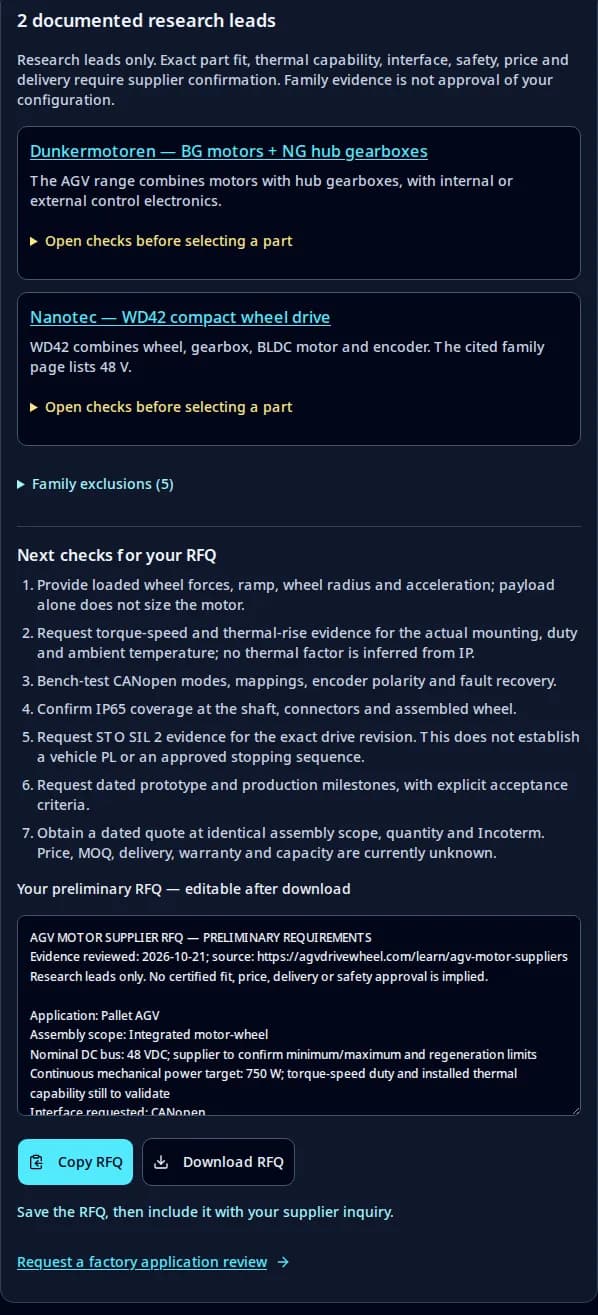
This page supports the first two steps. Supplier engineering and vehicle validation complete the last two.Reproduced tool output: integrated motor-wheel, 750 W, 48 V, CANopen, IP65, STO SIL 2 evidence requested. Generate the default example to reproduce two research leads. This screenshot documents software behavior; motor fit, safety, pricing and supplier endorsement remain unverified.
AGV motor supplier directory: documented scope & unknowns
Seven evidence entries, including two scope exclusions. Compare a named product family, then obtain the exact part specification. Table content scrolls horizontally on small screens.
Manufacturer evidence reviewed 2026-10-21; no price or lead-time inference
The i550 motec product page lists three-phase AC mains inputs, rather than a 24/48/72 V battery input.
The cited i550 motec is an AC mains inverter; it is excluded from this low-voltage DC research tool.
Choose an assembly boundary before comparing quotes
Engineering interpretation: trade-offs depend on the selected assembly
Assembly
Reason to investigate
Work the buyer still owns
Integrated motor-wheel
Fewer mechanical interfaces to specify
Wheel load, tire, brake, gearbox and service access still need evidence
Modular BLDC
Separate choice of reducer, wheel and driver
Buyer owns shaft alignment, controller tuning and interface verification
Servo + gearbox
Useful research path for controlled motion axes
Check encoder/drive pairing and reflected inertia for the actual mechanism
Stepper axis
Potential research path for positioning duties
No stepper family verified in this directory; request load/speed evidence before selection
Thermal evidence: retain the test conditions
The maxon IDX 56 S data below illustrates why operating conditions matter. These are manufacturer values for one drive family, not a derating curve for all AGV motors. The tool does not extrapolate from them.
Manufacturer sheet, provisional drive-data table (PDF p.4). Obtain the full permissible operating envelope and mounting conditions for your order code. IP65/IP67, insulation class and cold-operation limits answer different questions.
Knowns, unknowns and acceptance evidence
Buyer acceptance plan; no unknown is treated as a pass
Decision
Known boundary
Unknown for your vehicle
Minimum next check
Thermal fit
Catalog ratings apply under stated test conditions
Temperature, mounting and duty in your chassis
Request a representative thermal-rise test and manufacturer derating curve
Safety and braking
STO availability may be stated for a drive variant
Vehicle stopping performance and required safety architecture
Obtain safety manual, certificate scope and assessor-approved loaded stopping tests
Environmental fit
IP is an ingress classification
Cold starts, condensation, lubricants and tire behavior
Specify temperature range and separate cold/condensation tests
Communication
Product family may list the required fieldbus
Exact mode support, timings and fault behavior
Test EDS/ESI files and recovery on the target master
Commercial terms
Published family descriptions identify research leads
Current price, stock, MOQ, warranty and production capacity
Obtain a dated quote with Incoterm, currency and committed milestones
There is no verified cross-vendor price dataset for this page. Calculate your comparison from dated quotes: quantity × recurring assembly price + one-time engineering + freight/duties + commissioning + documented service costs. Record inventory carrying cost separately from stock value to avoid double counting.
Require every quote to include or explicitly exclude each item
Engineering
Adapters, tooling, firmware and commissioning
Separate one-time NRE from recurring unit price
Delivery
Freight, duties, tax and acceptance testing
Use the same Incoterm and destination
Operations
Spares, service labor and documented failure assumptions
Use your fleet data; do not invent vendor failure rates
Inventory
Carrying cost of committed buffer stock
Treat inventory cash and consumed service costs separately
Misuse, cost and scenario risks
Qualitative procurement risks and actions; not measured failure probabilities
Risk
Consequence
Mitigation / alternative
Misuse: watts treated as final selection
A required torque-speed point may lie outside the installed operating envelope
Supply a duty trace and use supplier engineering; start with the motor-sizing guide
Safety: component certificate treated as vehicle approval
Stopping, holding and fault behavior remain unvalidated
Have the assessor define the required functions and verify the assembled vehicle
Cost: unlike quote scopes
An apparently cheap motor omits reducer, brake, cables or commissioning
Request an included/excluded list; compare complete assemblies or separate the same items
Scenario mismatch: wet or cold duty
Ingress rating alone leaves temperature and condensation unproven
Add cold-start and condensation acceptance tests or select a documented environmental variant
Single-source interface
An alternate drive requires controller changes
Bench-test the alternate before production and preserve parameter/configuration exports
Three illustrative sourcing workflows
Examples explain a decision process. They are not customer deployments or measured commercial outcomes.
Pallet AGV: an integrated-wheel research path
Premise: Illustrative workflow: 48 V battery, integrated motor-wheel and a preliminary 750 W target.
Process: Review the Dunkermotoren and Nanotec assembly boundaries, then request wheel torque at travel speed, bearing load and controller details.
Output / limit: A supplier question list, not an approved motor. Payload alone cannot establish a motor power requirement.
Tote AMR: compare modular drive options
Premise: Illustrative workflow: 24 V battery, modular BLDC and a preliminary 200 W target.
Process: Use the maxon IDX and Oriental Motor BLV documents to identify candidate variants; specify gearbox and wheel interfaces separately.
Output / limit: Comparable assembly quotes and a controller bench-test plan; no price or energy-saving outcome is assumed.
Forklift: validate the safety concept first
Premise: Illustrative workflow: loaded slopes, high inertia and a power-loss holding requirement.
Process: Ask the vehicle assessor to define the required functions, then obtain brake, drive and vehicle-level validation evidence.
Output / limit: An acceptance plan with unresolved safety items. This tool cannot calculate a certified stop distance or select a safety architecture.
Before releasing a production order
Freeze motor, drive, firmware, reducer, encoder, brake and tire part numbers. Attach the mechanical drawing and full battery operating window.
Approve torque-speed and thermal-rise reports at representative mounting, duty and ambient conditions.
Have the safety assessor approve the evidence and loaded stopping/holding tests for the vehicle application.
Run the target fieldbus master, record modes and fault recovery, and archive EDS/ESI files and commissioning settings.
Agree sample and production acceptance criteria, traceability, change control, warranty and dated delivery milestones.
Sources, editions and evidence limits
Manufacturer sources are linked at each directory entry. The standards catalogue links below establish public scope and edition information. Full clauses, legal applicability and exact certificates require separate review. Reviewed ; confirm revisions when placing an order.
Safety requirements and verification for driverless industrial trucks and their systems.
Limit: The public abstract establishes scope, not a universal brake sequence or legal obligation in every market. Confirm the applicable edition and full requirements with the vehicle safety assessor.
Rating and performance of rotating electrical machines; motor component scope for integrated power drives.
Limit: The catalogue lists a 2026 edition. Its scope does not establish a motor-specific thermal curve; request installation and duty limits from the manufacturer.
Design principles for safety-related parts of control systems.
Limit: The required performance level follows the application assessment. SIL and PL are distinct measures and must not be treated as interchangeable labels.
Standardized drive behavior, operating modes and process data.
Limit: CiA explicitly describes limits to interchangeability from optional or partial implementations. Validate modes, mappings and fault handling on your controller.
AGV motor supplier FAQ
Shortlisting and evidence
Which AGV motor suppliers should I investigate?
Start from the assembly you need. This curated directory links manufacturer evidence for maxon, Dunkermotoren, Nanotec, Oriental Motor, Leadshine and SEW-EURODRIVE. It includes a Lenze scope exclusion. It is not an exhaustive market ranking or an approved vendor list.
Does a research lead mean that the motor fits?
No. The tool filters documented product families by architecture and excludes explicit voltage or power conflicts. Unpublished limits stay unknown. Exact order-code, torque-speed, thermal, brake, interface and commercial checks remain open.
Why can a supplier disappear from the results?
The cited family may not document your selected architecture, or its published voltage or power range may conflict with your request. Exclusions apply only to the cited family and do not establish the limits of the entire supplier.
Is this supplier comparison independent?
AGV Drive Wheel publishes this page and offers motor-wheel sourcing services. Manufacturer links support specific product descriptions, not an endorsement of this publisher. The tool applies no publisher bonus and makes no price-based ranking.
Engineering boundaries
Can power in watts select an AGV motor?
No. Power is a preliminary RFQ field. Selection needs torque at speed, wheel radius, gearing, efficiency, load distribution, acceleration, slope, duty and temperature. Use the linked motor-sizing guide and validate the resulting operating points with the supplier.
Does IP65 or IP67 specify a thermal derating factor?
No. Ingress protection does not determine chassis temperature or cooling. Use manufacturer curves and a representative installation test. This tool deliberately produces no thermal factor from an IP selection.
Does a motor STO certificate certify the AGV?
No. Component evidence must be integrated into the vehicle safety concept. Obtain the selected drive manual, certificate scope, brake behavior and system validation; the applicable requirements depend on the application assessment.
Are CANopen drives automatically interchangeable?
No. CiA describes limits caused by optional functions and partial implementations. Verify required modes, mappings, homing, feedback scaling and fault recovery on your controller.
RFQ and purchasing
What should a comparable RFQ include?
State the exact assembly boundary, DC bus window, torque-speed duty, thermal conditions, interface, safety evidence, quantity and requested delivery date. Require explicit exclusions, a dated quote and measurable acceptance criteria.
Where are the supplier prices and lead times?
They remain unverified until a dated supplier quote is received. This page does not infer them from brand, region or annual quantity. Compare offers at the same scope, Incoterm, currency and date.
What if the shortlist is empty?
Keep the current RFQ, review the family-level exclusion reasons and request an application review. Broaden the assembly choice only if your engineering team accepts the integration work. An empty result is not proof that no supplier can build the requirement.
Can I use the tool without clipboard permission?
Yes. The RFQ stays visible in a selectable text area and can be downloaded as a text file. A failed clipboard write shows a manual-copy message and selects the text instead of reporting success.
Turn your requirements into a supplier inquiry
Generate and save the RFQ above, add your duty cycle and drawing, then request a dated application review. For motor sizing or factory qualification, use the adjacent guides below.