AGV Motor Factory Sourcing & Evaluation
Evaluate an AGV motor factory by design capability, validation stage and purchasing evidence. Build an audit brief for your project.
Your result starts here
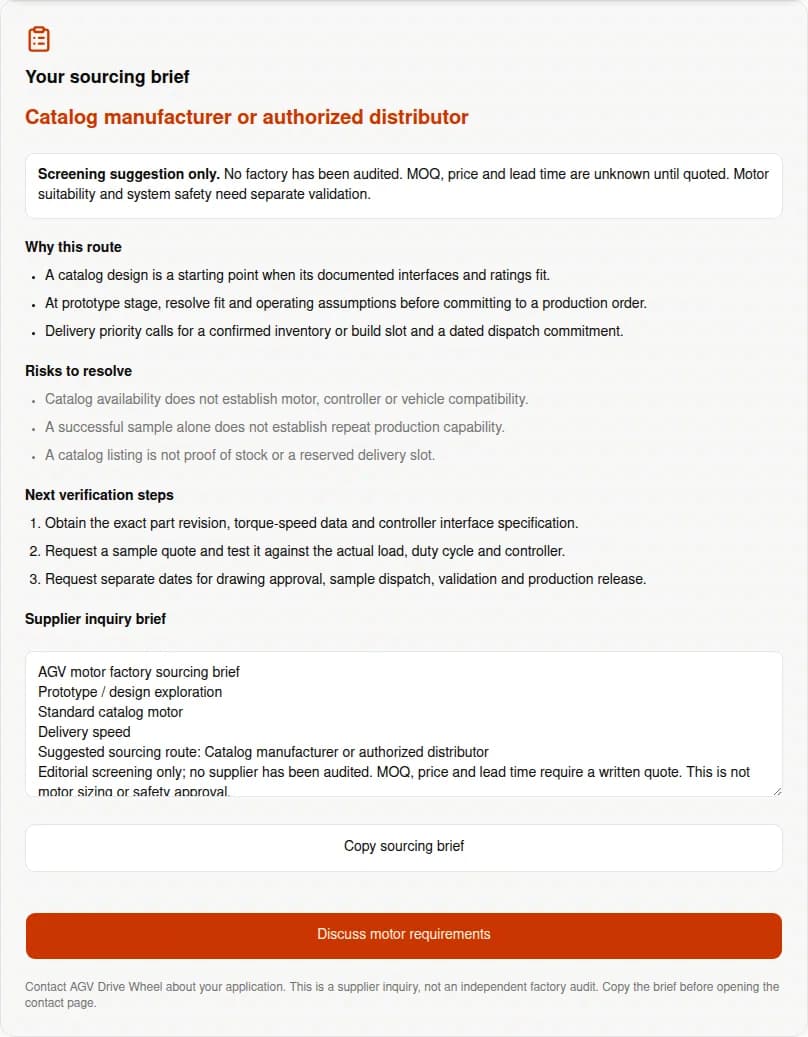
Select your project requirements and evaluate to see a suggested supplier capability, the reasons behind it and the next checks.
This tool uses editorial rules, with no live supplier database. It does not calculate motor size, rank factories or approve safety.
Read the matching rulesFour decisions before shortlisting a factory
An editorial procurement framework, not a factory ranking or market survey. Technical reference scopes and the remaining evidence gaps are linked below.
Separate supplier identity from motor proof
Verify the certificate entity and scope, then request records for the exact motor. A management-system certificate does not establish application performance.
Certificate scopeMatch ratings to the actual duty
Obtain test conditions for the offered motor and compare them with the vehicle duty profile. Keep short-time duty and peak limits separate.
Duty definitionsKeep safety responsibility at system level
A motor sourcing result cannot approve a driverless vehicle. The integrator must address the applicable system requirements and validation.
Truck-system scopeTreat commercial terms as unknown
No verified cross-vendor quote dataset supports universal MOQ, savings or delivery promises here. Request comparable written offers.
Quote comparison methodHow the sourcing rules work
The evaluator applies three independent rules. Customization selects the design capability; project stage adds validation or supply controls; your primary constraint sets the purchasing evidence to request. Standard prototypes allow either a catalog manufacturer or an authorized distributor. Modified parts always need a drawing owner, while custom motors need design capability.
- Customization → design capability
- Project stage → validation checks
- Purchasing priority → evidence to request
Use it when planning a supplier inquiry. It cannot select motor torque, confirm stock, establish factory capacity or approve safety. If voltage, load, duty or interfaces are unknown, resolve them before purchasing; the audit checklist remains usable while these inputs are pending.
A reproducible sourcing brief
Try Prototype / design exploration, Standard catalog motor and Delivery speed. The result allows a catalog manufacturer or an authorized distributor, then asks for part-revision, interface and stock evidence. Change customization to Modified shaft or cable to require a controlled drawing and first article.
AGV motor OEM vs ODM: compare responsibilities
| Route | Useful when | Evidence to request / trade-off |
|---|---|---|
| Catalog manufacturer or authorized distributor | A documented standard design can meet the prototype need. | Confirm part revision, authorization if applicable, stock and engineering escalation. A catalog listing is not a delivery commitment. |
| Manufacturer with modification capability | Shaft, cable or mounting details must change. | Name the drawing owner and approve a first article. Compare modification charges and revalidation work. |
| Manufacturer with design capability | Winding, housing or other core design work is needed. | Agree design/IP ownership, tooling access and validation milestones. Engineering scope can outweigh unit-price savings. |
| Repeat-supply manufacturer | The approved design will enter pilot or repeat production. | Request capacity and process-control evidence, change notification and warranty ownership. Order volume alone proves none of these. |
OEM and ODM terminology varies. Define who designs, builds, tests and warrants the motor in the contract. In-house and outsourced processes both require documented control; neither label is a quality ranking.
AGV motor factory audit: evidence and acceptance checks
Suggested buyer checks, not universal statutory requirements. Agree acceptance limits, sample size, test duration and responsibility for each item with the supplier.
| Check | Request | Decision / unresolved condition |
|---|---|---|
| Identity and scope | Legal entity, production address, certificate number and scope; issuer verification. | Resolve mismatched names or addresses. An unverified database entry needs issuer follow-up, not an automatic fraud finding. |
| Design ownership | Controlled drawing, BOM revision, outsourced process list and change approval owner. | Hold approval if the seller cannot identify who authorizes substitutions. |
| Thermal and mechanical rating | Torque-speed and thermal records with voltage, ambient, cooling, mounting and duty conditions. | Validate against the application profile. A short end-of-line test alone cannot establish thermal equilibrium. |
| Production checks | Inspection plan, test limits, equipment calibration and sample serial-number records. | Agree which checks apply to every unit and which are type or sample tests; do not assume every motor receives a full-load endurance test. |
| Controller and feedback integration | Controller model/firmware, encoder interface, wiring, fault response and combination-test record. | Resolve integration ownership before a vehicle trial; component compatibility remains unverified until demonstrated. |
| Repeat supply and service | Capacity assumptions, batch traceability, change notification and warranty process. | Qualify a recovery or alternate-source plan for critical components. |
Certificate verification context · Motor rating scope · Duty definitions
Separate motor ratings from system safety
| Reference | What it addresses | What this page cannot infer |
|---|---|---|
| IEC 60034-1:2026 | Rating and performance of rotating machines within its scope; integrated-drive scope is limited to the motor component. | The public catalog does not prove an offered motor passed tests, or mandate a particular factory test station. |
| ISO 3691-4:2023 | Safety requirements and verification for driverless industrial trucks and their systems. | A motor supplier audit cannot establish whole-vehicle compliance. Confirm edition, applicability and system validation with the integrator. |
| ISO 13849-1:2023 | Design and integration of safety-related control-system parts. | This standard does not assign a universal required PL to all applications. Brand names or batch tracking do not establish PL d/e. |
| S1 and S2 duty terminology | S1 concerns sustained constant load to thermal equilibrium. S2 concerns limited-duration load followed by cooling rest. | S2 is not an instantaneous peak-torque rating. A 24/7 vehicle schedule alone does not specify the motor load cycle. |
IEC catalog · ISO truck-system abstract · ISO control-system abstract · ABB section 4.7
Compare quote scope before unit price
No verified market-wide MOQ, lead-time or regional savings dataset is available for this page. Treat these fields as unknown until a dated supplier quote establishes them for the same design and release quantity.
| Item | Current evidence | Ask each supplier to state |
|---|---|---|
| Unit price and MOQ | Unknown; dependent on model and order terms. | Currency, exact revision, release quantity, minimum order, Incoterm and quote validity. |
| One-time NRE and tooling | Unknown; no universal percentage applies. | Separate engineering, tooling and test charges; ownership and revision allowance. |
| Lead time | Unknown; a catalog product may not be in stock. | Clock-start event, drawing approval, sample dispatch, validation and production dispatch dates. |
| Landed and lifecycle costs | Unknown; unit quotes may have different scope. | Freight, insurance, applicable import costs, spares, warranty handling and requalification responsibilities. |
Working method: compare acquisition cost at a common quantity, then separately assess service and redesign exposure. Do not spread NRE across an uncommitted future volume to make an offer look cheaper.
Risks, mitigation and alternatives
| Risk | Practical mitigation | Alternative if unresolved |
|---|---|---|
| Misuse: peak output treated as sustainable | Request duration, thermal limits, mounting and controller conditions; test the real duty profile. | Revise the drive size or operating cycle with the application engineer. |
| Cost: custom engineering exceeds budget | Separate NRE, tooling and retest milestones before committing. | Evaluate a standard motor with an independently validated mechanical interface. |
| Scenario mismatch: stock deadline plus custom design | Separate prototype feasibility from production release; identify validation dependencies. | Use a qualified standard part for the trial or renegotiate the deadline. |
| Process change or unapproved substitution | Agree BOM control, traceability, change notification and acceptance records. | Hold release, investigate the affected lot and qualify a documented alternate. |
| Unsupported safety claim | Assign safety-function requirements and system validation to responsible engineering teams. | Withhold safety approval until adequate system evidence exists. |
Three example decisions
Illustrative scenarios, not customer results or supplier performance claims. Each shows the same rules used by the evaluator.
Standard prototype; delivery priority
Compare a catalog manufacturer and an authorized distributor. Check exact stock, interfaces and sample terms.
Output: a sample inquiry. Fit and duty validation remain open.
Modified pilot; reliability priority
Route to controlled modification capability. Approve the changed drawing, first article and change process.
Output: a pilot acceptance plan. Repeatability remains unverified until records and tests support it.
Custom production; cost priority
Route to design capability. Compare NRE and recurring terms while checking capacity and design ownership.
Output: an itemized RFQ and qualification plan. No automatic low-cost or high-volume approval.
AGV motor RFQ checklist
Send the evaluator brief with the following application details. Mark unknowns explicitly and request feasibility review instead of silently assuming a rating.
- Load, wheel size, required speed, acceleration and slope conditions.
- Battery voltage range, controller model and feedback interface.
- Duty profile, ambient temperature, cooling and mounting arrangement.
- Drawing revision, shaft, cable, brake and environmental requirements.
- Sample and production quantities, release schedule and acceptance checks.
- Delivery location, design/tooling ownership and warranty expectations.
For motor-sizing context, use the AGV motor guide. For quote-cost inputs, see AGV motor sourcing cost planning. This page focuses on factory capability and the evidence needed to qualify it.
Factory sourcing questions
Supplier identity and capability
How do I verify a factory remotely?
Match the legal entity and production address to the quote, verify the certificate scope with the issuer or IAF CertSearch, and request a live process walkthrough tied to the offered part. Follow with sample inspection; a video alone cannot verify repeatability.
Is a distributor unsuitable for AGV motors?
No. An authorized distributor can supply a catalog motor and local support. Confirm authorization, traceability, warranty ownership and access to manufacturer engineering before purchasing.
Does in-house winding prove better quality?
No. Ask who controls the winding specification, incoming inspection, process changes and nonconforming parts. Either an internal line or a qualified subcontractor needs evidence of those controls.
What should OEM and ODM mean in a quote?
These labels are used inconsistently. Have the seller state who owns the design, drawings and tooling, who approves changes, and who is responsible for testing and warranty.
Engineering and safety evidence
Does an ISO 9001 certificate approve the motor?
No. It concerns a quality management system within a stated scope. Obtain model-specific rating data and acceptance records, and separately validate the application.
Does a 24/7 AGV always require an S1 motor rating?
The operating schedule alone is insufficient. Document load, speed, starts, braking, rest periods, ambient temperature and cooling; have the motor supplier validate the actual duty profile.
Is S2 another name for peak torque?
No. S2 is a defined short-time duty followed by a cooling rest period. Peak torque is a separate limit with its own duration and operating conditions; see the ABB duty reference below.
Can this tool confirm a safety performance level?
No. It has no safety-function design or validation data. ISO 13849-1 describes a control-system methodology; a motor brand, traceability record or supplier category cannot establish the required or achieved performance level.
Commercial decisions and next steps
What MOQ and lead time should I budget?
Both are unknown until the supplier quotes the exact design and release quantity. Ask separately for sample, pilot and repeat-order terms, quote validity and the assumptions behind each dispatch date.
How should custom engineering costs be compared?
Separate one-time design, tooling and validation charges from recurring unit price. Record ownership, revision limits, retest charges and cancellation terms at the same scope for every quote.
Will the motor include a compatible controller?
Do not assume this. Ask for the controller model, firmware, feedback interface, wiring, tuning responsibility and a documented combination test at your voltage and duty cycle.
What if my requirements are not settled?
Use the default example only to explore the output. Prepare the RFQ checklist, identify missing load or interface data, and request a feasibility discussion before treating any sourcing route as qualified.
Sources, date and evidence limits
Published and reviewed by AGV Drive Wheel on . Operated by Magatom Dynamics Co., Ltd.. These public references support technical definitions and scope. Full standards are not reproduced, and the page makes no clause-level compliance determination.
- IEC 60034-1:2026 — rating and performance (opens in a new tab)
Official edition and scope for rotating machines. The public abstract describes motor-level scope; it is not a supplier test report.
- ISO 3691-4:2023 — driverless industrial trucks (opens in a new tab)
System-level safety scope. Confirm the applicable edition and project requirements with your integrator.
- ISO 13849-1:2023 — safety-related control systems (opens in a new tab)
Design and integration methodology. The abstract does not prescribe a required performance level for every application.
- ABB Motor Guide (July 2019), section 4.7 (opens in a new tab)
Explains S1 and S2 duty definitions. A general motor reference, not performance evidence for an AGV model.
- IAF CertSearch — certificate validation FAQ (opens in a new tab)
Describes accredited management-system certificate verification. It is not a product approval database.
Evidence gap: no independent factory audits, comparative defect rates, verified commercial quotes or supplier rankings were used. Sourcing routes, audit requests and scenarios are editorial recommendations. Confirm commercial and engineering claims for the offered part before placing an order.
Turn the brief into a supplier discussion
Copy the tool result and add your RFQ details. AGV Drive Wheel can discuss your motor requirements; independent factory qualification and vehicle validation remain separate activities.