100mm Mecanum Wheel Rubber Roller Fit Checker and Decision Report
Run an immediate fit check for mecanum wheel rubber roller decisions, including 100mm mecanum wheel rubber roller, then review methodology, evidence, and risk boundaries on the same canonical route at/products/mecanum-wheels/mecanum-roller.
13 public sources checked through 2026-04-26
Published 2026-04-25; last updated 2026-04-26
3 operational scenarios from baseline to rough duty
Single canonical URL for alias and canonical intent
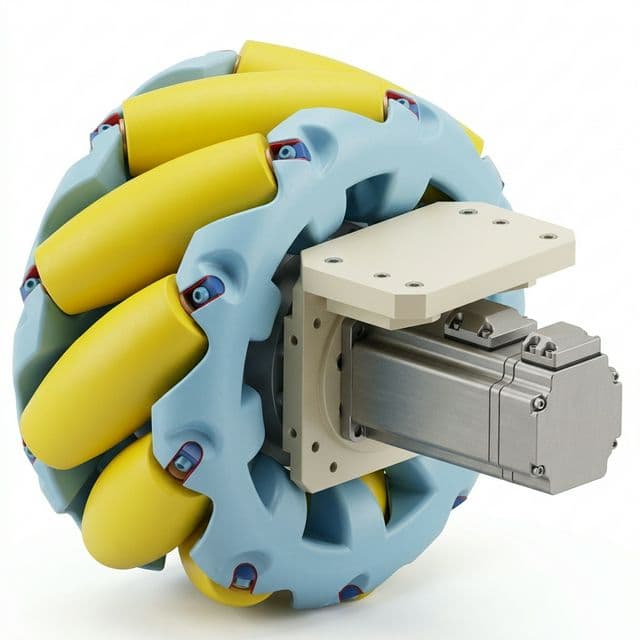
Default profile preview: Borderline, verification required (103%)
Empty state: run the checker to get a result for your exact 100mm mecanum wheel rubber roller profile.
Baseline preview below uses the default profile until you run calculation with your own inputs.
This preview is from default inputs. Click Calculate 100mm roller fit to generate your own result and decision CTA.
Benchmark usage
103%
Roller contact stress index
1.45
Traction stability score
66
Stage1b Audit: Gap Closure
Audit updated April 26, 2026| Gap found | Decision impact | Stage1b update | Status |
|---|---|---|---|
| Route-grade risk was mentioned in prose but not modeled as an explicit input/output variable in the tool. | Users could miss slope-driven instability and over-trust fit output for inclined routes. | Added route grade (%) field, grade amplification factor, and explicit >10% boundary warning aligned to 1910.178(n) travel clauses. | Closed |
| Cross-vendor load claims mixed kg/set and lb/wheel units without one normalized basis. | Procurement comparisons could be distorted by unit mismatch and wrong per-wheel/per-set interpretation. | Added NIST-based unit normalization path and explicit converted examples for AndyMark/Nexus references. | Closed |
| US safety-standard boundary for driverless AGV deployments was under-specified. | Teams could misclassify pre-screen results as sufficient without mapping to applicable system-level standard track. | Added ANSI/ITSDF B56.5-2024 scope/effective-date anchor and linked it to checker-to-compliance handoff guidance. | Closed |
| Impact and durability boundaries lacked public failure examples. | Cost risk could be understated when routes include repeated seam impacts and shock loads. | Added AndyMark durability white-paper datapoints (70lb performance degradation and 12-inch concrete-drop spindle failure). | Closed |
| Kinematic assumptions were not explicitly tied to a peer-reviewed framework. | Cross-functional reviewers could not quickly verify why the checker includes directionality and lateral-load factors. | Added CMU 1987 kinematic-modeling source to clarify model lineage and non-durability scope. | Closed |
| No open public standard publishes the exact 85/110 benchmark bands and 3.6/5.2 stress-index cutoffs. | Potential overconfidence if heuristics are interpreted as compliance or universal engineering limits. | Kept explicit pending-confirmation status and require supplier fatigue test plus pilot wear trend before final release. | Pending confirmation |
Report Summary: Key Conclusions
Updated April 26, 202686%-110% benchmark usage or stress index 3.7-5.2 or stability 55-69
Compared against 100kg/set reference for first-pass screening
Higher index means increased roller stress and wear risk
Rubber roller on Mixed concrete with joints
- Indoor AGV routes with floor joints around or below 2 mm.
- Projects that need quick pre-screening before detailed supplier validation.
- Teams comparing 100mm roller material options under similar duty assumptions.
- Outdoor or contamination-heavy lanes without reliable floor and wear data.
- Scenarios requiring final compliance evidence without system-level safety work.
- High-shock missions where benchmark usage consistently exceeds 110%.
- Sustained routes above 10% grade without dedicated pilot and engineering review.
Methodology and Evidence
1) Dynamic load/wheel = static load x safety factor x speed factor x joint factor x grade factor x floor factor.
2) Benchmark usage % = dynamic load/set / 100kg primary benchmark, with a secondary 45kg lower-reference check.
3) Stress index = load/roller x diameter ratio x material multiplier.
4) Stability score penalizes floor roughness, joints, speed, route grade, and long daily distance.
| Assumption | Value | Reason |
|---|---|---|
| Benchmark set load | 45-100 kg/set (public 100mm examples) | Nexus 100mm references show large within-class spread; this tool uses 100kg/set as primary benchmark and 45kg as lower-reference guardrail |
| Light-duty counterexample | 15 kg class (97mm) | DFRobot 97mm reference prevents treating "mecanum wheel" as one universal industrial class |
| Speed factor coefficient | 0.08 per m/s | Conservative amplification for lateral motion in first-pass sizing |
| Joint factor coefficient | 0.02 per mm | Approximates repeated seam impact sensitivity |
| Grade factor coefficient | 0.015 per % grade | Makes slope impact explicit and aligns warning logic to 1910.178(n) grade-travel boundary (above 10%). |
| Cross-vendor unit normalization | 1 lb = 0.4535924 kg | Uses NIST SI factor so lb/wheel and kg/set claims can be compared on one basis. |
| Stress-index thresholds | 3.6 / 5.2 | Engineering heuristics; no matching open standard cutoffs found, so final release requires supplier and pilot evidence |
| Regulatory operation boundary | Grade/surface constraints per OSHA 1910.178 | Regulation informs route-risk inputs but does not replace wheel durability validation |
| Source | Use |
|---|---|
| US Patent US3876255A (Mecanum wheel, Bengt Ilon) Patent publication 1975-04-08, checked 2026-04-26 | Primary origin source describing angled rollers and uninterrupted wheel periphery concept. Primary patent text and drawings are public. |
| CMU RI publication: Kinematic Modeling of Wheeled Mobile Robots Journal article date 1987-04, repository page checked 2026-04-26 | Peer-reviewed kinematic framework introducing wheel Jacobian mapping used to justify model structure. Academic primary source for kinematic formulation, but not a product-durability test. |
| Nexus Robot NM100A heavy-duty 100mm mecanum wheel Product page checked 2026-04-26 | Public product data for 100mm wheel: 8 rollers, PU-coated roller, and 100kg/set claim. Manufacturer page with downloadable datasheet references; load statement treated as product-level claim. |
| Nexus Robot 100mm bearing-roller set (14094) Product page checked 2026-04-26 | Counterexample within same nominal 100mm class: 9 rollers and 45kg/set published load. Manufacturer page gives structured spec table; claim remains vendor-specific. |
| DFRobot 97mm Mecanum Wheel Product page checked 2026-04-26 | Published dimensions and material for 97mm wheel: 45° roller angle, 15kg load class, silicone-rubber roller. Manufacturer page with basic dimensions and load data. |
| AndyMark MecanumWheelSpecSheet (6/8/10 in) Spec sheet checked 2026-04-26 | Cross-size load ratings (80/80/440 lb per wheel) showing load does not scale linearly by diameter. Manufacturer reference for a specific product family; converted values still require use-case normalization. |
| AndyMark 4 in Wheel Durability White Paper White paper checked 2026-04-26 | Public test notes with payload and drop-test outcomes used for impact-risk boundary setting. Single-vendor FTC-oriented test context; useful as caution signal, not universal lifecycle limit. |
| NIST Guide to SI Appendix B.9 NIST page checked 2026-04-26 | Exact conversion baseline for imperial-to-metric mass normalization: lb to kg factor 4.535924E-01. US national metrology source, suitable for cross-vendor unit normalization. |
| ISO 3691-4:2023 Edition 2 published 2023-06, ISO page checked 2026-04-26 | Safety scope baseline for driverless industrial trucks and system-level risk controls. Public abstract available; full standard clauses are paywalled. |
| ANSI/ITSDF B56.5-2024 (ITSDF standards page) ITSDF page checked 2026-04-26 | US driverless AGV standard title/scope and effective date (2025-12-16) for procurement-gate mapping. Publisher-maintained standards listing; full technical clauses still require full document review. |
| eCFR 29 CFR 1910.178(n) traveling clauses eCFR page checked 2026-04-26 | Operational constraints used as boundary triggers: >10% grade handling, wet/slippery-floor slowdown, and grade travel posture. Authoritative federal codification (eCFR is authoritative but unofficial online edition). |
| OSHA Powered Industrial Truck Operator Training Final Rule Federal Register publication 1998-12-01, page checked 2026-04-26 | Training-content baseline requiring workplace topics such as ramps/sloped surfaces and surface conditions. Primary OSHA final-rule text; useful for operator-training boundary, not wheel-component rating. |
| OSHA PIT eTool: Physical Conditions OSHA page checked 2026-04-26 | Operational floor prerequisites: surface strength, hole/obstruction control, and loading-limit checks. Public guidance content from OSHA. |
| Decision question | New data point | Boundary / counterexample | Action | Sources |
|---|---|---|---|---|
| Can two 100mm mecanum wheels have the same capacity by default? | Nexus publishes two 100mm references with very different claims: 45kg/set (14094) and 100kg/set (NM100A heavy duty). | Same diameter does not normalize hub design, roller architecture, or duty-cycle assumptions. | Treat diameter as a search filter only; compare using published set/wheel load plus duty definition. | Nexus NM100A page + Nexus 14094 page (checked 2026-04-26) |
| Can lb/wheel and kg/set claims be compared directly without conversion? | AndyMark publishes 80/80/440 lb per wheel (6/8/10 in), which is 36.3/36.3/199.6 kg per wheel using NIST factor 1 lb = 0.4535924 kg. | Per-wheel and per-set claims are not interchangeable; multiply by wheel count and keep unit basis explicit. | Normalize every supplier claim to one basis (kg/wheel and kg/set) before ranking options or setting safety margin. | AndyMark MecanumWheelSpecSheet + NIST SI Appendix B.9 (checked 2026-04-26) |
| Is a smaller-diameter mecanum wheel automatically unusable? | DFRobot 97mm unit publishes 45° roller angle with a 15kg load class and silicone-rubber rollers, showing it can work for light-duty tasks. | This is a light-duty example and does not support direct transfer to industrial AGV payload envelopes. | Use smaller diameter only for prototype/light payload scenarios unless industrial load evidence is provided. | DFRobot 97mm page (checked 2026-04-26) |
| Should route grade be a mandatory screening input? | eCFR 1910.178(n)(7) requires slow grade travel and specifies >10% grade handling posture for loaded trucks; 1910.178(n)(10) adds wet/slippery-floor slowdown. | These clauses are operation constraints, not wheel-fatigue acceptance thresholds. | Collect route grade in first-pass sizing and trigger mandatory pilot/engineering review when grade exceeds 10%. | eCFR 29 CFR 1910 Subpart N (checked 2026-04-26) |
| Is checker output enough to satisfy US AGV safety governance? | ITSDF lists ANSI/ITSDF B56.5-2024 for driverless automatic guided industrial vehicles with effective date 2025-12-16. | Standard title/scope confirms system-level requirements; checker output alone is not a conformity certificate. | Map checker result to formal standard track (ISO 3691-4 and/or B56.5) before release decisions. | ITSDF B56 standards page (checked 2026-04-26) |
| Can training documentation ignore route slope and floor conditions? | OSHA final rule for 1910.178(l) lists workplace training topics including surface conditions and ramps/sloped surfaces. | Training obligations do not set numeric wheel-rating limits by themselves. | Treat unknown slope/surface data as low-confidence input and block direct PO without field measurement. | OSHA PIT Operator Training Final Rule (checked 2026-04-26) |
| Can one heavy-duty claim replace duty validation? | AndyMark published load references span 80 to 440 lb per wheel across wheel sizes, showing architecture-specific rating spread. | Material hardness and one vendor architecture do not capture floor shock spectrum, route profile, or maintenance interval. | Require both product-level load/hardness data and route-level pilot evidence before release. | AndyMark product references + Mecanum spec sheet (checked 2026-04-26) |
| What is a public shock-risk signal for mecanum rollers under abuse? | AndyMark white paper reports reduced strafing at 70lb in FTC tests and roller-spindle breakage after a 12-inch concrete drop. | Test context is FTC-scale and single-vendor; use as caution evidence, not a universal lifecycle model. | If your route includes recurrent impacts, force a pilot gate before purchase commitment. | AndyMark durability white paper (checked 2026-04-26) |
| Can floor-joint and slope data be skipped during first-pass selection? | OSHA 1910.178 specifies grade-handling constraints (including >10% grade loading orientation) and cautions on wet/slippery travel speed. | These are operation-safety constraints and do not replace component fatigue or thermal validation. | Keep floor-joint and slope as mandatory inputs; unknown values should reduce confidence and trigger pilot. | eCFR 1910.178 + OSHA PIT physical conditions eTool (checked 2026-04-26) |
| Does this checker replace system-level AGV compliance work? | ISO 3691-4:2023 scope targets driverless industrial truck systems, not a wheel-only pass/fail certificate. | Public abstract is available, but full clauses are paywalled and still must be handled in formal compliance workflow. | Use checker output as component pre-screen input to ISO/plant safety processes, not as final conformity evidence. | ISO 3691-4 page (checked 2026-04-26) |
| Are the fit thresholds in this page an official standard requirement? | No open public source was found with identical 85%/110% benchmark bands or stress-index cutoffs. | These thresholds are engineering heuristics for pre-screening only. | Status pending confirmation: keep supplier fatigue report and pilot trend as release gate. | Source audit updated 2026-04-26; detailed clauses on many standards are paywalled |
Time marker: references above were checked through 2026-04-26.
Comparison, Boundaries, and Risks
| Option | Published load reference | Wear risk | Best fit | Evidence status |
|---|---|---|---|---|
| 100mm rubber roller mecanum | 45-100 kg/set public 100mm references | Medium | Indoor AGV with controlled floor quality | Public product-page evidence available |
| 100mm polyurethane roller mecanum | AndyMark family reference: 80-440 lb/wheel (36.3-199.6 kg/wheel) depending on wheel size | Medium-High | Higher wear resistance need with reduced grip tolerance | Public baseline exists but not same-size apples-to-apples with 100mm references |
| 97mm hobby/light-duty mecanum | 15 kg class public example | High | Prototype education or very light payload robots | Public product-page evidence available |
| Custom reinforced mecanum module | No open universal benchmark | Low-Medium after validation | High-shock or beyond-boundary production use | Requires supplier report + pilot data |
| Band | Boundary | Operational fit | Action |
|---|---|---|---|
| Fit for 100mm rubber roller pre-screen | <= 85% benchmark usage and stress index <= 3.6 with stability >= 70 | Indoor AGV lanes with low floor joints and controlled lateral speed. | Proceed to RFQ with this output and request supplier drawing confirmation. |
| Borderline, verification required | 86%-110% benchmark usage or stress index 3.7-5.2 or stability 55-69 | Mixed-floor routes where roller wear and vibration trend must be verified in pilot. | Run short pilot test and request roller hardness + fatigue report before PO. |
| Not fit, move to stronger module | > 110% benchmark usage or stress index > 5.2 or stability < 55 | High shock, high cycle, or heavy payload profile beyond 100mm rubber pre-screen envelope. | Switch to reinforced/custom wheel module and perform vehicle-level validation. |
Fit thresholds are pre-screening heuristics and must be replaced by supplier fatigue evidence for final release. Load comparisons above normalize lb-to-kg using NIST SI factors. Cross-source load references were checked through 2026-04-26.
| Risk | Trigger | Mitigation |
|---|---|---|
| Misuse risk | Treating checker output as final compliance proof | Run full vehicle-level validation and applicable safety workflow |
| Benchmark overconfidence risk | Using one product benchmark as universal limit | Compare multiple supplier datasheets and pilot data before PO |
| Unit mismatch risk | Mixing kg/set and lb/wheel claims without conversion | Normalize every claim to kg/wheel and kg/set before commercial comparison |
| Slope underestimation risk | Route grade above 10% treated as normal operation | Trigger pilot + engineering review gate whenever route grade exceeds 10% |
| Cost/wear risk | Ignoring daily distance and maintenance intervals | Add wear inspection gates and maintain spare-roller stock plan |
| Scenario mismatch risk | Using smooth-floor assumptions on rough routes | Default to rough-floor assumptions until measured route data is available |
| Alias dilution risk | Creating multiple near-duplicate URLs for same intent | Keep single canonical URL and route all alias intent here |
Scenario Examples
Dynamic load/set: 81.1 kg
Benchmark usage: 81%
Stress index: 1.14
Suggested class: Fit for 100mm rubber roller pre-screen
Dynamic load/set: 119.9 kg
Benchmark usage: 120%
Stress index: 1.69
Suggested class: Not fit, move to stronger module
Dynamic load/set: 207.3 kg
Benchmark usage: 207%
Stress index: 2.91
Suggested class: Not fit, move to stronger module
| Scenario | Total mass | Floor | Route grade | Benchmark usage | Stress index | Stability score | Band |
|---|---|---|---|---|---|---|---|
| Indoor Sortation Baseline | 62 kg | Smooth epoxy floor | 1.5% | 81% | 1.14 | 79 | Fit for 100mm rubber roller pre-screen |
| Mixed-Floor Fulfillment Lane | 78 kg | Mixed concrete with joints | 4.0% | 120% | 1.69 | 58 | Not fit, move to stronger module |
| Rough Dock Transfer | 95 kg | Rough floor with repeated seam impact | 9.0% | 207% | 2.91 | 20 | Not fit, move to stronger module |
Decision FAQ
Group 1: 100mm fit scope and alias-intent clarity
Group 2: material and wear boundaries
Group 3: deployment and procurement decisions
Total questions: 15
Action Layer: Move from checker output to release decision
Keep this canonical page in your sourcing workflow: run the tool, capture boundaries, then move to pilot or RFQ with evidence attached.
Related engineering articles
Deep-dive reads for wheel architecture trade-offs, acceptance criteria, and maintenance planning.
- 310mm Mecanum Wheel Forklift Checker
- 100mm Mecanum Wheels Checker and Decision Report
- 101.6mm Omnidirectional Wheel Fit Checker
- Mecanum Wheel vs Omni Wheel for AGV/AMR Platforms

- How to Define AGV Drive Wheel Acceptance Criteria Before Sampling
- The Complete Guide to AGV Drive Wheel Maintenance and Lifespan