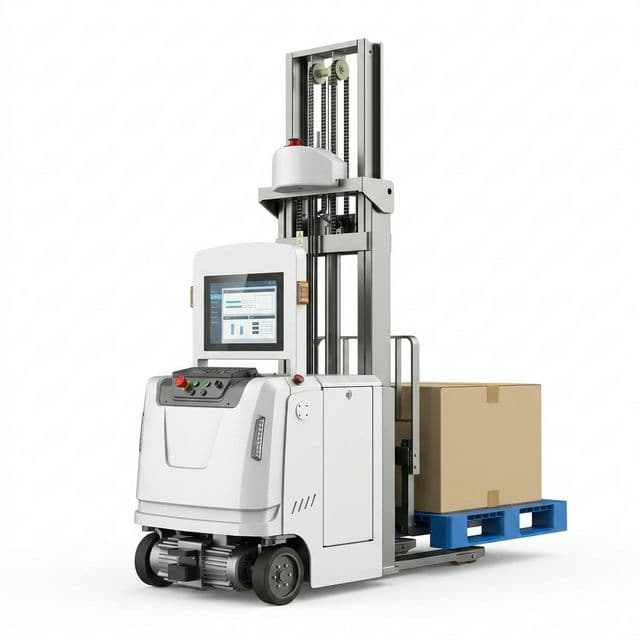
Advantages of Mecanum Wheels Fit Checker and Decision Report
Run an immediate fit check for mecanum wheel decisions, including lateral movement, zero-turn docking, compact alignment, and their load, floor, control, energy, and maintenance trade-offs, then review methodology, evidence, and risk boundaries on the same canonical route at/products/mecanum-wheels.
61 public sources checked through 2026-06-07
Published 2026-04-25; last updated 2026-06-07 (alias merge: advantages of mecanum wheels added to the canonical hybrid checker/report while keeping one URL); next scheduled refresh 2026-11-24
5 operational scenarios from baseline to eight-inch boundary duty
Single canonical URL for alias and canonical intent
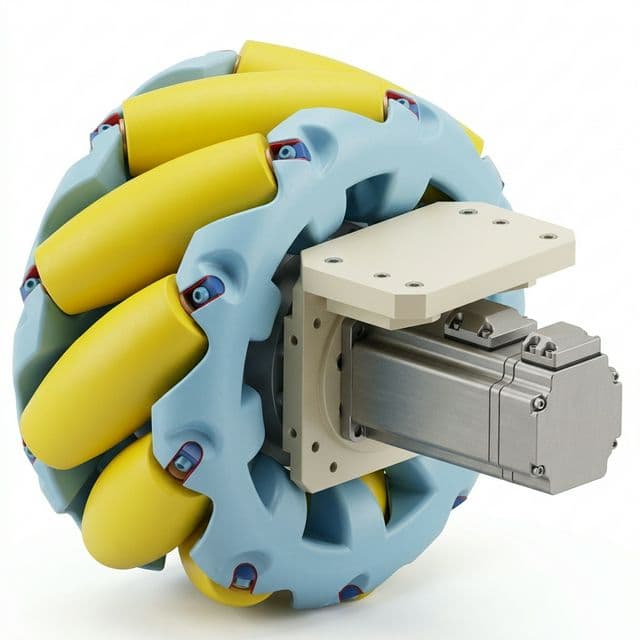
Default profile preview: Borderline, verification required (103%)
Empty state: run the checker to get a result for your exact mecanum wheel profile and route conditions for the advantages decision.
Baseline preview below uses the default profile until you run calculation with your own inputs.
This preview is from default inputs. Click Calculate mecanum wheel fit to generate your own result and decision CTA.
Benchmark usage
103%
Roller contact stress index
1.45
Traction stability score
66
Stage1b Audit: Gap Closure
Audit updated June 7, 2026| Gap found | Decision impact | Stage1b update | Status |
|---|---|---|---|
| Route-grade risk was mentioned in prose but not modeled as an explicit input/output variable in the tool. | Users could miss slope-driven instability and over-trust fit output for inclined routes. | Added route grade (%) field, grade amplification factor, and explicit >10% boundary warning aligned to 1910.178(n) travel clauses. | Closed |
| Cross-vendor load claims mixed kg/set and lb/wheel units without one normalized basis. | Procurement comparisons could be distorted by unit mismatch and wrong per-wheel/per-set interpretation. | Added NIST-based unit normalization path and explicit converted examples for AndyMark/Nexus references. | Closed |
| US safety-standard boundary for driverless AGV deployments was under-specified. | Teams could misclassify pre-screen results as sufficient without mapping to applicable system-level standard track. | Added ANSI/ITSDF B56.5-2024 scope/effective-date anchor and linked it to checker-to-compliance handoff guidance. | Closed |
| Impact and durability boundaries lacked public failure examples. | Cost risk could be understated when routes include repeated seam impacts and shock loads. | Added AndyMark durability white-paper datapoints (70lb performance degradation and 12-inch concrete-drop spindle failure). | Closed |
| Kinematic assumptions were not explicitly tied to a peer-reviewed framework. | Cross-functional reviewers could not quickly verify why the checker includes directionality and lateral-load factors. | Added CMU 1987 kinematic-modeling source to clarify model lineage and non-durability scope. | Closed |
| No open public standard publishes the exact 85/110 benchmark bands and 3.6/5.2 stress-index cutoffs. | Potential overconfidence if heuristics are interpreted as compliance or universal engineering limits. | Kept explicit pending-confirmation status and require supplier fatigue test plus pilot wear trend before final release. | Pending confirmation |
| "advantages of mecanum wheels" was not explicitly merged into the canonical mecanum wheel URL. | Searchers looking for benefits could land on a diameter-heavy page and miss that the same URL answers the decision question without creating a duplicate route. | Added explicit advantages phrasing to hero scope, metadata, FAQ, anchor navigation, internal links, and a dedicated decision-summary section with measurable benefit/failure signals. | Closed |
| The advantages section stated side-shift, zero-turn, docking, and path-planning benefits, but did not separate proven motion capability from release-ready industrial evidence. | Teams could treat a valid mecanum motion concept as automatic ROI and skip controller normalization, slip/drift testing, energy budgeting, and supplier load-method checks. | Added an evidence-gate table tied to patent/kinematic sources, ROS/WPILib controller docs, 2019 energy-model evidence, 2024 slip/drift studies, safety-scope references, and supplier load-denominator caveats. | Closed |
| No reliable open universal threshold was found for lateral-duty current rise, acceptable trajectory drift, or floor-surface slippage that applies to every mecanum AGV. | Procurement reviewers could demand a single public pass/fail value or, worse, invent one without route-specific validation. | Marked current, temperature, vibration, position drift, yaw drift, retry count, and surface-class acceptance as project-specific pilot KPIs rather than universal public constants. | Pending confirmation |
| "4 wheel mecanum kinematic model" alias intent was not mapped to a dedicated canonical boundary section. | Users could assume this query needs a separate page, or could apply software-kinematics statements without geometry validation and release gates. | Added a dedicated 4-wheel mecanum kinematic model boundary section with one-URL mapping, controller/order preconditions, known/unknown evidence table, and direct CTA path to tool + custom review. | Closed |
| "4in mecanum wheels" short-form alias was not made explicit alongside the "4 inch mecanum wheels" canonical boundary section. | Users searching with short-form wording could miss one-URL mapping and fork into duplicate route assumptions. | Added explicit "4in mecanum wheels" coverage in hero copy, FAQ scope, section heading, and anchor-entry labels while preserving the same dedicated 4-inch canonical boundary section and one-URL CTA path on /products/mecanum-wheels. | Closed |
| "6in mecanum wheels" / "6 inch mecanum wheels" alias intent was not mapped to a dedicated canonical boundary section. | Users could split into a duplicate URL path or treat 6-inch wording as an automatic high-capacity class without denominator-aware evidence checks. | Added a dedicated 6-inch alias boundary section with exact 152.4mm conversion, same-URL mapping, baseline-delta interpretation, and per-wheel/per-set evidence gates. | Closed |
| "6 mecanum wheels" short query was not explicitly listed alongside 6in/6 inch alias wording in top-level copy and FAQ prompts. | Users using the shorter query could miss canonical mapping confidence and assume a separate landing route is required. | Added explicit "6 mecanum wheels" wording in hero/FAQ/anchor/report labels while preserving one canonical URL and the same 152.4mm boundary workflow. | Closed |
| 6-inch source details were stale in key places (AndyMark roller count and Nexus 14165 load denominator/class). | Teams could overestimate 6-inch capacity class and shortlist the wrong architecture before RFQ validation. | Re-audited official pages on 2026-05-20: corrected AndyMark SR to 15 rollers, corrected Nexus 14165 to 15kg/wheel with 8 rollers, and added Nexus 14169 (150kg/set) as a medium-class reference. | Closed |
| Historical-versus-current 6-inch document freshness risk was not explicit. | Users could mix legacy PDF ratings with current SKU pages and treat them as one transferable capacity baseline. | Added legacy AndyMark spec-sheet age marker (Last-Modified 2010-10-08) and explicit boundary notes that old PDF ratings must not replace current SKU verification. | Closed |
| 2-inch alias conversion (50.8 mm) was shown but lacked a metrology-grade primary citation in the mecanum source table. | Teams could challenge alias mapping integrity and fork procurement threads around diameter wording. | Added NIST Appendix B.8 as exact conversion evidence and linked it to the 2 mecanum wheels alias boundary section. | Closed |
| "3 inch mecanum wheels" alias intent was not explicitly mapped to one canonical boundary section. | Users could misread 3-inch intent as requiring a separate route or directly reuse 100mm assumptions without diameter boundary checks. | Added 76.2mm alias conversion evidence, a dedicated 3-inch canonical boundary section, and explicit supplier-load evidence gates on the same URL. | Closed |
| "3606 series mecanum wheel set" legacy alias intent was not explicitly mapped to a canonical boundary section. | Legacy SKU searchers could assume a dedicated route or over-trust old catalog naming as a current, fully-equivalent release class. | Added a dedicated 3606 alias section with known/unknown evidence table, discontinuation boundary, and one-URL action path to canonical checker outputs. | Closed |
| 3-inch public-source interpretation was stale: roller count and load-evidence status were inaccurate. | Teams could under-estimate available 3-inch load evidence and mis-rank light-duty listings against 100mm baseline assumptions. | Re-audited AndyMark 3-inch source: corrected to 8 rollers and 40 lb/set disclosure, then added NIST-normalized kg conversion plus light-duty/torque boundary notes. | Closed |
| "2 mecanum wheels" query ambiguity (count/diameter wording and drive wheel vs intake wheel role) was not explicit in decision guidance. | Users could compare non-drive intake SKUs directly against AGV drive-wheel candidates and mis-rank options. | Added AndyMark 2.25 in intake-wheel counterexample plus disambiguation guidance to confirm quantity meaning, diameter intent, and duty role before RFQ. | Closed |
| Small-diameter public listings without load ratings were not highlighted as a blocking evidence gap. | No-load-rating products could enter direct capacity ranking and inflate release confidence. | Added REV 75mm and DFRobot 48mm evidence gap notes and forced pending-confirmation handling before PO decisions. | Closed |
| "75mm mecanum wheel set" alias intent did not have a dedicated canonical boundary anchor and explicit decision path. | Searchers could miss one-URL intent resolution and over-read geometry-only 75mm pages as ready-to-rank capacity evidence. | Added a dedicated 75mm alias boundary section with internal anchor, conversion context, known/unknown evidence table, and explicit supplier load/test-evidence gate before PO decisions. | Closed |
| 75mm section did not state supplier-page duty-context boundaries (FTC kit context and >25 lb support caution) on the same decision surface as alias/load checks. | Teams could over-interpret geometry-only 75mm listings as industrial support proof and under-scope supplier evidence requests. | Re-audited REV 75mm listing (checked 2026-05-26) and added duty-context boundary language: keep this as pre-screen evidence only, and require signed supplier load/test-method data before PO/release. | Closed |
| 75mm boundary lacked a quantitative speed/command-margin statement versus 100mm baseline. | Programs could reuse 100mm cycle-time assumptions and overlook wheel-speed saturation risk when downshifting to 75mm candidates. | Added diameter-ratio screening guidance (75mm/100mm speed ratio and required wheel-speed uplift for same chassis speed) plus WPILib desaturate gate linkage before release decisions. | Closed |
| "8 inch mecanum wheels" alias intent was not explicitly mapped to a canonical boundary section. | Searchers could assume a dedicated page is required, or treat 8-inch sourcing as a direct high-load class without conversion, inertia, and load-denominator checks. | Added a dedicated 8-inch alias boundary section with exact 203.2mm conversion, current AndyMark 8-inch MK load/roller evidence, legacy 80 lb/wheel contrast, and one-URL action path to the canonical checker. | Closed |
| The tool input range stopped below 8-inch diameter, so the canonical checker could not execute the alias scenario it claimed to answer. | A visitor with true 8-inch diameter intent would hit a validation boundary instead of receiving a controlled large-diameter pre-screen and next action. | Raised the wheels-variant diameter guardrail to 203.2mm, added an 8-inch scenario, and kept low-confidence boundary messaging plus supplier evidence gates for release decisions. | Closed |
| 8-inch source freshness was compressed into a current-vs-legacy contrast without a dated evidence timeline. | Users could merge a 2010 spec sheet, 2011 assembly PDF, 2012 HD launch note, and 2025 current product page into one undifferentiated 8-inch rating. | Added a dated 8-inch evidence timeline and source rows that separate legacy standard, legacy HD, assembly/service context, and current MK am-3340 product evidence. | Closed |
| The 8-inch load discussion did not make the missing public test-method and duty-cycle basis prominent enough. | A published 500 lb/wheel value could be copied into industrial AGV release criteria without static/dynamic basis, floor condition, cycle duty, or thermal/braking context. | Marked the reusable test method, dynamic duty cycle, and route envelope as pending confirmation, and added RFQ gates for signed supplier method and pilot KPI evidence. | Pending confirmation |
| 8-inch serviceability and assembly risk were under-specified. | Teams could shortlist a large wheel by load number alone and miss left/right set requirements, spare roller/axle planning, or legacy spacer-generation differences. | Added current am-3340 set details (2 left/2 right, 48 rollers per set) and legacy spacer/outer-roller context so the RFQ path asks for spares, interface, and generation-specific parts evidence. | Closed |
| "mecanum wheel 60mm" phrase order was not explicit in key alias-scope copy, so only "60mm mecanum wheel" wording was visible in most decision prompts. | Searchers using reversed phrase order could miss canonical coverage confidence and assume a separate route should exist. | Added explicit "mecanum wheel 60mm / 60mm mecanum wheel" wording in hero scope, FAQ prompts, and 60mm boundary section labels while preserving one canonical URL. | Closed |
| 60mm boundary relied mostly on a single public load example, leaving same-size spread under-evidenced. | Teams could overfit one 60mm product page as a universal class and under-estimate sourcing risk for small-diameter variants. | Added Nexus 60mm single-wheel (14159R, 3kg) and 60mm 4-piece set (14144, 10kg) rows to quantify same-size spread and strengthen boundary evidence. | Closed |
| Public 60mm pages still do not provide a fully comparable denominator/test-method basis across all listings. | Without explicit denominator/test setup, cross-SKU 60mm ranking can look numeric but remain non-reproducible. | Kept this boundary in pending-confirmation state and added explicit action gates requiring supplier denominator declaration plus test-method disclosure before PO. | Pending confirmation |
| Industrial load transfer assumptions for 2-inch intent were not tied to application-specific integration guidance. | Buyers could treat one generic value as universal across floor, cycle, and system architecture changes. | Added TENTE industrial guidance showing load-capacity dependence on diameter and application context, with explicit prototyping gate. | Closed |
| "2 mecanum wheels" guidance did not explicitly state the controllability boundary for true two-wheel architecture requests. | Users could misread alias handling as approval for two-wheel holonomic drivetrain equivalence. | Added kinematic full-rank boundary note (3+ wheel constraint context) and explicit custom-review path for true two-wheel architecture. | Closed |
| Type-X vs Type-O wheel-arrangement sensitivity was missing from decision content. | Teams could compare load specs only and miss trajectory-precision differences driven by arrangement choice. | Added peer-reviewed arrangement evidence and made X/O declaration a required RFQ comparison field. | Closed |
| Slip- and payload-shift trajectory-error risk was not explicit in the report layer. | Procurement decisions could under-budget calibration and pilot effort for mixed-surface routes. | Added 2024 trajectory-model evidence on systematic error and linked it to pilot/calibration action gates. | Closed |
| Energy tradeoff for frequent lateral/diagonal duty was implicit but lacked source-backed framing. | Cost decisions could under-estimate energy overhead and duty-cycle impact in high-flexibility workflows. | Added peer-reviewed energy-model evidence and converted it into explicit power-budget review guidance. | Closed |
| The 3606 replacement note did not quantify active family drift across 96mm, 104mm, and 140mm options. | Teams could treat any current goBILDA mecanum SKU as one-to-one equivalent and miss speed/packaging/inertia tradeoffs. | Added family split evidence (96/104/140) with published mass/roller disclosures and explicit diameter-ratio screening guidance. | Closed |
| Legacy-to-current service-part compatibility risk was implicit and easy to miss in procurement discussions. | Spare-part BOM could be copied from 3213-3606-0001 into 3213-3606-0002 builds and fail maintenance assumptions. | Added explicit roller-pack compatibility boundary (0001 compatible, 0002 not compatible) and maintenance gate language in decision tables. | Closed |
| 4-inch alias section did not quantify same-diameter SD/BB/HD load and architecture spread on one comparable table. | Users could over-trust the 4-inch wording and miss that published same-diameter references span drastically different capacity and construction classes. | Added same-vendor 4-inch SD/BB/HD evidence (17 lb/wheel SD, 40 lb/set BB, 200 lb/wheel HD) plus roller-count and structure fields to force architecture-aware comparison. | Closed |
| 4-inch decision guidance did not explicitly force denominator normalization (per-wheel vs per-set) before ranking candidates. | Capacity ranking could be distorted by mixed units and mixed denominator bases across otherwise similar-looking 4-inch listings. | Added mandatory kg/wheel + kg/set normalization gate and cross-checked it against NIST conversion factors in method assumptions and external-fact actions. | Closed |
| 4-inch report layer did not surface same-page denominator inconsistency signals (for example SD page showing both 17 lb/wheel and 50 lb/set). | Teams could treat mixed denominator disclosures as directly equivalent and overstate capacity margin during shortlist ranking. | Added explicit denominator-conflict evidence and action gates requiring supplier test method + denominator declaration before PO decisions. | Closed |
| EU regulatory transition timing was absent from wheel-level decision guidance. | Cross-region teams could complete component pre-screening but miss that EU machinery compliance timeline shifts on 2027-01-20. | Added Regulation (EU) 2023/1230 timeline boundary with phased-application dates and explicit handoff to regional compliance workflow. | Closed |
| Standards lifecycle transition risk (ISO 3691-4 to ISO/DIS 3691-4 and B56.5-2024 effective status) was not surfaced in wheel-level decision logic. | Teams could treat old compliance mapping as static and skip review of current system-level standards status before release planning. | Updated lifecycle evidence to current public metadata: ISO 3691-4 stage 90.92 + ISO/DIS 3691-4 stage 40.00 events (2026-04-08) plus ANSI B56.5 revision lineage, with explicit handoff from checker output to system-level compliance workflow. | Closed |
| Current goBILDA 96mm/104mm/140mm public pages disclose geometry and mass but not explicit load ratings. | Users might over-read replacement wording as equivalent load evidence and skip supplier test-basis requests. | Kept load equivalence as pending confirmation; require signed supplier load statement and test method for whichever active SKU is selected. | Pending confirmation |
| Four-wheel software-controller boundary was implicit in prose and not tied to a primary controller spec. | Teams could over-extend this checker to non-four-wheel controller assumptions without documenting model mismatch risk. | Added official ROS mecanum_drive_controller evidence showing four-wheel scope and explicit FL/FR/RL/RR command-joint parameterization. | Closed |
| Wheel-geometry input contract (wheel positions relative to robot center) and overdetermined forward-kinematics behavior were not explicit. | Incorrect wheel-center measurements could bias odometry interpretation while appearing numerically valid. | Added WPILib kinematics evidence for ordered wheel-position inputs and least-squares/pseudoinverse forward-kinematics framing; converted into explicit geometry-measurement gate language. | Closed |
| Wheel-speed command feasibility boundary (toWheelSpeeds output saturation handling) was not explicit. | Teams could pass unattainable wheel-speed commands to motor control and misread instability as hardware weakness instead of command-level saturation. | Added WPILib API evidence that toWheelSpeeds outputs are not normalized and mapped this to a mandatory wheel-speed normalization gate before command dispatch. | Closed |
| Controller safety boundary for stale command timeout and raw odometry velocity handling was under-specified. | Release decisions could ignore command-timeout behavior and treat raw velocity output as production-grade without explicit filtering/covariance pipeline. | Added ROS mecanum userdoc evidence for reference_timeout behavior and raw velocity output; converted to explicit timeout configuration plus odometry post-processing gate. | Closed |
| Non-four-wheel controller alternative path was vague ("custom review" only) and lacked primary controller-family evidence. | Teams could overfit four-wheel assumptions to 3+ wheel omni layouts or branch into ad-hoc control stacks without documented baseline options. | Added ROS omni_wheel_drive_controller evidence (3+ symmetric/equiangular layout scope) to clarify when to branch away from four-wheel mecanum assumptions. | Closed |
| 6-wheel tool-mode boundary was under-evidenced and easy to over-read as equivalent to four-wheel controller assumptions. | Teams could treat 6-wheel pre-screen outputs as production-ready without documenting layout-specific kinematics and controller-family fit. | Added ROS n-wheel kinematics evidence plus six-wheel heavy-load study caveats (no-slip/equal-parameter assumptions), then mapped 6-wheel outputs to explicit custom-model + pilot gates. | Closed |
| Surface-dependent drift and energy/cost signals were mostly qualitative and lacked one quantitative industrial test reference. | Programs could under-budget calibration and thermal margin when moving from smooth concrete pilots to rougher or higher-drag surfaces. | Added Scientific Reports 2022 quantitative concrete/asphalt deltas (tracking error + current draw) and converted them into explicit surface-class KPI gates. | Closed |
| No open public universal tolerance value for acceptable wheel-center measurement error in four-wheel mecanum odometry was documented. | Reviewers may assume one generic tolerance exists and skip project-specific calibration acceptance criteria. | Marked this as pending confirmation and require project-level odometry drift KPI plus calibration record before release. | Pending confirmation |
| No open public universal threshold was found for acceptable lateral-current rise or vibration PSD during mecanum side-shift duty. | Teams may apply one route baseline to all surfaces and miss thermal/vibration failure risk on higher-drag lanes. | Kept this as pending confirmation and require project-specific current/temperature/vibration KPI limits by surface class before release. | Pending confirmation |
| No open public standard threshold for acceptable mecanum trajectory drift was documented. | Teams may assume one generic pass/fail drift limit exists when tolerance is usually application-specific. | Kept this as pending confirmation and require project-level pilot KPI (position/yaw drift) before release. | Pending confirmation |
Report Summary: Key Conclusions
Updated June 7, 202686%-110% benchmark usage or stress index 3.7-5.2 or stability 55-69
Compared against 100kg/set reference for first-pass screening
Higher index means increased roller stress and wear risk
Rubber roller on Mixed concrete with joints
- Indoor AGV routes with floor joints around or below 2 mm.
- Projects that need quick pre-screening before detailed supplier validation.
- Teams comparing 100mm baseline options while needing a clear, no-new-route answer for advantages of mecanum wheels, 3606 series mecanum wheel set, 75mm mecanum wheel set, 2 mecanum wheels, 2 inch mecanum wheels, mecanum wheel 60mm / 60mm mecanum wheel, 3 inch mecanum wheels, 4in mecanum wheels, 4 inch mecanum wheels, 6 mecanum wheels, 6in mecanum wheels, 6 inch mecanum wheels, 8 inch mecanum wheels, 4 mecanum wheels, mecanum wheels 4 inch, and 4 wheel mecanum kinematic model intent.
- Outdoor or contamination-heavy lanes without reliable floor and wear data.
- Scenarios requiring final compliance evidence without system-level safety work.
- High-shock missions where benchmark usage consistently exceeds 110%.
- Sustained routes above 10% grade without dedicated pilot and engineering review.
Advantages of Mecanum Wheels: Decision Summary
Alias intent answered on /products/mecanum-wheels| Advantage | Decision value | Measurable signal |
|---|---|---|
| Sideways movement without a steering arc | Useful when the vehicle must dock, align, or shift laterally in narrow aisle cells. | Count lateral moves per cycle, docking offset tolerance, and aisle-width reduction target before selecting hardware. |
| In-place rotation and compact maneuvering | Can reduce multi-point turns where AGVs queue around conveyors, lift tables, or inspection stations. | Compare turning area, cycle-time target, and wheel-speed saturation logs in simulation or pilot. |
| Flexible path planning with fewer chassis changes | Supports routes that require diagonal movement, side-shift, and tight repositioning on one platform. | Map motion mix by percentage of straight, lateral, diagonal, and rotate-in-place segments. |
| High positioning value for transfer interfaces | Good fit when the business value comes from repeatable alignment at racks, fixtures, or dock faces. | Define position/yaw drift KPI, retry count, and acceptable dock time before pilot. |
Evidence basis: mecanum patent motion concept, CMU wheeled-robot kinematics, ROS/WPILib controller geometry docs, peer-reviewed arrangement/energy/slippage studies, and supplier load-source audit checked through 2026-06-07.
| Fails when | Next action |
|---|---|
| Floor joints exceed about 3 mm, lateral speed is high, or roller wear raises vibration beyond pilot limits. | Run the checker with real floor-joint height and lateral-speed values before requesting RFQ. |
| Wheel-center geometry is unmeasured, controller wheel order is wrong, or commands are not normalized to attainable wheel speeds. | Use the 4-wheel kinematic boundary section before trusting odometry or cycle-time estimates. |
| High lateral/diagonal duty creates unacceptable current draw, heat, or maintenance interval compression. | Add energy-budget and maintenance checks to sourcing documents before PO. |
| Mixed surfaces, payload center-of-mass shift, or unfiltered odometry causes drift beyond process tolerance. | Treat open drift thresholds as project-specific and collect pilot telemetry by surface class. |
Tool-first action for this alias
If the route has a known lateral-duty share, floor-joint height, and payload range, run the checker first. If those values are missing, keep the advantages claim as inconclusive and move to route measurement before RFQ.
| Gate | Verified evidence | Boundary / limitation | Decision action | Source marker |
|---|---|---|---|---|
| Motion model gate | The original 1975 mecanum patent describes oblique free rollers around the wheel periphery, and the CMU 1987 kinematic framework supports Jacobian-based wheel-to-body velocity mapping. | This proves omnidirectional motion feasibility, not industrial payload life, floor tolerance, or release readiness. | Treat side-shift and zero-turn as valid motion capabilities only after wheel order, wheel-center geometry, and attainable wheel-speed limits are configured. | US3876255A (1975-04-08); CMU RI / IJRR 1987 |
| Controller implementation gate | ROS 2 mecanum_drive_controller documentation scopes the controller to four wheels with FL/FR/RL/RR joint parameters; WPILib requires wheel-location inputs and provides desaturation for wheel-speed outputs. | A route can be kinematically valid and still fail if commands saturate, wheel order is wrong, or the chassis is not a four-wheel mecanum layout. | Pin controller family and version, log wheel-speed normalization, and validate odometry drift before using the advantages claim in ROI math. | ROS 2 Control Kilted docs; WPILib MecanumDriveKinematics docs/API |
| Energy and heat gate | A 2019 peer-reviewed energy model for a four-mecanum-wheel robot reports experimental validation above 95%, with energy use depending on path and control strategy. | The public paper supports energy tradeoff screening, but does not publish a universal industrial battery derating rule for every payload and floor. | Measure current, motor temperature, and battery reserve by motion mix; keep lateral/diagonal duty as a budget item, not a free advantage. | Symmetry 2019-11-07, 11(11):1372 |
| Slip and surface gate | 2024 non-ideal friction and slippage studies report setup-dependent trajectory/orientation errors under velocity, pose, center-of-mass, and road-surface variation. | No reliable open universal pass/fail drift threshold was found; public results are platform- and surface-specific. | Define project-specific position/yaw drift, retry count, and surface-class acceptance KPIs before PO. | Mechanism and Machine Theory 2024-03; JMST 2024-10-22 abstract |
| Safety and operating environment gate | ISO 3691-4:2023 and ANSI/ITSDF B56.5-2024 define system-level driverless truck / AGV safety scope; OSHA materials also flag slopes, surface conditions, holes, and obstructions as operating constraints. | Wheel advantages do not replace system risk assessment, site validation, or applicable standard review. | Keep standards compliance outside the wheel calculator and document route hazards, grade, wet/slippery areas, and stopping/control validation separately. | ISO 3691-4:2023; ANSI/ITSDF B56.5-2024; eCFR 29 CFR 1910.178(n); OSHA PIT physical conditions |
| Public-load evidence gate | Public product pages show load-rating denominators vary by SKU and family: some publish per-set values, some per-wheel values, and many omit duty-cycle/test-method detail. | A published load number is useful for screening but cannot be copied directly into an industrial release envelope without supplier basis. | Ask suppliers for static/dynamic basis, test surface, cycle duty, temperature, braking, and spare-roller plan before treating the advantage as procurement-ready. | Nexus, DFRobot, AndyMark, goBILDA source audit checked through 2026-06-07 |
Pending confirmation
This audit did not find reliable open universal thresholds for acceptable mecanum lateral-current rise, vibration PSD, wheel-center tolerance, or trajectory drift. Treat those as route-specific pilot KPIs, not public constants.
2 mecanum wheels / 2in mecanum wheels: Canonical Alias Boundary
Alias intent answered on /products/mecanum-wheels| Check item | Known value | Decision impact |
|---|---|---|
| Alias mapping | 2 mecanum wheels / 2in mecanum wheels -> mecanum wheel | Keep one canonical URL and avoid duplicate pages |
| Query disambiguation | `2 mecanum wheels` / `2in mecanum wheels` can mean quantity request or 2-inch shorthand | Confirm quantity + duty role first, then use 50.8mm boundary logic when diameter intent is confirmed |
| Nominal diameter conversion | 2 in = 50.8 mm | Use as boundary context before applying 100mm baseline assumptions |
| Intent-role ambiguity | Some 2.25 in mecanum SKUs are listed for intake or conveyor roles | Confirm drive-wheel duty before comparing lifecycle and load claims |
| Holonomic architecture boundary | Omnidirectional full-rank condition is discussed in 3+ wheel context; query wording alone does not define a two-wheel drivetrain as equivalent | Route true two-wheel architecture requests to custom engineering review instead of direct benchmark reuse |
| Arrangement sensitivity | Published tests report Type-X arrangement with better tracking/stability than Type-O in several motion modes | Confirm X/O arrangement and left/right wheel orientation before supplier comparison |
| Trajectory non-ideality | Recent studies report systematic tracking error from non-ideal friction, velocity changes, center-of-mass shifts, and surface differences | Add mixed-surface and payload-shift pilot scenarios before release commitment |
| Tool screening envelope | 45-203.2 mm (input guardrail) | 2 mecanum wheels / 2-inch intent is calculable as boundary input, then routed to custom review when confidence is low or load evidence is incomplete |
| Open public universal 2-mecanum/2-inch load limit | N/A (public evidence not universal) | Treat as pending confirmation and require supplier fatigue + pilot data |
| Open public universal trajectory-drift limit | N/A (no universal component-level threshold found in open sources) | Define project-specific drift KPI and validate in pilot acceptance |
| Public data completeness | Some 48-75mm listings publish geometry but no explicit load rating | Mark as pending confirmation until signed load statement + test method are available |
Sources for this alias boundary and disambiguation: NIST Appendix B.8, AndyMark 2.25 in intake wheel page, DFRobot 48/60mm pages, REV 75mm page, Symmetry topological and energy-model papers, Proc IMechE arrangement study, and MMT 2024 friction-model study (checked 2026-04-27).
Applicable: teams using this alias for early sourcing research and needing one canonical decision workflow for both `2 mecanum wheels` and `2 inch mecanum wheels` wording.
Not applicable: direct release decisions without supplier load reports, pilot wear trend, and route-floor measurements. Also not applicable for treating ambiguous two-wheel wording as an approved two-wheel holonomic drivetrain architecture.
75mm mecanum wheel set: Canonical Alias Boundary
Alias intent answered on /products/mecanum-wheels| Check item | Known value | Decision impact |
|---|---|---|
| Alias mapping | 75mm mecanum wheel set -> mecanum wheel | Keep one canonical URL and avoid duplicate intent routes |
| Exact conversion anchor | 75 mm / 25.4 = 2.953 in | Align metric and inch RFQ wording before supplier comparison |
| 3-inch proximity check | 3 in = 76.2 mm; delta = 1.2 mm | Treat 75mm and 3-inch as adjacent but non-identical classes until supplier tolerance/test basis is confirmed |
| Published 75mm geometry | REV public listing discloses 75mm diameter, 40mm width, and wheel mass | Geometry is usable for screening, but not enough for release ranking |
| Published 75mm load limit | N/A (explicit load-capacity value not published on the referenced public page) | Keep 75mm capacity decisions in pending-confirmation status until signed supplier load/test evidence is available |
| Cross-size boundary context | 75mm is below 100mm baseline by 25mm and above 60mm class by 15mm | Use as intermediate boundary input, not as automatic equivalent to 100mm benchmark references |
| Speed ratio vs 100mm baseline (derived) | 75mm / 100mm = 0.75 at equal wheel rpm | Avoid reusing 100mm cycle-time assumptions without re-validating route throughput |
| Command-speed margin gate | Same chassis speed needs about 1.33x wheel angular speed; WPILib marks toWheelSpeeds outputs as non-normalized unless desaturate is applied | Add wheel-speed desaturation and motor current/thermal margin checks before release |
| Tool screening envelope | 45-203.2 mm (input guardrail) | 75mm can run in this checker with downgraded confidence and boundary warnings until load evidence closes |
Sources for this alias boundary: NIST exact conversion anchor, REV 75mm duty-context note, WPILib wheel-speed normalization boundary, and same-page 60mm/100mm evidence rows (checked through 2026-05-26).
Applicable: teams searching `75mm mecanum wheel set` and needing one canonical workflow for fit screening plus source-backed boundary notes.
Not applicable: direct capacity ranking or release decisions when public 75mm pages still lack explicit load/test-method disclosure, or when support claims exceed the listing's published duty context.
mecanum wheel 60mm / 60mm mecanum wheel: Canonical Alias Boundary
Alias intent answered on /products/mecanum-wheels| Check item | Known value | Decision impact |
|---|---|---|
| Alias mapping | mecanum wheel 60mm / 60mm mecanum wheel -> mecanum wheel | Keep one canonical URL and avoid duplicate intent routes |
| Exact conversion anchor | 60 mm / 25.4 = 2.362 in | Keep RFQ wording consistent when teams switch between metric and inch phrasing |
| Baseline delta | 100 mm baseline - 60 mm = 40 mm | Treat as non-baseline diameter and keep confidence downgrade active |
| Public 60mm load signals (multi-source) | DFRobot 60mm lists 15kg (9 rollers); Nexus 14159R lists 3kg single-wheel (8 rollers); Nexus 14144 4-piece set lists 10kg | Same nominal diameter can still diverge widely, so treat 60mm as boundary evidence, not one fixed load class |
| 60mm denominator and test-basis clarity | Public 14144 set page does not fully declare a denominator/test basis directly comparable with all single-wheel listings | Keep 60mm ranking as pending confirmation until supplier confirms denominator and method |
| Cross-size spread on this page | 60mm public values span 3kg/10kg/15kg classes; 100mm references on this URL span 45-100kg/set | Diameter wording alone cannot prove equivalent load class or lifecycle margin |
| Small-size data completeness | Neighbor 48-75mm pages can publish geometry without explicit load rating | Mark missing-load SKUs as pending confirmation until supplier test basis is disclosed |
| Tool screening envelope | 45-203.2 mm (input guardrail) | 60mm runs directly in this checker but output remains pre-screening until supplier evidence and pilot validation close |
| Open public universal 60mm industrial limit | N/A (no universal open threshold found) | Define project-specific duty and wear KPIs before PO or release |
Sources for this alias boundary: NIST exact conversion anchor, DFRobot 60mm listing, Nexus 14159R single-wheel listing, Nexus 14144 4-piece set listing, and this page's 100mm reference rows (checked through 2026-05-24).
Applicable: teams searching `mecanum wheel 60mm` or `60mm mecanum wheel` and needing one canonical, no-new-route workflow for pre-screening plus evidence-based next steps.
Not applicable: direct industrial PO or release decisions that skip supplier load-method disclosure, duty-profile validation, and route-level pilot evidence.
3 inch mecanum wheels: Canonical Alias Boundary
Alias intent answered on /products/mecanum-wheels| Check item | Known value | Decision impact |
|---|---|---|
| Alias mapping | 3 inch mecanum wheels -> mecanum wheel | Keep one canonical URL and avoid duplicate intent routes |
| Exact conversion anchor | 3 in = 76.2 mm | Use exact conversion for consistent RFQ and supplier communication |
| Baseline delta | 100 mm baseline - 76.2 mm = 23.8 mm | Treat as non-baseline diameter; keep boundary warning active |
| Public architecture signal | 3-inch listing publishes 8 rollers and notes all 4 wheels are required | Do not infer valid two-wheel drivetrain behavior from 3-inch alias wording |
| Published load reference | AndyMark 3 in BB lists 40 lb/set of 4 (~18.1 kg/set after NIST conversion) | Treat as a light-duty SKU signal, not as industrial-class equivalence to 100mm baselines |
| Context caveat on listing | 3-inch listing is optimized for FTC chassis and the 1/2 in hex option is flagged for limited torque / light-duty use | Require supplier load basis, duty definition, and pilot evidence before release or PO decisions |
| Neighbor-size caution | 48-75mm references may publish geometry but not load rating | Prevent geometry-only listings from entering capacity ranking |
| Tool screening envelope | 45-203.2 mm (input guardrail) | 76.2 mm is calculable here but output remains pre-screening until pilot and supplier evidence close |
| Open public universal 3-inch load limit | N/A (no universal public limit) | Keep release gate on route-specific pilot wear trend and fatigue evidence |
Sources for this alias boundary: NIST Appendix B.8/B.9 conversion anchors, AndyMark 3-inch BB listing (8 rollers, 40 lb/set, light-duty caveat), and AndyMark 4 in SD listing for same-vendor size-class comparison (checked 2026-04-29).
Applicable: teams using `3 inch mecanum wheels` as search phrasing and needing one canonical checker workflow with explicit conversion and boundary interpretation.
Not applicable: direct PO decisions without supplier load declaration, fatigue test context, and mixed-surface pilot validation for the target route.
4in / 4 inch mecanum wheels / 4 mecanum wheels: Canonical Alias Boundary
Alias intent answered on /products/mecanum-wheels| Check item | Known value | Decision impact |
|---|---|---|
| Alias mapping | 4in / 4 inch mecanum wheels / 4 mecanum wheels -> mecanum wheel | Keep one canonical URL and avoid duplicate intent routes |
| Exact conversion anchor | 4 in = 101.6 mm | Use exact conversion for RFQ wording and supplier comparison consistency |
| Baseline delta | 101.6 mm - 100 mm = +1.6 mm | Close to baseline but still non-identical; keep boundary interpretation visible |
| Baseline ratio | 101.6 / 100 = 1.016 | Diameter ratio can shift linear speed by ~1.6% at equal wheel rpm in first-pass screening |
| Public 100mm load-spread signal | 45 kg/set to 100 kg/set on published 100mm-class examples | Do not treat 4-inch alias wording as automatic load-equivalence proof |
| Same-diameter 4-inch spread | AndyMark SD 17 lb/wheel (50 lb/set), BB 40 lb/set, and HD 200 lb/wheel (800 lb/set) | Same 4-inch wording can span major capacity and architecture differences; do not rank by diameter label alone |
| Same-family 100mm spread (Nexus) | 14162R single wheel 15kg, 14162 set 45kg/set, NM100A 100kg/set | Even within one nominal 4-inch family, published capacity can span wide ranges; do not infer equivalence from diameter wording |
| Denominator normalization gate | Public pages mix lb/wheel and lb/set disclosures across SD/BB/HD | Normalize to both kg/wheel and kg/set before any shortlist ranking or margin calculation |
| Denominator conflict signal | AndyMark SD page simultaneously shows 17 lb/wheel and 50 lb/set of 4 | Treat per-wheel and per-set values as potentially different test-basis disclosures unless supplier confirms denominator and method |
| Architecture variance within 4 in | SD (6 dual rollers), BB (12 rollers), HD (9 rollers + steel plate structure) | Make roller count, width, bore type, and torque caveats mandatory RFQ comparison fields |
| System-standard lifecycle signal | ISO page shows 3691-4 stage 90.92 (to be revised), ISO/DIS page shows stage 40.00 progression, and ANSI webstore marks B56.5-2024 as revising the 2019 edition | Keep checker output as component pre-screen and re-validate system-level compliance mapping before release |
| EU timeline boundary | Regulation (EU) 2023/1230 applies from 2027-01-20 with phased earlier article dates | For EU placement, add regional compliance handoff; ISO/B56 mapping alone is incomplete |
| Tool screening envelope | 45-203.2 mm (input guardrail) | 101.6mm can run directly in the checker; low confidence still forces pilot + engineering review |
| Open public universal 4-inch load limit | N/A (no universal public limit) | Keep supplier load/test-method evidence mandatory before PO or release |
Sources for this alias boundary: NIST Appendix B.8/B.9, AndyMark 4 in SD/BB/HD listings (load denominator + architecture spread), Nexus 100mm references (including 14162R/14162/NM100A), ISO 3691-4 lifecycle page, ISO/DIS 3691-4 page, ANSI Webstore B56.5-2024 listing, and EUR-Lex Regulation (EU) 2023/1230 summary (checked through 2026-05-18).
Applicable: teams searching `4in mecanum wheels`, `4 inch mecanum wheels`, or `4 mecanum wheels` and needing one canonical checker path with exact conversion and boundary-safe interpretation.
Not applicable: direct release or PO decisions that skip supplier load declaration, denominator normalization, test-method disclosure, and pilot wear evidence; also not applicable for system-level compliance sign-off without current ISO/B56 standards review.
6 mecanum wheels / 6in / 6 inch: Canonical Alias Boundary
Alias intent answered on /products/mecanum-wheels| Check item | Known value | Decision impact |
|---|---|---|
| Alias mapping | 6 mecanum wheels / 6in / 6 inch -> mecanum wheel | Keep one canonical URL and avoid duplicate intent routes |
| Exact conversion anchor | 6 in = 152.4 mm | Use exact conversion for RFQ wording and cross-vendor dimensional consistency |
| Baseline delta | 152.4 mm - 100 mm = +52.4 mm | Treat as non-baseline diameter and keep boundary interpretation mandatory |
| Baseline ratio | 152.4 / 100 = 1.524 | At equal wheel rpm, first-pass linear-speed scaling can increase by about 52.4% |
| Public 6-inch load-spread signal | Nexus 14165: 15kg/wheel; Nexus 14169: 150kg/set; Nexus NM152A: 300kg/set; AndyMark SR: 200 lb/wheel (~90.7 kg/wheel) | Diameter wording alone does not prove one uniform capacity class |
| Denominator normalization gate | 6-inch public references mix per-wheel and per-set disclosures | Normalize to both kg/wheel and kg/set before shortlist ranking |
| Architecture context | Public 6-inch references already show roller-count differences (AndyMark SR: 15 rollers; Nexus 14165/14169: 8 rollers) plus structure variations | Confirm roller structure and test basis before lifecycle comparison |
| Legacy document freshness gate | AndyMark legacy 6-inch PDF was last modified on 2010-10-08 and lists 80 lb/wheel, while current SR listing shows 200 lb/wheel | Do not merge legacy and current ratings as one baseline without SKU-level method confirmation |
| Tool screening envelope | 45-203.2 mm (input guardrail) | 152.4mm can run directly in this checker but still requires pilot + supplier evidence before release |
| Open public universal 6-inch load limit | N/A (no universal open standard threshold) | Keep supplier test method and route-level pilot KPI mandatory before PO |
Sources for this alias boundary: NIST Appendix B.8/B.9, AndyMark 6 in SR listing, AndyMark legacy MecanumWheelSpecSheet (Last-Modified 2010-10-08), Nexus 14165 6-inch set, Nexus 14169 6-inch set, and Nexus NM152A heavy-duty 6-inch set (checked through 2026-05-20).
Applicable: teams searching `6 mecanum wheels`, `6in mecanum wheels`, or `6 inch mecanum wheels` and needing one canonical checker flow with explicit conversion plus capacity-denominator checks.
Not applicable: direct PO or release decisions that skip denominator normalization, supplier test-method disclosure, floor/route pilot evidence, or compliance handoff.
8 inch mecanum wheels: Canonical Alias Boundary
Alias intent answered on /products/mecanum-wheels| Check item | Known value | Decision impact |
|---|---|---|
| Alias mapping | 8 inch mecanum wheels -> mecanum wheel | Keep one canonical URL and avoid duplicate intent routes |
| Exact conversion anchor | 8 in = 203.2 mm | Use exact conversion for RFQ wording and cross-vendor dimensional consistency |
| Baseline delta | 203.2 mm - 100 mm = +103.2 mm | Treat as a large-diameter boundary, not as a direct 100mm equivalent |
| Baseline ratio | 203.2 / 100 = 2.032 | At equal wheel rpm, first-pass travel per revolution can more than double; re-check speed, braking, and packaging |
| Current public 8-inch listing | AndyMark 8 in MK am-3340 page lists 12 rollers, 80A TPU overmold rollers, 4.58 lb wheel weight, 3.50 in width, and 500 lb/wheel (~226.8 kg/wheel) | Useful current SKU evidence, but still not a universal class threshold or route-duty release rule |
| Current set configuration | am-3340 set of 4 includes 2 left and 2 right wheels; public page states all 4 are required for holonomic mecanum drive behavior | Keep handedness, spare rollers/axles, hub interface, and set completeness in RFQ records |
| Legacy document contrast | AndyMark legacy spec sheet lists 8 in at 80 lb/wheel (~36.3 kg/wheel) | Do not merge current and historical ratings without SKU generation and test-method confirmation |
| Denominator normalization gate | 500 lb/wheel implies ~907.2 kg/set of 4 only after arithmetic conversion; legacy 80 lb/wheel implies ~145.1 kg/set of 4 | Normalize kg/wheel and kg/set, then confirm supplier denominator, test method, and duty cycle |
| Drivetrain margin gate | Matching a 100mm chassis-speed target needs about 49.2% of the 100mm wheel rpm, but larger radius can raise torque, inertia, and braking demands | Add motor-current, thermal, braking-distance, and CG checks before pilot or release sign-off |
| Tool screening envelope | 45-203.2 mm (input guardrail) | 203.2mm can run directly in this checker as a low-confidence large-diameter boundary case |
| Open public universal 8-inch load limit | N/A (no universal open standard threshold) | Keep supplier test method and route-level pilot KPI mandatory before PO |
8-inch evidence freshness timeline
| Evidence date | Public fact | Use / limit |
|---|---|---|
| 2010 PDF snapshot | Legacy AndyMark spec sheet lists 8 in at 80 lb/wheel (~36.3 kg/wheel). | Historical contrast only; do not copy into current SKU release criteria without supplier confirmation. |
| July 2011 assembly PDF | 8 in wheel assembly context lists one-wheel hardware with 12 molded rollers and the 1600 spacer. | Service and generation boundary evidence; not a load-test certificate. |
| 2012 HD news page | 8 in HD am-2118 is described at 500 lb/wheel versus 80 lb/wheel standard 8 in, with support-spacer and outer-roller changes. | Explains why generation/architecture matters; not a universal 8-inch threshold. |
| 2025/2026 current page | am-3340 current MK page was published 2025-06-15 and checked 2026-05-28 with 500 lb/wheel, 12 rollers, 80A TPU rollers, and 2L/2R set options. | Current shortlist evidence; still request static vs dynamic basis, duty cycle, floor limits, and route-pilot data. |
Pending confirmation: public 8-inch pages do not disclose a reusable industrial load-test protocol, dynamic duty cycle, floor-condition envelope, braking/thermal margin, or route-level acceptance KPI. Treat those as RFQ and pilot requirements, not assumptions.
Sources for this alias boundary: NIST Appendix B.8/B.9, AndyMark 8 in MK am-3340 current page, AndyMark AM News 2012-05-15 HD page, AndyMark 8 in assembly instructions PDF, AndyMark legacy MecanumWheelSpecSheet, and same-page WPILib normalization gate (checked through 2026-05-28).
Applicable: teams searching `8 inch mecanum wheels` and needing one canonical checker flow with exact conversion, current SKU evidence, and large-diameter boundary guidance.
Not applicable: direct PO or release decisions that skip SKU-generation checks, supplier test-method disclosure, left/right set and spare-part planning, motor/brake/CG validation, floor/route pilot evidence, or compliance handoff.
4 wheel mecanum kinematic model: Canonical Alias Boundary
Alias intent answered on /products/mecanum-wheels| Check item | Known value | Decision impact |
|---|---|---|
| Alias mapping | 4 wheel mecanum kinematic model -> mecanum wheel | Keep one canonical URL and avoid duplicate intent routes |
| Canonical route | /products/mecanum-wheels | Tool layer and report layer remain unified for this alias |
| Tool entry baseline | wheelCount default is 4, diameter default is 100 mm | Users can run first-pass execution immediately before deeper kinematic review |
| Controller-scope evidence | ROS mecanum_drive_controller docs define four-wheel FL/FR/RL/RR command-joint structure | Keep non-four-wheel requests on this URL but route them to custom model review |
| Geometry-input contract | Wheel-center coordinates and ordered FL/FR/BL/BR mapping are required kinematic inputs | Wrong geometry order can produce numerically valid but physically wrong interpretation |
| Forward-kinematics behavior | WPILib notes overdetermined forward kinematics solved by least-squares pseudoinverse | Solver availability does not remove measurement and calibration responsibilities |
| Wheel-speed feasibility gate | WPILib API states toWheelSpeeds outputs are not normalized | Normalize wheel speeds to attainable limits before command dispatch to avoid saturation-driven misinterpretation |
| Timeout safety contract | ROS userdoc documents reference_timeout behavior (0.0 resets each control cycle) | Stale-command handling must be explicitly configured and tested in pilot/release gates |
| Odometry data conditioning | ROS mecanum controller velocity output is raw/unfiltered | Add filtering/covariance and drift acceptance criteria before trusting kinematic-model outputs |
| Universal open tolerance for wheel-center error | N/A (no universal open threshold confirmed) | Define project-specific odometry drift KPI and calibration acceptance gate |
| Universal open pass/fail drift threshold | N/A (no ISO/ANSI component-level value found in open sources) | Pilot route metrics remain mandatory before PO or release decisions |
| Non-four-wheel branch option | ROS rolling docs include a separate omni_wheel_drive_controller family for 3+ symmetric or equiangular omni-wheel layouts | Do not reuse four-wheel defaults blindly; branch to controller-family review when wheel count/layout differs |
| Six-wheel evidence quality | Public six-wheel heavy-load references are simulation-heavy and explicitly assume no slip and equal wheel parameters | Keep 6-wheel outputs as pre-screen only until layout-specific model and pilot evidence are documented |
| Non-ideal radius and surface-drift evidence | Scientific Reports 2022 reports roller-state radius shifts and route-dependent error/current deltas; 10 m accumulated error dropped from 2.57/1.89 m to 0.57/0.22 m after correction | Require surface-class drift/current KPIs and calibration records before trusting model outputs in release decisions |
| Standards scope boundary | ISO 3691-4 and ANSI/ITSDF B56.5 remain system-level | This alias section supports component pre-screening, not compliance sign-off |
Sources for this alias boundary: ROS 2 Control Kilted mecanum controller userdoc + ROS rolling changelog/omni controller userdoc + ROS mobile-robot kinematics page, WPILib mecanum kinematics guide + C++ API notes, Scientific Reports 2022 heavy-duty trajectory study, six-wheel heavy-load model study (Adv. Mech. Eng. 2017), and ISO 3691-4 / ANSI/ITSDF B56.5 lifecycle pages (checked through 2026-05-20).
Applicable: teams using `4 wheel mecanum kinematic model` wording and needing one canonical workflow to run quick fit checks, then verify wheel-order/geometry assumptions before quote or pilot.
Not applicable: direct release decisions without wheel-center measurement records, odometry calibration evidence, supplier load/test basis, and route-level pilot KPI definition.
3606 series mecanum wheel set: Canonical Alias Boundary
Alias intent answered on /products/mecanum-wheels| Check item | Known value | Decision impact |
|---|---|---|
| Alias mapping | 3606 series mecanum wheel set -> mecanum wheel | Keep one canonical URL and avoid duplicate intent routes |
| Canonical route | /products/mecanum-wheels | One tool layer and one report layer for this legacy SKU phrase |
| Legacy diameter cue | 100 mm (legacy 3606 listing) | Start with 100mm baseline assumptions, then confirm active supplier geometry before RFQ |
| Lifecycle status | Legacy 3606 listing is marked discontinued | Force active-SKU verification; do not treat legacy wording as current release evidence |
| Replacement signal | Replacement pointer references 96mm series (3213-3606-0002) | Diameter-class drift can change speed/load assumptions, so keep boundary review mandatory |
| Current family split | Public family now spans 96mm (3213-3606-0002), 104mm GripForce (3625-0202-0104), and 140mm (3213-3606-0003) | Replacement is not a single-SKU class; compare diameter, roller architecture, durometer, and packaging constraints before PO |
| Published mass clue | 315 g each (legacy 3606) vs 207 g each (96mm replacement) | Mechanical architecture differs across generations; avoid one-to-one lifecycle carryover |
| Derived diameter effect (same wheel rpm) | 96/100 = 0.96, 104/100 = 1.04, 140/100 = 1.40 | Use only as first-pass speed/force trend check, then validate motor current/thermal and cycle-time on the actual drivetrain |
| Service-part compatibility | 40-pack roller note: compatible with 3213-3606-0001 and not 3213-3606-0002 | Legacy spare inventory may not carry over; lock generation-specific service BOM before launch |
| Public load disclosure on active family | 96mm/104mm/140mm public pages show geometry + mass, but no explicit load-capacity field | Treat direct capacity ranking as pending confirmation until supplier load statement and test method are provided |
| Public universal load-equivalence bridge | N/A (open source not universal) | Require current supplier load statement + test method before PO |
| Tool screening envelope | 45-203.2 mm (input guardrail) | 3606 alias can run as first-pass 100mm screening, then move to active-SKU evidence gate |
Sources for this alias boundary: ServoCity/goBILDA 3606 listing (100mm, discontinued), goBILDA 96mm/104mm/140mm listings (mass/geometry/family split), ServoCity roller-pack compatibility note (0001 vs 0002), and ServoCity discontinued table confirmation for 3213-3606-0001 (checked 2026-05-05).
Applicable: teams receiving legacy `3606 series mecanum wheel set` wording in RFQ notes and needing one canonical checker workflow with explicit replacement/lifecycle boundaries.
Not applicable: direct PO or release decisions based only on legacy SKU naming without current supplier load declaration, test method, and pilot evidence.
Methodology and Evidence
1) Dynamic load/wheel = static load x safety factor x speed factor x joint factor x grade factor x floor factor.
2) Benchmark usage % = dynamic load/set / 100kg primary benchmark, with a secondary 45kg lower-reference check.
3) Stress index = load/roller x diameter ratio x material multiplier.
4) Stability score penalizes floor roughness, joints, speed, route grade, and long daily distance.
| Assumption | Value | Reason |
|---|---|---|
| Benchmark set load | 45-100 kg/set (public 100mm examples) | Nexus 100mm references show large within-class spread; this tool uses 100kg/set as primary benchmark and 45kg as lower-reference guardrail |
| Light-duty counterexample | 15 kg class (97mm) | DFRobot 97mm reference prevents treating "mecanum wheel" as one universal industrial class |
| Speed factor coefficient | 0.08 per m/s | Conservative amplification for lateral motion in first-pass sizing |
| Joint factor coefficient | 0.02 per mm | Approximates repeated seam impact sensitivity |
| Grade factor coefficient | 0.015 per % grade | Makes slope impact explicit and aligns warning logic to 1910.178(n) grade-travel boundary (above 10%). |
| Cross-vendor unit normalization | 1 lb = 0.4535924 kg | Uses NIST SI factor so lb/wheel and kg/set claims can be compared on one basis. |
| Stress-index thresholds | 3.6 / 5.2 | Engineering heuristics; no matching open standard cutoffs found, so final release requires supplier and pilot evidence |
| Regulatory operation boundary | Grade/surface constraints per OSHA 1910.178 | Regulation informs route-risk inputs but does not replace wheel durability validation |
| Advantages alias handling | Treat "advantages of mecanum wheels" as the decision layer of the canonical mecanum wheel page | The benefit query asks whether the same wheel architecture is worth its trade-offs; it should share the checker, evidence, and risk boundaries instead of creating a duplicate page. |
| Advantage measurement | Measure lateral-move count, docking retry rate, aisle clearance, cycle time, drift, current draw, and maintenance interval | Mecanum benefits become actionable only when they are tied to route KPIs and failure gates. |
| Alias normalization | 2 in = 50.8 mm, 3 in = 76.2 mm, 4 in = 101.6 mm, 6 in = 152.4 mm, and 8 in = 203.2 mm (exact conversion) | NIST Appendix B.8 gives exact inch conversion, so 2/3/4/6/8-inch alias mapping remains auditable and reproducible. |
| 8-inch large-diameter gate | Treat 203.2 mm as non-baseline (+103.2 mm versus 100 mm baseline) | This page keeps one canonical route for 8 inch mecanum wheels, but larger diameter still requires speed, inertia, clearance, and denominator-normalized load evidence. |
| 6-inch baseline delta gate | Treat 152.4 mm as non-baseline (+52.4 mm versus 100 mm baseline) | This page keeps one canonical route for 6-inch aliases, but larger diameter still requires boundary interpretation and denominator-normalized load evidence. |
| 4-inch denominator normalization | Normalize mixed claims to both kg/wheel and kg/set before ranking | Public 4-inch SD/BB/HD listings mix per-wheel and per-set claims; unnormalized comparison can invert candidate ranking. |
| 4-inch architecture guardrail | Roller count, width, bore type, and torque caveats are mandatory comparison fields | Same 4-inch nominal diameter appears in materially different architectures, so diameter-only screening is insufficient. |
| 3606-series legacy handling | Treat "3606 series mecanum wheel set" as legacy 100mm intent on this URL | Public listing metadata marks the 3606 set as discontinued and points to a 96mm replacement, so legacy naming must be mapped with explicit lifecycle boundary notes. |
| Legacy-to-current diameter ratio screen | Use published-diameter ratios for first-pass change estimates (96/100, 104/100, 140/100) | Linear speed scales with wheel diameter at equal wheel rpm; this is a quick boundary check, not a substitute for drivetrain validation. |
| Service-part generation lock | Treat 3213-3606-0001 and 3213-3606-0002 roller service parts as non-interchangeable unless supplier confirms otherwise | Public compatibility note on the 40-pack roller listing blocks default carryover of legacy spare-part BOM assumptions. |
| Role disambiguation | Confirm drive-wheel vs intake-wheel duty before comparison | Small-diameter mecanum listings can represent non-drive components, which invalidates drivetrain benchmarking if mixed directly. |
| Missing load-rating handling | No explicit load value = pending confirmation | Geometry-only listings cannot be normalized into reliable kg/wheel or kg/set comparisons. |
| Holonomic architecture boundary | Treat two-wheel wording as ambiguous; full-rank omnidirectional control needs 3+ wheel constraint context | Alias intent resolution does not certify two-wheel drivetrain controllability equivalence. |
| Arrangement sensitivity | Type-X and Type-O layouts are not interchangeable by default | Published arrangement testing reports different precision/stability behavior across motion patterns. |
| Trajectory non-ideality | Velocity, center-of-mass, and surface changes can cause systematic tracking error | Recent friction-model and slippage studies show idealized kinematics alone is insufficient for release decisions. |
| Rolling-radius non-ideality | Do not assume constant effective wheel radius without calibration evidence | Heavy-duty mecanum experiments report roller-state-dependent radius changes and measurable heading/tracking drift effects. |
| Four-wheel controller scope | Public ROS mecanum controller docs scope baseline implementation to FL/FR/RL/RR four-wheel command joints | Provides a software-model boundary so alias wording is not misread as generic approval for arbitrary wheel-count control architectures. |
| Non-four-wheel branch boundary | 3+ symmetric/equiangular omni layouts should be evaluated against ROS omni_wheel_drive_controller assumptions, not auto-mapped to four-wheel mecanum defaults | ROS controller families publish different scope and parameter contracts; branching logic must be explicit before integration decisions. |
| Six-wheel evidence gate | Treat 6-wheel tool outputs as pre-screen until layout-specific model and pilot evidence are confirmed | Available six-wheel heavy-load references are model-heavy with idealized assumptions (no slip/equal parameters), so direct production transfer is risky without validation. |
| Wheel-position geometry contract | Use measured FL/FR/BL/BR wheel locations relative to robot center; do not substitute nominal catalog symmetry blindly | WPILib kinematics documentation requires ordered relative wheel positions and uses overdetermined least-squares forward kinematics, so geometry input quality directly affects odometry interpretation. |
| Wheel-speed normalization gate | Normalize inverse-kinematics wheel-speed outputs to attainable wheel limits before command dispatch | WPILib API explicitly states toWheelSpeeds outputs are not normalized, so feasibility control must be handled by the integration layer. |
| Controller timeout contract | Set and verify reference_timeout behavior in software-in-the-loop and pilot runs | ROS mecanum userdoc documents timeout semantics; stale-command policy should be explicit in release gates. |
| Raw odometry output handling | Treat mecanum controller velocity as raw signal and define post-filter/covariance pipeline | ROS docs state mecanum encoder velocity is raw/unfiltered, so downstream quality controls are required for decision-grade drift interpretation. |
| Geometry tolerance threshold | No reliable open universal tolerance value found; keep as pending confirmation | Current public software docs do not publish one transferable tolerance number, so project-specific drift KPI and calibration evidence are required. |
| Energy tradeoff | Higher maneuver flexibility can increase energy demand | Peer-reviewed energy modeling indicates path/control strategy materially affects power consumption. |
| Surface-class KPI separation | Define drift/current/temperature KPIs by route surface class (for example concrete vs asphalt) instead of one global threshold | Published heavy-duty tests show materially different error accumulation and sideways current across surfaces under similar command profiles. |
| B56.5 revision traceability | Use ANSI/ITSDF B56.5-2024 as revised baseline (revises 2019) | ANSI catalog metadata provides revision lineage needed for controlled compliance handoff from checker output to system-level review. |
| Standards lifecycle tracking | Re-check ISO 3691-4 / ISO-DIS 3691-4 stage status and ANSI/ITSDF B56.5 revision lineage before release | Public metadata is evolving (ISO stage progression + ANSI revision lineage), so compliance mapping should be version-controlled per project milestone. |
| Source | Use |
|---|---|
| US Patent US3876255A (Mecanum wheel, Bengt Ilon) Patent publication 1975-04-08, checked 2026-04-26 | Primary origin source describing angled rollers and uninterrupted wheel periphery concept. Primary patent text and drawings are public. |
| CMU RI publication: Kinematic Modeling of Wheeled Mobile Robots Journal article date 1987-04, repository page checked 2026-04-26 | Peer-reviewed kinematic framework introducing wheel Jacobian mapping used to justify model structure. Academic primary source for kinematic formulation, but not a product-durability test. |
| Nexus Robot NM100A heavy-duty 100mm mecanum wheel Product page checked 2026-04-26 | Public product data for 100mm wheel: 8 rollers, PU-coated roller, and 100kg/set claim. Manufacturer page with downloadable datasheet references; load statement treated as product-level claim. |
| Nexus Robot 100mm bearing-roller set (14094) Product page checked 2026-04-26 | Counterexample within same nominal 100mm class: 9 rollers and 45kg/set published load. Manufacturer page gives structured spec table; claim remains vendor-specific. |
| DFRobot 97mm Mecanum Wheel Product page checked 2026-04-26 | Published dimensions and material for 97mm wheel: 45° roller angle, 15kg load class, silicone-rubber roller. Manufacturer page with basic dimensions and load data. |
| AndyMark MecanumWheelSpecSheet (6/8/10 in) Spec sheet checked 2026-04-26 | Cross-size load ratings (80/80/440 lb per wheel) showing load does not scale linearly by diameter. Manufacturer reference for a specific product family; converted values still require use-case normalization. |
| AndyMark 4 in Wheel Durability White Paper White paper checked 2026-04-26 | Public test notes with payload and drop-test outcomes used for impact-risk boundary setting. Single-vendor FTC-oriented test context; useful as caution signal, not universal lifecycle limit. |
| NIST Guide to SI Appendix B.9 NIST page checked 2026-04-26 | Exact conversion baseline for imperial-to-metric mass normalization: lb to kg factor 4.535924E-01. US national metrology source, suitable for cross-vendor unit normalization. |
| ISO 3691-4:2023 Edition 2 published 2023-06, ISO page checked 2026-04-26 | Safety scope baseline for driverless industrial trucks and system-level risk controls. Public abstract available; full standard clauses are paywalled. |
| ANSI/ITSDF B56.5-2024 (ITSDF standards page) ITSDF page checked 2026-04-26 | US driverless AGV standard title/scope and effective date (2025-12-16) for procurement-gate mapping. Publisher-maintained standards listing; full technical clauses still require full document review. |
| eCFR 29 CFR 1910.178(n) traveling clauses eCFR page checked 2026-04-26 | Operational constraints used as boundary triggers: >10% grade handling, wet/slippery-floor slowdown, and grade travel posture. Authoritative federal codification (eCFR is authoritative but unofficial online edition). |
| OSHA Powered Industrial Truck Operator Training Final Rule Federal Register publication 1998-12-01, page checked 2026-04-26 | Training-content baseline requiring workplace topics such as ramps/sloped surfaces and surface conditions. Primary OSHA final-rule text; useful for operator-training boundary, not wheel-component rating. |
| OSHA PIT eTool: Physical Conditions OSHA page checked 2026-04-26 | Operational floor prerequisites: surface strength, hole/obstruction control, and loading-limit checks. Public guidance content from OSHA. |
| NIST Guide to SI Appendix B.8 NIST page modified 2025-08-18, checked 2026-05-28 | Exact inch conversion anchor used for alias boundary mapping: 1 in = 2.54E-02 m (exact), so 2 in = 50.8 mm, 3 in = 76.2 mm, 4 in = 101.6 mm, 6 in = 152.4 mm, and 8 in = 203.2 mm. US national metrology source for exact inch-to-metric conversion. |
| ServoCity / goBILDA 3606 series mecanum wheel set page Product page checked 2026-05-05 | Legacy alias evidence: title states 100mm diameter and page status marks this 3606 set as discontinued with a replacement pointer to a 96mm set. Manufacturer-owned listing metadata is useful for alias and lifecycle status, but not a universal durability certification. |
| goBILDA 96mm mecanum wheel set (3213-3606-0002) Product page checked 2026-05-05 | Replacement-reference page for the discontinued 3606 set; publishes 96mm diameter and 207g-each mass for current-series comparison context. Manufacturer product listing is suitable for current-SKU context, but does not establish universal load-rating equivalence. |
| goBILDA 140mm mecanum wheel set (3213-3606-0003) Product page checked 2026-05-05 | Public page discloses 16 rollers, 37mm width, 383g each, and tech-tip notes on swapping from 96mm with a chassis-length caveat. Manufacturer listing provides geometry and integration notes, but does not publish a universal load rating. |
| ROS 2 Control mecanum_drive_controller user documentation Kilted docs checked 2026-06-07 | Controller-family boundary for advantages claims: public docs scope the mecanum controller to four-wheel drive with front-left, front-right, rear-left, and rear-right wheel joints. Primary project documentation for controller configuration scope; not a durability or safety certification. |
| WPILib Mecanum Drive Kinematics documentation Documentation checked 2026-06-07 | Implementation boundary for kinematic advantage claims: wheel locations must be provided, and wheel-speed outputs may need desaturation to attainable limits. Primary robotics-control documentation; suitable for geometry/normalization gates, not industrial wheel load evidence. |
| goBILDA GripForce 104mm mecanum wheel set (3625-0202-0104) Product page checked 2026-05-05 | Public page discloses 104mm diameter, 40A durometer, 11 rollers, 236g each, and states 96mm was the prior standard in this family. Manufacturer listing is primary for family-positioning and geometry disclosure; load-rating equivalence is still not declared. |
| ServoCity mecanum roller pack compatibility note (40-pack) Product page checked 2026-05-05 | Service-parts note states rollers are compatible with 3213-3606-0001 and not 3213-3606-0002, adding a maintenance compatibility boundary. Manufacturer parts page provides SKU-level compatibility language suitable for maintenance-risk screening. |
| ServoCity discontinued products table (3213-3606-0001) Discontinued table checked 2026-05-05 | Cross-page lifecycle confirmation that SKU 3213-3606-0001 remains listed in discontinued catalog records. Manufacturer-maintained lifecycle index strengthens alias-to-status traceability. |
| AndyMark 3 in BB Mecanum Wheels Product page checked 2026-04-29 | 3-inch listing publishes diameter, width, 8 rollers, and 40 lb per set of 4 weight capacity, and states that all 4 wheels are required for intended drive behavior. Manufacturer listing includes geometry plus a SKU-level load claim, and also flags limited torque capacity/light-duty guidance for the 1/2 in hex option. |
| AndyMark 4 in SD Mecanum Wheel Product page checked 2026-05-18 | 4-inch listing publishes 17 lb per wheel (50 lb per set of 4) and explicitly routes heavier-use cases to the HD set. Same-vendor reference for size/class comparison; still SKU-specific and competition-context oriented. |
| AndyMark 4 in BB Mecanum Wheels Product page checked 2026-05-18 | 4-inch BB listing publishes 40 lb per set of 4, 12 rollers, and a limited-torque caveat on molded hex bores. Manufacturer listing provides direct same-diameter architecture context, but remains SKU-specific and competition-context oriented. |
| AndyMark 4 in HD Mecanum Wheels Product page checked 2026-05-18 | 4-inch HD listing publishes 200 lb per wheel, 9 rollers, and explicit X-pattern/all-4-wheel configuration guidance for holonomic drive behavior. Manufacturer listing is primary for published capacity and architecture fields; still requires denominator normalization and duty-context matching. |
| AndyMark 6 in SR Mecanum Wheels Product page checked 2026-05-20 | 6-inch listing publishes 15 rollers, 1.5 in wheel width, and 200 lb per-wheel weight-capacity disclosure. Manufacturer listing gives same-family large-diameter context, but denominator and duty-method checks are still required. |
| AndyMark 8 in MK Mecanum Wheels (am-3340 current page) Product page published 2025-06-15, checked 2026-05-28 | Current Shopify product page discloses 8 in diameter, set of 4 with 2 left/2 right required for holonomic drive, 12 rollers, 80A TPU overmold rollers, 4.58 lb wheel weight, 3.50 in width, and 500 lb per-wheel load capacity. Manufacturer listing is primary for current SKU geometry and load fields; public page still does not define the full load-test method, duty cycle, or industrial route envelope. |
| AndyMark AM News 2012-05-15: Heavy Duty 8 in Mecanum Wheels News page dated 2012-05-15; HTTP Last-Modified 2012-08-20; checked 2026-05-28 | Official historical news page distinguishes 8 in HD wheel set am-2118 at 500 lb/wheel from the standard 8 in wheel at 80 lb/wheel, and attributes the higher class to support-spacer and outer-roller changes. Vendor-owned historical product announcement; useful for generation-change evidence, not proof of the current MK test method or a universal 8-inch limit. |
| AndyMark 8 in Mecanum Wheel Assembly Instructions PDF dated July 2011; HTTP Last-Modified 2019-11-16; checked 2026-05-28 | Official July 2011 assembly PDF for 8 in wheel set am-0083 lists one-wheel hardware context including 12 molded rollers and the 1600 spacer, adding legacy service-part boundary evidence. Vendor-hosted assembly document for legacy build context; does not provide a current load certification or route-duty validation. |
| AndyMark legacy MecanumWheelSpecSheet (PDF snapshot) PDF Last-Modified 2010-10-08 (HTTP header), checked 2026-05-28 | Legacy sheet lists 6 in and 8 in as 80 lb per wheel and 10 in as 440 lb per wheel, plus basic wheel-actuation/X-pattern notes, showing same-brand ratings can differ across document generation and product family. Official vendor-hosted file, but historical snapshot; do not treat as current-SKU rating without current listing verification. |
| Nexus 14162R 4-inch (100mm) aluminum mecanum wheel (single right) Product page checked 2026-05-18 | Public spec lists 4-inch (100mm), 9 rollers, and 15kg load capacity on the single-wheel page, adding a lower-capacity counterexample within the same nominal diameter class. Manufacturer page is a primary source for disclosed wheel-level geometry/load fields, but still requires denominator and duty-context validation. |
| Nexus 14162 4-inch (100mm) aluminum mecanum wheel set (2L+2R) Product page checked 2026-05-18 | Public set-level page lists 45kg/set with 9 rollers per wheel for the same 4-inch nominal class, enabling direct wheel-vs-set denominator checks against 14162R and other 100mm references. Manufacturer page provides structured set-level specs; cross-page comparability still depends on test method disclosure. |
| Nexus 14165 6-inch (152mm) aluminum mecanum wheel set (2L+2R) Product page checked 2026-05-20 | Public set page lists 6-inch (152mm), 8 rollers, 50mm wheel width, and 15kg per-wheel load capacity, creating a low-capacity counterexample within the same diameter wording. Manufacturer page provides directly comparable diameter + wheel-level load disclosure, but cross-vendor equivalence still needs denominator and method checks. |
| Nexus 14169 industrial 6-inch mecanum wheel set Product page checked 2026-05-20 | Public set page lists 6-inch diameter, 8 rollers, and 150kg load capacity for the set, adding a medium-capacity class between low-end and heavy-duty examples. Manufacturer page provides set-level load disclosure; denominator and test-method context remain required for cross-vendor ranking. |
| Nexus NM152A heavy-duty 6-inch mecanum wheel set Product page checked 2026-05-20 | Public page title and listing context disclose a heavy-duty 6-inch set with stated 300kg load capacity, adding an upper-class signal within the same diameter wording. Manufacturer listing strengthens upper-bound context for 6-inch alias intent, but detailed test basis remains vendor-specific. |
| AndyMark 2.25 in HD Mecanum Vectored Intake Wheel Product page checked 2026-04-27 | Product is explicitly positioned for front intake/conveyor use with 6 rollers, showing that small-diameter mecanum listings can be non-drive components. Manufacturer page with explicit use-case text for intake workflows. |
| DFRobot 60mm Black Mecanum Wheel with Motor Shaft Coupling Product page checked 2026-05-24 | Small-size reference with published 15kg load capacity, 60mm diameter, 9 rollers, and 45 degree roller geometry. Manufacturer page with structured dimensional and load information. |
| Nexus 14159R 60mm aluminum mecanum wheel (single right) Product page checked 2026-05-24 | Single-wheel listing publishes 60mm diameter, 8 rollers, and 3kg load capacity while stating this is the smallest aluminum mecanum size in that family. Manufacturer page is primary for wheel-level geometry and load disclosure, but capacity context and test method remain vendor-specific. |
| Nexus 14144 60mm mecanum wheel set (2L+2R) Product page checked 2026-05-24 | Set listing publishes 60mm diameter, 8 rollers per wheel, and 10kg load capacity for the 4-piece set, providing a same-size counterexample to single-wheel disclosures. Manufacturer set-level listing gives useful same-diameter comparison context, but denominator and test-method basis are not fully disclosed on the public page. |
| DFRobot 48mm Mecanum Wheel Kit Product page checked 2026-04-27 | Public listing shows 48mm class and 9-roller architecture, while public page does not publish an explicit load rating in its specification table. Manufacturer page confirms geometry but leaves load evidence incomplete in open specs. |
| REV 75mm Mecanum Wheel Set Product page checked 2026-05-26 | Public listing discloses 75mm diameter, 40mm width, wheel mass, and FTC Starter Bot kit context (4-wheel set), while also stating that heavier robot-weight support (>25 lb) should use a MAXSwerve drivetrain and not this listing as direct heavy-load proof. Manufacturer page is primary for disclosed geometry and non-disclosed load limits. |
| TENTE industrial mecanum wheel solutions brochure Brochure checked 2026-04-27 | Industrial guidance states load capacities vary by diameter and application constraints, and recommends on-site analysis/prototyping before release. Manufacturer industrial brochure; supports boundary framing, not a universal pass/fail limit. |
| ISO 3691-4:2023 lifecycle snapshot (ISO page) ISO page checked 2026-05-26 | ISO page metadata now shows stage 90.92 (to be revised), keeps exclusions for severe climate/public-road/potentially explosive operations, and links to the ISO/DIS 3691-4 replacement track. Publisher-managed abstract and lifecycle metadata; full clause text remains paywalled. |
| ISO/DIS 3691-4 lifecycle page ISO lifecycle page checked 2026-05-26 | ISO lifecycle metadata shows DIS registration flow with stage transitions including 30.60 (close of comments) and 40.00 (DIS registered), with event markers on 2026-04-08. Publisher-managed lifecycle metadata; draft details still require formal publication review. |
| ANSI/ITSDF B56.5-2024 effective-date snapshot ITSDF page checked 2026-05-05 | ITSDF standards page lists B56.5-2024 for driverless AGV/automatic guided industrial vehicles with EFFECTIVE 12/16/25. Publisher-maintained standards listing; full technical clauses require full document review. |
| ANSI Webstore entry: ANSI/ITSDF B56.5-2024 ANSI webstore page checked 2026-05-18 | Publisher listing identifies ANSI/ITSDF B56.5-2024 and marks it as revising ANSI/ITSDF B56.5-2019 for compliance-baseline version control. Publisher-backed standards catalog metadata; full technical clauses remain in paid standard text. |
| EUR-Lex summary: Regulation (EU) 2023/1230 on machinery EUR-Lex summary last update 2025-06-12, checked 2026-05-18 | EU summary states Regulation (EU) 2023/1230 applies from 2027-01-20 (with phased earlier article dates) and replaces Directive 2006/42/EC, creating a dated compliance-transition boundary for EU deployments. Official EU legal-information summary; clause-level engineering still requires direct regulation text review. |
| ROS 2 Control Kilted userdoc: mecanum_drive_controller ROS userdoc checked 2026-05-18 | Official userdoc scopes implementation to four-wheel FL/FR/RL/RR command joints, defines geometry parameters, documents reference_timeout behavior (0.0 resets each cycle), and states controller encoder velocity is raw/unfiltered. Official controller documentation for software-interface and geometry assumptions; not a hardware durability source. |
| ROS 2 Rolling mecanum_drive_controller changelog ROS rolling changelog checked 2026-05-18 | Rolling changelog shows fast release cadence (for example 6.7.0 on 2026-05-12) and records the set_odometry service introduction in 6.4.0 (2026-03-12), which is relevant for version-pinning and integration review. Official package and changelog metadata; useful for integration governance, not for wheel-load validation. |
| ROS 2 Control Rolling userdoc: omni_wheel_drive_controller ROS rolling userdoc checked 2026-05-18 | Official rolling userdoc defines a separate omni-wheel controller family for three or more wheels in symmetric/equiangular layouts, with explicit cmd_vel_timeout and covariance parameters. Official controller documentation for non-four-wheel omni layouts; model assumptions still require per-project validation. |
| ROS 2 Control: Wheeled mobile robot kinematics (master) ROS kinematics page checked 2026-05-20 | Official n-wheel model defines wheel constraints for n >= 3 with angle-dependent Jacobian terms, making wheel-count/layout assumptions explicit for non-four-wheel branches. Official framework kinematics reference; model correctness still depends on measured geometry and controller implementation. |
| WPILib mecanum kinematics guide WPILib page last updated 2024-09-06, checked 2026-05-18 | Official guide defines constructor order (front-left, front-right, back-left, back-right) and requires wheel locations relative to robot center when building kinematics. Official software-kinematics documentation; supports geometry-input boundary clarity, not industrial load certification. |
| WPILib API: MecanumDriveKinematics / MecanumDriveWheelSpeeds WPILib API docs release 2026.2.2 / generated 2026-02-27, checked 2026-05-26 | Release API docs state forward kinematics is overdetermined and solved with least-squares, and explicitly note toWheelSpeeds outputs are not normalized, with guidance to use desaturate against attainable max wheel speed before command dispatch. Official framework API references with explicit mathematical and command-saturation boundary statements. |
| Symmetry 2019: Topological Design Methods for Mecanum Wheel Configurations Article published 2019-10-08, checked 2026-04-27 | Peer-reviewed kinematic analysis shows omnidirectional behavior requires full-rank constraints; not every wheel-count/layout combination is omnidirectional. Open-access peer-reviewed paper with explicit Jacobian-rank condition discussion. |
| Proc IMechE Part C 2019: Analysis of the Mecanum wheel arrangement of an omnidirectional vehicle Article volume year 2019, checked 2026-04-27 | Kinematic + experimental comparison reports Type-X arrangement with better precision/stability than Type-O across straight, sideways, diagonal, and revolving maneuvers. Peer-reviewed experimental evidence, but platform/control setup is not universal. |
| Mechanism and Machine Theory 193 (2024): orthotropic-friction mecanum model Issue dated 2024-03, checked 2026-04-27 | Validated non-ideal wheel model reports systematic trajectory errors under velocity, pose, and center-of-mass variations. Peer-reviewed journal source with experimental validation; error magnitudes remain setup-dependent. |
| Scientific Reports 2022: Enhanced heading correction for heavy-duty omnidirectional robot Published online 2022-11-19, checked 2026-05-20 | Peer-reviewed heavy-duty study reports non-constant effective radius behavior for 12-roller mecanum wheels (radius state changes every 30 deg), plus route-dependent tracking/current deltas and closed-loop correction gains on concrete/asphalt tests. Peer-reviewed source with quantitative route tests; values are platform- and surface-dependent and should not be treated as universal limits. |
| Advances in Mechanical Engineering 2017: six-wheeled mecanum platform for heavy loading Published online 2017-08-07, checked 2026-05-20 | Peer-reviewed six-wheel dynamic-model + fuzzy-PI simulation study for heavy-load intent; assumptions explicitly include pure rolling without slip and equal wheel parameters. Peer-reviewed, but evidence is simulation-first with idealized assumptions and limited direct transfer to production routes. |
| Symmetry 2019: Energy modeling and experimental validation for four-mecanum-wheel robot Article published 2019-11-07, checked 2026-04-27 | Energy model (validated to >95% in experiments) highlights efficiency tradeoff versus motion flexibility and sensitivity to path/control strategy. Open-access peer-reviewed study with controlled-lab validation; not a universal industrial energy benchmark. |
| Journal of Mechanical Science and Technology 2024: trajectory correction with slippage in mecanum AGV Published online 2024-10-22, checked 2026-04-27 | Abstract-level evidence confirms slippage can cause significant orientation deviation and that correction performance varies by road surface. Peer-reviewed source; full quantitative details are not open in the abstract page. |
| Decision question | New data point | Boundary / counterexample | Action | Sources |
|---|---|---|---|---|
| Can two 100mm mecanum wheels have the same capacity by default? | Nexus publishes two 100mm references with very different claims: 45kg/set (14094) and 100kg/set (NM100A heavy duty). | Same diameter does not normalize hub design, roller architecture, or duty-cycle assumptions. | Treat diameter as a search filter only; compare using published set/wheel load plus duty definition. | Nexus NM100A page + Nexus 14094 page (checked 2026-04-26) |
| Can lb/wheel and kg/set claims be compared directly without conversion? | AndyMark publishes 80/80/440 lb per wheel (6/8/10 in), which is 36.3/36.3/199.6 kg per wheel using NIST factor 1 lb = 0.4535924 kg. | Per-wheel and per-set claims are not interchangeable; multiply by wheel count and keep unit basis explicit. | Normalize every supplier claim to one basis (kg/wheel and kg/set) before ranking options or setting safety margin. | AndyMark MecanumWheelSpecSheet + NIST SI Appendix B.9 (checked 2026-04-26) |
| Is a smaller-diameter mecanum wheel automatically unusable? | DFRobot 97mm unit publishes 45° roller angle with a 15kg load class and silicone-rubber rollers, showing it can work for light-duty tasks. | This is a light-duty example and does not support direct transfer to industrial AGV payload envelopes. | Use smaller diameter only for prototype/light payload scenarios unless industrial load evidence is provided. | DFRobot 97mm page (checked 2026-04-26) |
| Should route grade be a mandatory screening input? | eCFR 1910.178(n)(7) requires slow grade travel and specifies >10% grade handling posture for loaded trucks; 1910.178(n)(10) adds wet/slippery-floor slowdown. | These clauses are operation constraints, not wheel-fatigue acceptance thresholds. | Collect route grade in first-pass sizing and trigger mandatory pilot/engineering review when grade exceeds 10%. | eCFR 29 CFR 1910 Subpart N (checked 2026-04-26) |
| Is checker output enough to satisfy US AGV safety governance? | ITSDF lists ANSI/ITSDF B56.5-2024 for driverless automatic guided industrial vehicles with effective date 2025-12-16. | Standard title/scope confirms system-level requirements; checker output alone is not a conformity certificate. | Map checker result to formal standard track (ISO 3691-4 and/or B56.5) before release decisions. | ITSDF B56 standards page (checked 2026-04-26) |
| Can training documentation ignore route slope and floor conditions? | OSHA final rule for 1910.178(l) lists workplace training topics including surface conditions and ramps/sloped surfaces. | Training obligations do not set numeric wheel-rating limits by themselves. | Treat unknown slope/surface data as low-confidence input and block direct PO without field measurement. | OSHA PIT Operator Training Final Rule (checked 2026-04-26) |
| Can one heavy-duty claim replace duty validation? | AndyMark published load references span 80 to 440 lb per wheel across wheel sizes, showing architecture-specific rating spread. | Material hardness and one vendor architecture do not capture floor shock spectrum, route profile, or maintenance interval. | Require both product-level load/hardness data and route-level pilot evidence before release. | AndyMark product references + Mecanum spec sheet (checked 2026-04-26) |
| What is a public shock-risk signal for mecanum rollers under abuse? | AndyMark white paper reports reduced strafing at 70lb in FTC tests and roller-spindle breakage after a 12-inch concrete drop. | Test context is FTC-scale and single-vendor; use as caution evidence, not a universal lifecycle model. | If your route includes recurrent impacts, force a pilot gate before purchase commitment. | AndyMark durability white paper (checked 2026-04-26) |
| Can floor-joint and slope data be skipped during first-pass selection? | OSHA 1910.178 specifies grade-handling constraints (including >10% grade loading orientation) and cautions on wet/slippery travel speed. | These are operation-safety constraints and do not replace component fatigue or thermal validation. | Keep floor-joint and slope as mandatory inputs; unknown values should reduce confidence and trigger pilot. | eCFR 1910.178 + OSHA PIT physical conditions eTool (checked 2026-04-26) |
| Does this checker replace system-level AGV compliance work? | ISO 3691-4:2023 scope targets driverless industrial truck systems, not a wheel-only pass/fail certificate. | Public abstract is available, but full clauses are paywalled and still must be handled in formal compliance workflow. | Use checker output as component pre-screen input to ISO/plant safety processes, not as final conformity evidence. | ISO 3691-4 page (checked 2026-04-26) |
| Are the fit thresholds in this page an official standard requirement? | No open public source was found with identical 85%/110% benchmark bands or stress-index cutoffs. | These thresholds are engineering heuristics for pre-screening only. | Status pending confirmation: keep supplier fatigue report and pilot trend as release gate. | Source audit updated 2026-04-26; detailed clauses on many standards are paywalled |
| Should "advantages of mecanum wheels" be a separate page from "mecanum wheel"? | The same evidence used for mecanum-wheel selection answers the benefits query: angled rollers enable lateral/diagonal/in-place motion, while published kinematics, energy, slippage, and product-load sources define when that advantage is usable. | Benefit intent is not a separate product class; it becomes a decision layer on the canonical mecanum wheel workflow. | Keep the query on /products/mecanum-wheels and evaluate advantage fit with tool inputs plus floor, load, controller, energy, and maintenance gates. | US3876255A, CMU 1987 kinematics, ROS/WPILib docs, Symmetry 2019 energy study, and source audit updated 2026-06-07 |
| What are the practical advantages of mecanum wheels in AGV routes? | The decision value is lateral shift, compact docking, in-place rotation, and flexible path planning; those gains are measurable through aisle width, docking retry rate, cycle time, and drift/current telemetry. | Advantages degrade on rough floors, high seams, high lateral duty, missing wheel-order calibration, and unsupported load classes. | Use the advantages section as a go/no-go checklist before moving from checker output to RFQ or pilot. | Mecanum patent, ROS/WPILib kinematic docs, peer-reviewed arrangement/energy/slippage sources checked through 2026-06-07 |
| Which advantages are evidence-backed versus still project-specific? | Evidence supports the motion capability and model structure: the 1975 patent describes oblique rollers, CMU 1987 supports wheel Jacobian modeling, ROS/WPILib document four-wheel controller geometry, and 2019/2024 peer-reviewed studies document energy and slip/drift behavior. | The same sources do not publish one universal industrial threshold for battery derating, acceptable lateral-current rise, vibration PSD, wheel-center tolerance, or route drift across every floor and payload. | Use public sources to justify the advantage hypothesis, then require pilot KPIs for current, temperature, drift, retry count, surface class, and supplier load-test basis before release. | US3876255A; CMU 1987; ROS 2 Control/WPILib docs; Symmetry 2019; Mechanism and Machine Theory 2024; JMST 2024; updated 2026-06-07 |
| Can mecanum advantages reduce aisle width without changing safety work? | Side-shift and in-place rotation can reduce steering-arc space, but ISO 3691-4:2023, ANSI/ITSDF B56.5-2024, OSHA, and eCFR sources frame safety at the system and operating-environment level rather than at the wheel-benefit level. | A smaller maneuver envelope is not a substitute for route risk assessment, stopping/control validation, slope handling, wet/slippery-floor controls, or obstruction/hole management. | Translate the advantage into a site test: measured aisle clearance, docking offset, stopping zone, floor condition, route grade, and obstacle policy before layout sign-off. | ISO 3691-4:2023; ANSI/ITSDF B56.5-2024; eCFR 29 CFR 1910.178(n); OSHA PIT physical conditions; updated 2026-06-07 |
| How should "4 wheel mecanum kinematic model" intent be handled without creating a competing route? | ROS 2 mecanum_drive_controller docs scope command interfaces to four-wheel FL/FR/RL/RR joints, and WPILib kinematics docs/API require ordered wheel-center geometry with least-squares forward-kinematics behavior. | These software/model references define kinematic preconditions, not wheel-load durability limits or route-level release approval. | Keep this alias on /products/mecanum-wheels, run 4-wheel screening in the tool layer, then require geometry-calibration and supplier evidence before release decisions. | ROS 2 Control Kilted userdoc + WPILib kinematics guide/API (checked 2026-05-18) |
| Can wheel-speed commands from mecanum inverse kinematics be sent directly without feasibility normalization? | WPILib API documentation states toWheelSpeeds outputs are not normalized, so commanded wheel speeds can exceed attainable limits unless explicitly normalized before dispatch. | Normalization preserves command direction but still depends on correct geometry, max-wheel-speed constraints, and drivetrain tuning. | Add an explicit wheel-speed normalization gate (attainable max speed) in control integration checklists before pilot/release sign-off. | WPILib C++ MecanumDriveKinematics API (checked 2026-05-18) |
| Is stale-command handling and odometry data conditioning implicit in the mecanum controller defaults? | ROS mecanum userdoc documents reference_timeout behavior (0.0 resets each cycle) and explicitly states encoder velocity output is raw/unfiltered, unlike diff_drive_controller. | Controller defaults do not replace project-level command-timeout policy, filtering pipeline, covariance tuning, or acceptance thresholds. | Require explicit timeout configuration, odometry filtering/covariance plan, and pilot drift KPIs before trusting model output in release decisions. | ROS 2 Control Kilted mecanum_drive_controller userdoc (checked 2026-05-18) |
| Should non-four-wheel layouts always inherit four-wheel mecanum controller assumptions? | ROS rolling docs provide a separate omni_wheel_drive_controller family for three or more symmetric/equiangular omni-wheel layouts, with dedicated timeout/covariance parameters. | This alternative controller family is not a blanket approval for arbitrary geometry; per-layout kinematic validation is still required. | When wheel count/layout departs from four-wheel mecanum assumptions, branch to the appropriate controller-family review instead of reusing four-wheel defaults. | ROS 2 Control Rolling omni_wheel_drive_controller userdoc (checked 2026-05-18) |
| Can ROS mecanum integration parameters be treated as static across distro upgrades? | Rolling changelog shows rapid updates (for example 6.7.0 on 2026-05-12) and records set_odometry service introduction in 6.4.0 (2026-03-12), which indicates interface/runtime behavior can evolve within short release windows. | Changelog evidence indicates cadence and feature evolution, not automatic backward-compatibility guarantees for every integration detail. | Pin controller version by distro, re-run kinematic/odometry regression tests on upgrade, and document migration notes before release. | ROS 2 Rolling mecanum_drive_controller changelog (checked 2026-05-18) |
| Can a 6-wheel tool result be treated as equivalent to four-wheel controller evidence by default? | ROS mobile-robot kinematics defines n-wheel constraints (n >= 3) with layout-dependent Jacobian terms, while a six-wheel heavy-load mecanum study uses simulation assumptions including pure rolling without slip and equal wheel parameters. | These sources show six-wheel behavior is model- and assumption-sensitive; they do not provide a universal production-ready equivalence to four-wheel controller defaults. | Keep 6-wheel results as pre-screen only and require layout-specific kinematic model validation, controller-family mapping, and pilot evidence before PO/release. | ROS 2 Control mobile_robot_kinematics + Adv. Mech. Eng. 2017 six-wheel study (checked 2026-05-20) |
| Can wheel effective radius be treated as constant when validating mecanum trajectory quality? | A 2022 heavy-duty study reports 12-roller mecanum wheels shift effective radius every 30 deg and links this non-ideality to heading/trajectory deviation if left uncorrected. | This is platform-specific quantitative evidence, not a universal tolerance threshold for every wheel family. | Add roller-state/radius calibration checks and keep odometry drift acceptance as a mandatory release gate. | Scientific Reports 2022 s41598-022-24270-x (checked 2026-05-20) |
| How large can surface choice change tracking and current demand under similar command profiles? | In the same 2022 heavy-duty study, open-loop 10 m accumulated error changed from 2.57 m (concrete) and 1.89 m (asphalt) to 0.57 m and 0.22 m after correction (about 77% and 88% reductions), while sideways-current measurements were higher on asphalt (16.6 A) than concrete (10.4 A). | Single-platform results are directional evidence and should not be copied as universal pass/fail numbers. | Define surface-specific pilot KPIs (drift, current, temperature, vibration) instead of reusing one baseline across all routes. | Scientific Reports 2022 s41598-022-24270-x (checked 2026-05-20) |
| Should "4in mecanum wheels" / "4 inch mecanum wheels" be split into a separate URL from the canonical mecanum wheel page? | NIST Appendix B.8 defines 4 in as exactly 101.6 mm, while this canonical tool baseline is 100 mm, so 4-inch wording is diameter-alias intent with a small but explicit normalization delta. | 4-inch wording alignment does not mean every 100mm-class SKU is equivalent in load architecture, roller geometry, or duty limits. | Keep 4-inch intent on this canonical URL, run 101.6mm as boundary input, and require supplier load/test evidence before release decisions. | NIST SP 811 Appendix B.8 + Nexus 100mm references (checked through 2026-05-18) |
| Can two 4-inch mecanum listings be treated as the same capacity class by default? | Same-vendor 4-inch pages disclose large spread: SD lists 17 lb/wheel and 50 lb/set of 4, BB lists 40 lb/set of 4, and HD lists 200 lb/wheel (800 lb/set of 4), which is about 7.7/22.7 kg, 18.1 kg/set, and 90.7/362.9 kg after NIST conversion. | These values come from different constructions (SD/BB/HD) and duty contexts, so diameter alone cannot establish equivalent lifecycle margin. | Force architecture + duty comparison before PO: roller count, width, bore type, torque caveats, plus normalized kg/wheel and kg/set. | AndyMark 4 in SD + 4 in BB + 4 in HD pages + NIST SP 811 Appendix B.9 (checked 2026-05-18) |
| Can per-wheel and per-set numbers be assumed arithmetically equivalent on 4-inch listings? | AndyMark 4-inch SD page states both 17 lb per wheel and 50 lb per set of 4, while Nexus 100mm pages show 15kg on single-wheel 14162R and 45kg/set on 14162 set pages. | Public catalog values can reflect different test basis or safety margin conventions; arithmetic equivalence cannot be assumed without supplier method disclosure. | Before ranking, require each candidate to declare denominator (wheel/set), test condition, and static-vs-dynamic context; unresolved denominator conflicts stay pending confirmation. | AndyMark 4 in SD page + Nexus 14162R/14162 pages (checked 2026-05-18) |
| Does the 4-inch class carry uniform drivetrain architecture assumptions? | Public 4-inch references show SD with 6 dual rollers, BB with 12 rollers, and HD with 9 rollers plus explicit X-pattern and all-4-wheel guidance for holonomic drive behavior. | Roller-count and assembly differences are architecture signals, not direct proof of route-level durability or compliance. | Keep 4-inch query handling on this URL but block release decisions until architecture fields and pilot wear evidence are captured in RFQ records. | AndyMark 4 in SD + 4 in BB + 4 in HD pages (checked 2026-05-18) |
| Should "6in mecanum wheels" / "6 inch mecanum wheels" be split into a separate URL from the canonical mecanum wheel page? | NIST Appendix B.8 defines 6 in as exactly 152.4 mm, so this query is diameter-alias intent that can run on the same checker with explicit non-baseline interpretation (+52.4 mm vs 100 mm baseline). | Larger diameter wording does not prove equivalent capacity class, floor compatibility, or lifecycle margin across vendors. | Keep 6-inch intent on /products/mecanum-wheels, run 152.4mm as boundary input, then require supplier load/test evidence before RFQ or release decisions. | NIST SP 811 Appendix B.8 (checked 2026-05-20) |
| Can all 6-inch mecanum listings be treated as one capacity class by default? | Current public 6-inch disclosures already span low-to-high classes and mixed denominators: Nexus 14165 lists 15kg/wheel, Nexus 14169 lists 150kg/set, Nexus NM152A lists 300kg/set, and AndyMark SR lists 200 lb/wheel (~90.7 kg/wheel). | Cross-page values can reflect different test bases and duty assumptions, so direct arithmetic equivalence is unsafe without supplier method disclosure. | Normalize 6-inch candidates to both kg/wheel and kg/set, then lock denominator + test method + pilot acceptance metrics before shortlist ranking. | AndyMark 6 in SR page + Nexus 14165/14169/NM152A pages + NIST SP 811 Appendix B.9 (checked 2026-05-20) |
| Can legacy 6-inch PDF ratings be merged directly with current product-page ratings? | AndyMark legacy MecanumWheelSpecSheet (HTTP Last-Modified 2010-10-08) lists 6 in as 80 lb/wheel, while current AndyMark 6 in SR listing shows 200 lb/wheel. | Legacy-vs-current rating differences can come from generation, architecture, or test-basis changes; document age alone cannot prove equivalence. | Treat older PDF ratings as historical context only, and require current SKU page + supplier test-method confirmation before capacity ranking or PO decisions. | AndyMark legacy MecanumWheelSpecSheet + AndyMark 6 in SR page + HTTP Last-Modified header check (checked 2026-05-20) |
| Should "8 inch mecanum wheels" be split into a separate URL from the canonical mecanum wheel page? | NIST Appendix B.8 maps 8 in to exactly 203.2 mm, so this is a diameter alias for the same mecanum-wheel selection workflow, not a separate search intent cluster. | The larger diameter changes speed, clearance, inertia, and packaging assumptions; it does not create a universal industrial pass/fail class by itself. | Keep 8-inch intent on /products/mecanum-wheels, run 203.2mm as a large-diameter boundary input, and require supplier load/test evidence before shortlist or release decisions. | NIST SP 811 Appendix B.8 (checked 2026-05-28) |
| Can the public 8-inch load rating be copied into all 8-inch sourcing decisions? | The current AndyMark 8 in MK am-3340 page publishes 500 lb/wheel with 12 rollers, 80A TPU overmold rollers, 4.58 lb wheel weight, and 3.50 in width; the 2010 legacy spec sheet lists 8 in at 80 lb/wheel, while the 2012 HD news page explains an 8 in HD 500 lb/wheel generation using support-spacer and outer-roller changes. | These values are generation- and SKU-specific, and the public pages do not expose one harmonized load-test method, dynamic duty cycle, or route-duty envelope. | Normalize 8-inch candidates by SKU, generation, kg/wheel, kg/set, roller count, durometer, wheel width, and test method; unresolved method and duty-cycle gaps stay pending confirmation. | AndyMark 8 in MK current page + AndyMark AM News 2012-05-15 + AndyMark legacy MecanumWheelSpecSheet + NIST SP 811 Appendix B.9 (checked 2026-05-28) |
| What RFQ evidence is still needed after finding a current 8-inch SKU with a 500 lb/wheel listing? | The current am-3340 product page shows set-of-4 availability, 2 left/2 right wheel composition, all-four-wheel holonomic-drive requirement, and 48 rollers/axles in a full set, so service and handedness are real procurement fields, not just catalog decoration. | A product page can confirm SKU configuration and public specs, but it still does not prove drivetrain fit, bearing/hub compatibility, thermal margin, braking distance, or floor-joint durability for a specific AGV route. | Ask suppliers for signed load basis, static/dynamic test method, duty cycle, hub/bearing interface, left/right set confirmation, spare roller/axle kit, floor-condition limits, and pilot acceptance data before PO. | AndyMark 8 in MK current page + AndyMark 8 in assembly PDF + route-pilot gate audit (checked 2026-05-28) |
| What drivetrain margin changes when moving from the 100mm baseline to 8-inch wheels? | 203.2mm / 100mm = 2.032, so equal wheel rpm can more than double first-pass linear travel per revolution; matching a 100mm speed target uses about 49.2% of the wheel rpm, but torque, inertia, CG, and floor clearance must be rechecked. | This is geometry-derived screening only; it does not replace motor thermal validation, braking tests, or controller saturation checks. | For 8-inch shortlists, run motor-current, brake-distance, CG/packaging, and controller-normalization checks before pilot release. | NIST SP 811 Appendix B.8 + WPILib MecanumDriveKinematics/MecanumDriveWheelSpeeds API (checked 2026-05-28) |
| Is the AGV standards mapping for this checker static after one-time setup? | ISO 3691-4 public metadata now shows stage 90.92 (to be revised), ISO/DIS 3691-4 shows active stage 40.00 with 2026-04-08 events, and ANSI webstore marks B56.5-2024 as revising B56.5-2019. | Lifecycle metadata and title/abstract scope do not replace clause-level compliance engineering for your exact operating envelope. | Treat checker output as component pre-screen only, then route to current system-level standard review with revision tracking in project compliance logs. | ISO 3691-4 page + ISO/DIS 3691-4 page + ANSI Webstore B56.5-2024 entry (checked 2026-05-26) |
| If deployment targets the EU market, can ISO/B56-only mapping be treated as complete? | EUR-Lex summary states Regulation (EU) 2023/1230 applies from 2027-01-20 and includes phased earlier application dates for specific articles, replacing Directive 2006/42/EC. | This summary confirms timeline and scope direction but does not replace clause-by-clause legal/engineering conformity analysis for the exact machine configuration. | Add a regional compliance gate: when EU placement is in scope, map checker output to Regulation (EU) 2023/1230 workflow and document article-phase applicability before release. | EUR-Lex machinery safety summary for Regulation (EU) 2023/1230 (checked 2026-05-18) |
| Is there one open public 4-inch mecanum test protocol that harmonizes SD/BB/HD capacity claims? | This audit did not find a single open, cross-vendor component test protocol that normalizes all 4-inch SD/BB/HD load claims into one transferable pass/fail number. | Absence of a public harmonized protocol does not invalidate supplier claims; it means cross-SKU comparability remains incomplete without supplier method disclosure. | Mark cross-family ranking as pending confirmation until supplier test method, denominator basis, and pilot acceptance metrics are documented. | AndyMark 4 in SD/BB/HD public listings + standards-source audit (checked 2026-05-05) |
| Is the 2-inch alias conversion only an approximation? | NIST Appendix B.8 marks inch conversion as exact (1 in = 2.54E-02 m), so 2 in maps exactly to 50.8 mm. | Exact conversion aligns wording but does not imply identical wheel architecture or load class. | Use 50.8 mm as alias normalization only, then evaluate capacity using wheel-specific load evidence. | NIST SP 811 Appendix B.8 (checked 2026-04-27) |
| How should "3606 series mecanum wheel set" intent be handled on this URL? | The ServoCity/goBILDA 3606 listing states a 100mm diameter set and marks the item as discontinued, with a replacement pointer to a 96mm wheel set. | Legacy SKU wording helps intent mapping, but the public listing does not provide a universal load-equivalence bridge to all current 100mm options. | Keep one canonical URL, map 3606 intent to this checker, and require current supplier load/test evidence before PO or release decisions. | ServoCity 3606 listing + replacement pointer (checked 2026-05-05) |
| Can the 96mm replacement pointer be treated as one-to-one kinematic equivalence to legacy 100mm wording? | Public specs show 100mm legacy at 315g each and 96mm replacement at 207g each; diameter ratio is 0.96, so equal wheel-rpm screening implies about 4% lower linear speed and about 4.2% higher contact-force leverage for the 96mm option. | This ratio is a geometry-derived pre-screen and does not replace drivetrain efficiency, current draw, or thermal validation. | Use diameter-ratio math as initial screening only, then confirm cycle-time and motor-margin impact on the actual platform before PO. | ServoCity 3606 page + goBILDA 96mm page (checked 2026-05-05) |
| Does one replacement SKU fully represent the current goBILDA mecanum family for legacy 3606 requests? | Public family references currently span 96mm (207g each), 104mm GripForce (40A, 11 rollers, 236g each), and 140mm (16 rollers, 37mm width, 383g each with 96mm swap note). | These listings show different geometry, roller architecture, and intended context; family membership does not equal drop-in equivalence. | Force SKU-specific comparison fields (diameter, roller count, durometer, mass, width/offset notes) before approving legacy-to-current substitution. | goBILDA 96mm/104mm/140mm pages (checked 2026-05-05) |
| Is spare-part interchangeability guaranteed between 3213-3606-0001 and 3213-3606-0002? | ServoCity 40-pack roller listing explicitly says compatibility with 3213-3606-0001 and non-compatibility with 3213-3606-0002. | This is a SKU-specific service-part statement, not a general rule for all mecanum families. | Lock replacement decisions with a generation-matched spare-parts BOM and service-kit plan before launch. | ServoCity roller-pack page (checked 2026-05-05) |
| Do public goBILDA 96mm/104mm/140mm pages publish explicit load-capacity values for direct ranking? | As of 2026-05-05 audit, public pages disclose geometry and mass but no explicit load-capacity field on those three listings. | Absence on public pages does not prove no internal rating exists; it only means open-source comparison remains incomplete. | Keep load ranking under pending confirmation until supplier load statement and test method are provided for the selected SKU. | goBILDA 96mm/104mm/140mm pages (checked 2026-05-05) |
| Can "3 inch mecanum wheels" be treated as a separate URL or direct 100mm equivalent? | NIST exact conversion maps 3 in to 76.2 mm, and AndyMark 3 in BB listing publishes 8 rollers plus 40 lb per set of 4 (~18.1 kg/set after NIST conversion) with all-4-wheel configuration notes. | Alias wording and diameter conversion do not provide industrial equivalence; this specific 3-inch listing is optimized for FTC/light-duty context and flags limited torque capacity for one bore option. | Keep one canonical URL, run 76.2 mm as boundary-intent screening, normalize lb-to-kg, and require supplier load basis plus pilot wear evidence before release decisions. | NIST SP 811 Appendix B.8/B.9 + AndyMark 3 in BB page (checked 2026-04-29) |
| Does published 3-inch load data remove the need for diameter-class comparison against 100mm options? | Same-vendor AndyMark pages show 3 in BB at 40 lb/set versus 4 in SD at 50 lb/set, and the 4 in SD page explicitly routes heavier-use cases to an HD set. | These are SKU-level competition-context values, not universal industrial thresholds. | Use set-level load normalization and duty context as mandatory comparison fields; do not extrapolate one 3-inch listing to all 3-inch candidates. | AndyMark 3 in BB + 4 in SD pages (checked 2026-04-29) |
| Can 2-inch-class and 100mm mecanum wheels be treated as one load class? | DFRobot 60mm listing publishes 15kg load capacity, while 100mm public references on this page span 45-100kg/set classes. | Diameter class and duty context create large load spread; small-size references are not direct industrial substitutes. | Separate short-listing by duty class first, then compare geometry/material/load method before quote decisions. | DFRobot 60mm page + Nexus 100mm references (checked through 2026-05-24) |
| Can "mecanum wheel 60mm" / "60mm mecanum wheel" be treated as a single fixed-capacity class? | Public 60mm references already split within same nominal diameter: DFRobot lists 15kg (9 rollers), Nexus 14159R single-wheel lists 3kg (8 rollers), and Nexus 14144 4-piece set lists 10kg. | The 14144 public page does not fully state denominator/test basis in a way that is directly comparable with single-wheel listings, so open-data ranking remains incomplete. | Keep both phrase orders on this canonical URL, then require supplier denominator declaration (per-wheel vs per-set) plus test method before PO decisions. | DFRobot 60mm page + Nexus 14159R + Nexus 14144 pages (checked 2026-05-24) |
| Does the phrase "2 mecanum wheels" always imply drivetrain wheels? | AndyMark 2.25 in HD mecanum listing is framed as an intake/conveyor wheel with 6 rollers, not as an AGV drive baseline. | Intent-level keyword match does not guarantee equivalent mechanical role in the drivetrain or a diameter-specific interpretation. | Confirm query meaning (quantity vs diameter) and role (drive, intake, or transfer mechanism) before any load or lifecycle comparison. | AndyMark 2.25 in intake wheel page (checked 2026-04-27) |
| Can supplier pages without load ratings still enter numeric capacity ranking? | REV 75mm and DFRobot 48mm public pages disclose geometry but do not publish explicit load-capacity values in open specs; the REV listing also frames this as an FTC kit context and points >25 lb robot-weight support to a different drivetrain family. | Without declared load basis and test method, reproducible kg/wheel or kg/set normalization is impossible. | Mark these candidates as pending confirmation and require signed load statement plus test method before PO. | REV 75mm page + DFRobot 48mm page (checked 2026-05-26) |
| Can a 75mm candidate reuse 100mm cycle-time assumptions without drivetrain command checks? | Using published diameters, 75mm/100mm gives a 0.75 linear-speed ratio at equal wheel rpm; matching 100mm chassis speed therefore needs about 1.33x wheel angular speed, and WPILib API notes toWheelSpeeds outputs are not normalized unless desaturate is applied. | This is kinematic screening derived from public geometry and controller API behavior; it does not replace route-level durability or thermal validation. | For 75mm shortlists, add wheel-speed desaturation and motor-current/thermal margin checks before pilot and release sign-off. | NIST SP 811 Appendix B.8 + WPILib MecanumDriveKinematics/MecanumDriveWheelSpeeds API (checked 2026-05-26) |
| Can a single published value be reused across all industrial 2-inch-like deployments? | TENTE industrial brochure states load capacities depend on wheel diameter and application conditions and recommends on-site analysis/prototyping. | Industrial suitability is system-level and route-specific; catalog snippets alone are insufficient. | Route any high-impact deployment to prototype validation before release commitments. | TENTE mecanum solutions brochure (checked 2026-04-27) |
| Can "2 mecanum wheels" be treated as a complete holonomic-drive decision by default? | A 2019 peer-reviewed topological analysis states omnidirectional behavior depends on full-rank wheel constraints (n >= 3 context), so two-wheel wording is not enough to infer full holonomic drivetrain capability. | This is a kinematic boundary, not a direct durability/load rating; it still needs drivetrain-specific implementation review. | Treat the alias query as intent disambiguation only and force custom engineering review for true two-wheel architecture requests. | Symmetry 11(10):1268 topological analysis (checked 2026-04-27) |
| Does wheel arrangement (Type-X vs Type-O) matter once diameter/load class are similar? | A 2019 kinematic + experimental study reports Type-X arrangement with higher stiffness index and better tracking/stability than Type-O across multiple motion modes. | Study context is a specific platform/control stack; results are directionally useful but not universal for every chassis. | Require suppliers/integrators to declare arrangement mode and include arrangement-specific validation in pilot acceptance. | Proc IMechE Part C 233(15), doi:10.1177/0954406219836358 (checked 2026-04-27) |
| Can ideal kinematic equations alone guarantee trajectory accuracy on mixed routes? | A 2024 mecanum friction-model study shows systematic trajectory errors under changes in velocity, platform pose, and center-of-mass, and uses experiments to validate non-ideal behavior. | Error magnitude remains platform- and surface-dependent; abstracted equations cannot replace route-specific testing. | Add payload-shift and mixed-surface pilot scenarios before release, with calibration tasks captured in RFQ scope. | Mechanism and Machine Theory 193 (2024) 105548, checked 2026-04-27 |
| Is mecanum flexibility free from measurable energy tradeoff in high-maneuver workflows? | A 2019 four-mecanum energy model (validated to >95% in experiments) explicitly models flexibility-efficiency tradeoff and path/control dependence of energy use. | Experimental setup is lab-scale and control-strategy dependent; do not treat one value as universal plant energy cost. | Include motion-profile and energy-budget review in sourcing decisions, especially for routes dominated by lateral/diagonal maneuvers. | Symmetry 11(11):1372 (checked 2026-04-27) |
| Can controller assumptions for wheel count be left implicit when a query says "4 mecanum wheels" or "2 mecanum wheels"? | Official ROS mecanum_drive_controller docs explicitly scope implementation to four-wheel drive and define front-left/front-right/rear-left/rear-right command-joint parameters. | This software-interface scope does not provide durability limits and should not be copied into non-four-wheel architectures without dedicated modeling. | For non-4-wheel architectures, keep alias handling on this URL but force custom controller/model review before PO or release decisions. | ROS 2 Control Kilted userdoc + ROS rolling changelog (checked 2026-05-18) |
| Is wheel-center geometry optional if load references look acceptable? | WPILib mecanum kinematics guide requires wheel locations relative to robot center in a fixed FL/FR/BL/BR order, and the API notes forward kinematics is solved as an overdetermined least-squares problem via pseudoinverse. | Mathematically solvable outputs do not guarantee physical correctness when wheel-center inputs are wrong. | Treat measured wheel-center coordinates and wheel-order validation as mandatory preconditions before trusting odometry-based fit interpretation. | WPILib mecanum kinematics guide + WPILib C++ MecanumDriveKinematics API (checked 2026-05-18) |
| Does B56.5-2024 behave like a static label once a project mapped B56.5-2019? | ANSI catalog metadata identifies B56.5-2024 and marks it as revising ANSI/ITSDF B56.5-2019, which confirms baseline revision lineage for compliance logs. | Catalog metadata confirms revision lineage but does not replace clause-level compliance engineering for your specific deployment. | Update compliance baselines from 2019 to 2024 revision traceability and document which clauses were re-reviewed before release. | ANSI Webstore B56.5-2024 entry (checked 2026-05-18) |
| Is there a reliable open public tolerance number for wheel-center measurement error in mecanum odometry setup? | This audit found no universal open tolerance threshold published in the cited ROS/WPILib documentation. | Lack of a universal public threshold does not imply no tolerance exists; it means acceptance must be project-specific and calibration-backed. | Mark tolerance as pending confirmation and require project-level odometry drift KPI plus calibration evidence before release. | ROS 2 Control Kilted userdoc + WPILib mecanum docs/API (checked 2026-05-18) |
| Is there a universal public pass/fail threshold for mecanum trajectory drift? | This stage1b audit found no open ISO/ANSI component-level numeric limit that can be applied as a universal drift threshold for mecanum wheel modules. | Available studies report setup-specific tracking behavior and correction effectiveness across surfaces. | Mark drift criteria as pending confirmation and define project-specific pilot acceptance KPIs before PO. | Source audit updated 2026-05-24; open standards pages checked for public scope only |
Time marker: references above were checked through 2026-06-07.
Comparison, Boundaries, and Risks
| Option | Published load reference | Wear risk | Best fit | Evidence status |
|---|---|---|---|---|
| 100mm rubber roller mecanum | 45-100 kg/set public 100mm references | Medium | Indoor AGV with controlled floor quality | Public product-page evidence available |
| 100mm polyurethane roller mecanum | AndyMark family reference: 80-440 lb/wheel (36.3-199.6 kg/wheel) depending on wheel size | Medium-High | Higher wear resistance need with reduced grip tolerance | Public baseline exists but not same-size apples-to-apples with 100mm references |
| 97mm hobby/light-duty mecanum | 15 kg class public example | High | Prototype education or very light payload robots | Public product-page evidence available |
| 2.25 in vectored intake mecanum (non-drive role) | AndyMark listing emphasizes intake/conveyor duty and 6-roller architecture | High for AGV drive use | Material handling intake workflows, not drivetrain load bearing | Public role description exists; not suitable as direct drive-wheel benchmark |
| 3 in mecanum listing (76.2mm alias class) | AndyMark 3 in BB publishes 40 lb/set of 4 (~18.1 kg/set) with 8 rollers and light-duty torque caveat | Medium-High (light-duty boundary) | Alias-intent normalization, early prototyping, and packaging checks before industrial-duty release decisions | Public load + geometry available, but still requires supplier load basis and route-specific pilot validation |
| 4 in SD mecanum listing (100mm nominal) | 17 lb/wheel and 50 lb/set of 4 (~7.7 kg/wheel, ~22.7 kg/set) | Medium-High (light-duty class) | Smaller/light-duty robots and early prototype motion checks, not direct transfer to heavy industrial duty | Public load and geometry available; denominator normalization and duty-context check are mandatory |
| 4 in BB mecanum listing (100mm nominal) | 40 lb/set of 4 (~18.1 kg/set), 12 rollers, slim profile | Medium-High (light-duty torque caveat) | Smooth-motion packaging and FTC-scale layouts with explicit torque and lifecycle validation | Public load/architecture available; still SKU-specific and not a universal 4-inch baseline |
| 4 in HD mecanum listing (100mm nominal) | 200 lb/wheel (~90.7 kg/wheel, ~362.9 kg/set), 9 rollers | Medium | Higher-load 4-inch applications after motor margin, floor profile, and pilot wear trend verification | Public high-capacity listing available; requires supplier method disclosure and route-level validation before release |
| 6 in mecanum listings (152.4mm alias class) | AndyMark SR: 200 lb/wheel (~90.7 kg/wheel); Nexus 14165: 15kg/wheel; Nexus 14169: 150kg/set; Nexus NM152A: 300kg/set | Medium (route-speed and inertia sensitivity) | Teams evaluating larger-diameter mecanum candidates that need explicit speed/clearance gains with denominator-normalized load evidence | Public load disclosures exist across vendors, but test method and denominator consistency are still required before release ranking |
| 8 in mecanum listing (203.2mm alias class) | Current AndyMark MK page: 500 lb/wheel (~226.8 kg/wheel, ~907.2 kg/set of 4); legacy AndyMark sheet: 80 lb/wheel (~36.3 kg/wheel) | Medium (larger diameter, inertia, and packaging sensitivity) | Large-diameter shortlist where clearance/load potential matters and supplier method, motor margin, and route pilot evidence are documented | Public current and legacy values exist but conflict by generation/document; SKU-specific supplier test basis is mandatory before release ranking |
| 96mm replacement set (3213-3606-0002) | 96mm diameter, 70A rollers, 207g each; no explicit public load rating on listing | Medium (pending duty-specific proof) | Legacy 3606 migration only after cycle-time, packaging, and supplier load evidence checks | Pending confirmation: geometry/mass are public, but load-test basis is not disclosed on the public page |
| 104mm GripForce set (3625-0202-0104) | 104mm, 40A durometer, 11 rollers, 236g each; dedicated 44-roller service-pack ecosystem | Medium-High (softer roller lifecycle tradeoff) | High-traction / high-agility profiles where roller replacement cadence is acceptable and documented | Pending confirmation: public geometry/service-pack evidence exists, but no explicit public load rating for direct capacity ranking |
| 140mm set (3213-3606-0003) | 140mm, 16 rollers, 37mm width, 383g each; public swap note with 96mm plus chassis-length caveat | Medium (higher inertia and packaging sensitivity) | Obstacle-clearance and ground-clearance priorities after packaging and motor-margin verification | Pending confirmation: geometry and integration guidance are public, but load-test basis is not published on the public page |
| 60mm small mecanum module | 15 kg load-capacity listing (single wheel class) | High | Prototype/light-duty robotic platforms | Public product-page evidence available; do not transfer directly to industrial AGV duty |
| 48-75mm listing without explicit load rating | No explicit load value in open product specs | Unknown (information gap) | Early screening only until signed supplier load and test-method data is provided | Pending confirmation: capacity comparison blocked until load basis is disclosed |
| Custom reinforced mecanum module | No open universal benchmark | Low-Medium after validation | High-shock or beyond-boundary production use | Requires supplier report + pilot data |
| Band | Boundary | Operational fit | Action |
|---|---|---|---|
| Fit for 100mm rubber roller pre-screen | <= 85% benchmark usage and stress index <= 3.6 with stability >= 70 | Indoor AGV lanes with low floor joints and controlled lateral speed. | Proceed to RFQ with this output and request supplier drawing confirmation. |
| Borderline, verification required | 86%-110% benchmark usage or stress index 3.7-5.2 or stability 55-69 | Mixed-floor routes where roller wear and vibration trend must be verified in pilot. | Run short pilot test and request roller hardness + fatigue report before PO. |
| Not fit, move to stronger module | > 110% benchmark usage or stress index > 5.2 or stability < 55 | High shock, high cycle, or heavy payload profile beyond 100mm rubber pre-screen envelope. | Switch to reinforced/custom wheel module and perform vehicle-level validation. |
Fit thresholds are pre-screening heuristics and must be replaced by supplier fatigue evidence for final release. Load comparisons above normalize lb-to-kg using NIST SI factors. Cross-source load references were checked through 2026-05-28.
| Risk | Trigger | Mitigation |
|---|---|---|
| Misuse risk | Treating checker output as final compliance proof | Run full vehicle-level validation and applicable safety workflow |
| Benchmark overconfidence risk | Using one product benchmark as universal limit | Compare multiple supplier datasheets and pilot data before PO |
| Unit mismatch risk | Mixing kg/set and lb/wheel claims without conversion | Normalize every claim to kg/wheel and kg/set before commercial comparison |
| Slope underestimation risk | Route grade above 10% treated as normal operation | Trigger pilot + engineering review gate whenever route grade exceeds 10% |
| Cost/wear risk | Ignoring daily distance and maintenance intervals | Add wear inspection gates and maintain spare-roller stock plan |
| Scenario mismatch risk | Using smooth-floor assumptions on rough routes | Default to rough-floor assumptions until measured route data is available |
| Role mismatch risk | Treating intake-oriented 2-inch mecanum listings as drive-wheel equivalents | Confirm drivetrain role and require explicit load basis before capacity comparison |
| Arrangement mismatch risk | Reusing Type-O and Type-X layouts as if they are performance-equivalent | Lock arrangement mode in RFQ and validate arrangement-specific tracking in pilot |
| Trajectory-drift risk | Ignoring payload center-of-mass shifts and mixed surfaces while relying on ideal kinematics | Add calibration plan plus mixed-surface/payload-shift pilot criteria before PO |
| Energy-budget risk | Assuming high lateral/diagonal maneuver duty has no energy penalty | Include motion-profile energy check in sourcing and duty-cycle decisions |
| Command-saturation risk | Dispatching unnormalized wheel speeds after inverse kinematics | Normalize wheel-speed commands to attainable limits and capture saturation events in pilot telemetry |
| Stale-command safety risk | Leaving timeout behavior implicit when reference updates drop or jitter | Configure and test reference_timeout policy and fail-safe behavior before release |
| Version-drift integration risk | Reusing old controller assumptions across fast ROS release cadence without regression checks | Pin controller/distro version and rerun odometry + control regression tests on each upgrade |
| Alias dilution risk | Creating multiple near-duplicate URLs for same intent | Keep single canonical URL and route all alias intent here |
Scenario Examples
Dynamic load/set: 81.1 kg
Benchmark usage: 81%
Stress index: 1.14
Suggested class: Fit for 100mm rubber roller pre-screen
Dynamic load/set: 119.9 kg
Benchmark usage: 120%
Stress index: 1.69
Suggested class: Not fit, move to stronger module
Dynamic load/set: 207.3 kg
Benchmark usage: 207%
Stress index: 2.91
Suggested class: Not fit, move to stronger module
Dynamic load/set: 304.1 kg
Benchmark usage: 304%
Stress index: 1.57
Suggested class: Not fit, move to stronger module
Dynamic load/set: 226.5 kg
Benchmark usage: 226%
Stress index: 2.38
Suggested class: Not fit, move to stronger module
| Scenario | Total mass | Floor | Route grade | Benchmark usage | Stress index | Stability score | Band |
|---|---|---|---|---|---|---|---|
| Indoor Sortation Baseline | 62 kg | Smooth epoxy floor | 1.5% | 81% | 1.14 | 79 | Fit for 100mm rubber roller pre-screen |
| Mixed-Floor Fulfillment Lane | 78 kg | Mixed concrete with joints | 4.0% | 120% | 1.69 | 58 | Not fit, move to stronger module |
| Rough Dock Transfer | 95 kg | Rough floor with repeated seam impact | 9.0% | 207% | 2.91 | 20 | Not fit, move to stronger module |
| 8-Inch Large-Diameter Boundary Check | 180 kg | Mixed concrete with joints | 3.0% | 304% | 1.57 | 56 | Not fit, move to stronger module |
| Six-Wheel Boundary Transfer | 126 kg | Mixed concrete with joints | 4.0% | 226% | 2.38 | 53 | Not fit, move to stronger module |
Decision FAQ
Group 1: advantages of mecanum wheels + 100mm fit scope + 60mm/75mm/3606/2/3/4/6/8 inch + 4-wheel kinematic alias-intent clarity
Group 2: material and wear boundaries
Group 3: deployment and procurement decisions
Total questions: 53
Action Layer: Move from checker output to release decision
Keep this canonical page in your sourcing workflow: run the tool, capture boundaries, then move to pilot or RFQ with evidence attached.
Related engineering resources
Continue with boundary details, architecture trade-offs, and acceptance-criteria planning.
- Advantages of mecanum wheels: canonical checker and report section
- AGV Forklift & Automated Forklifts Fit Assessment
- 4 wheel mecanum kinematic model: canonical boundary answer (single URL)
- 3606 series mecanum wheel set: canonical boundary answer
- 75mm mecanum wheel set: canonical boundary answer
- 3 inch mecanum wheels: canonical boundary answer
- 4in mecanum wheels / 4 mecanum wheels / mecanum wheels 4 inch: canonical boundary answer
- 6 mecanum wheels / 6in / 6 inch: canonical boundary answer
- 8 inch mecanum wheels: canonical boundary answer
- 2 mecanum wheels: canonical boundary answer
- mecanum wheel 60mm / 60mm mecanum wheel: canonical boundary answer
- 100mm Mecanum Wheel Rubber Roller Boundary Deep Dive
- Mecanum Wheel vs Omni Wheel for AGV/AMR Platforms
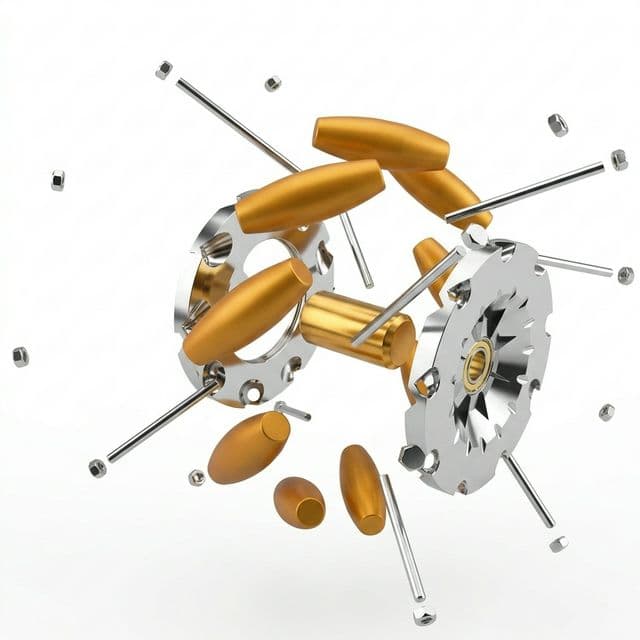
- AGV Drive Wheel for Manufacturing Factory
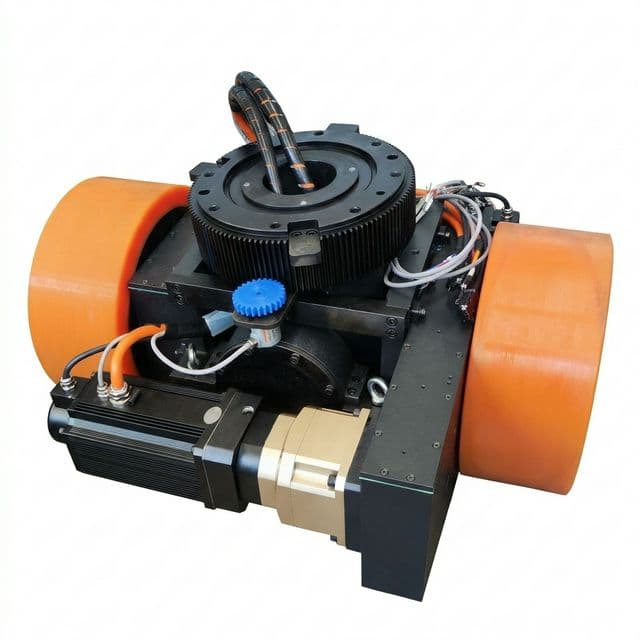
- 3.25 omnidirectional wheels + 101.6mm fit checker (canonical)
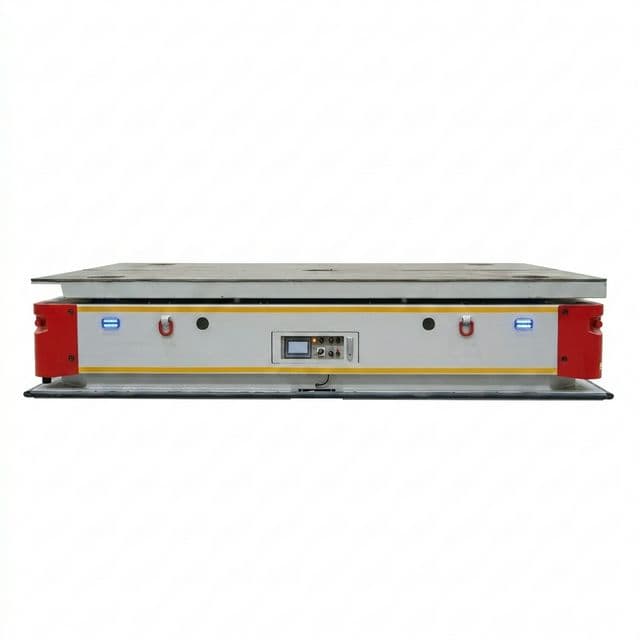
- How to Define AGV Drive Wheel Acceptance Criteria Before Sampling
- AGV Caster Wheel Load Calculator